Photo credit: Matthew Hirsch/GroundUp
His name was Elvis Nyathi. He was 44 years old. A gardener from Zimbabwe who had built a quiet life in Diepsloot, a working-class township on the northern edge of Johannesburg. He had no political connections and no powerful people in his corner. What he had was a job and a community in which he lived. When a mob came knocking at his door one night in April 2022 and demanded identity documents and money that he did not have, Nyathi tried to flee. He was stoned and burned to death.
He was not a criminal. He was not a threat. He was a Black man killed by other Black people in a country that was built on the bones of those who once died fighting for the right of Black people to be treated as human beings.
Across the ocean, a Ghanaian nurse in the UK scrolls through TikTok and sees videos of anti‑immigrant protests. She hears chants about “taking our jobs”. She sighs. She just finished a 12‑hour shift. She is helping to save lives. Yet somehow, she is still seen as the problem.
These are not isolated stories. It is a pattern. It has happened repeatedly to Black immigrants spread across the globe. Across Africa, Europe, and other parts of the world, Black immigrants are becoming the easiest targets for public frustration. From xenophobic attacks in South Africa to anti-immigrant rhetoric in parts of the United Kingdom, Black immigrants are facing hostility, not because of who they are, but because of systems that fail everyone and then convince people to blame the most vulnerable.
When unemployment rises, housing becomes expensive, healthcare systems become overwhelmed, or wages stagnate, the blame is rarely directed at policymakers. Instead, accusing fingers turn toward the newest faces in the community. Migrants become the scapegoats for problems they did not create and cannot control, a convenient distraction from deeper structural failures that governments would rather not confront.
Why are Black immigrants blamed for problems they did not create?
The faces change, the country changes, but the slogan is always the same: “They are taking our jobs.”
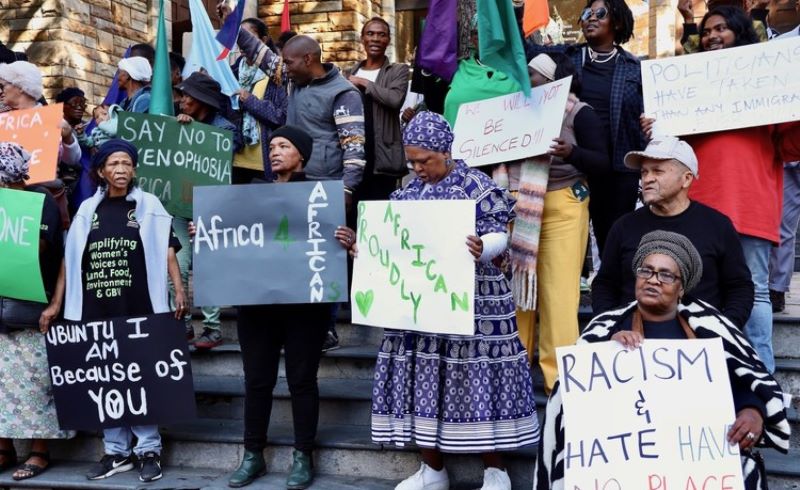
In South Africa, immigrants from Nigeria, Zimbabwe, Mozambique, Ethiopia, Somalia, and other African countries are often accused of stealing jobs and business opportunities. For weeks now, these Black immigrants have been living in fear following protests against them by the locals. Some of these protests have turned violent as houses have been burned, shops damaged and looted, and people have been forced to leave their homes. At least two Nigerian men reportedly died in April during the latest wave of violence.
Demonstrators are accusing foreign nationals of taking jobs and economic opportunities from South Africans. “There are undocumented foreigners working everywhere in our business field. People here have been trying to find work for a long time and have given up. It’s becoming an issue,” Mythobisi Sabelo, one of the protesters, told Al Jazeera in Durban.
It is no different in the UK, US, and other countries where Black migrants are frequently blamed for pressure on housing, healthcare, and public services.
When people cannot find work, afford rent, access healthcare, or feel safe, they search for someone to blame. Migrants are an easy target because they are visible, politically vulnerable, and often lack the protection or voice to defend themselves.
In the UK, for example, Black migrants are often unfairly linked to pressures placed on the National Health Service (NHS) or social housing, despite the fact that the NHS relies heavily on migrant labor to function.
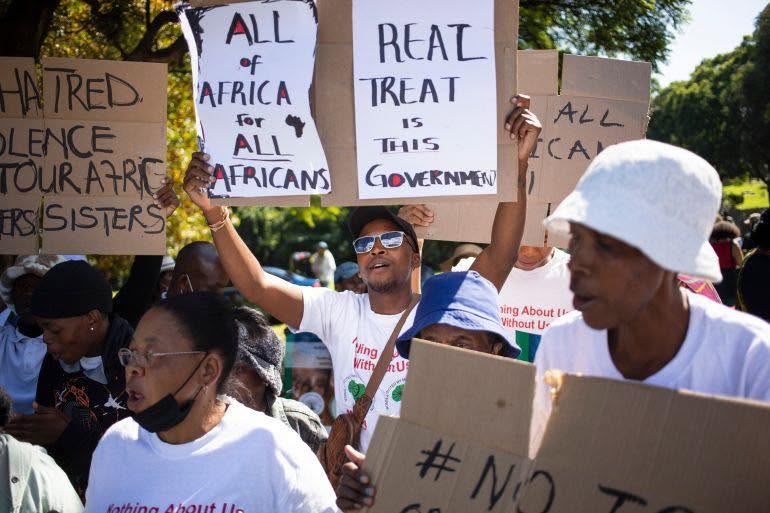
Photo credit: Kim Ludbrook / EPA-EFE
In the United States, Black immigrants, especially from the Caribbean and Africa, are often accused of “taking opportunities” or “draining resources,” despite contributing billions to the economy and having some of the highest workforce participation rates.
Also, blaming migrants is politically useful. It allows leaders to sound tough without solving the real problems. Instead of confronting unemployment, unaffordable housing, or underfunded hospitals, politicians can make it seem as though outsiders are the problem.
News coverage and political speeches often focus on border crossings, crime stories, or overcrowded housing. These stories, when repeated without context, create the impression that migrants are the crisis itself.
But migrants did not create housing shortages or unemployment, nor are they responsible for the healthcare crisis. Migrants may increase demand in some areas, especially where public services are already stretched. It is the government that decides how much public housing to build. Landlords decide rents. Banks influence mortgages. Investors buy property. Local authorities manage planning systems.
Black migrants are often doing jobs locals are unwilling to do, filling labor gaps in sectors societies depend on: care work, cleaning, delivery, farming, construction, security, transport, food service, nursing, entrepreneurship, and informal trade. But somehow, public anger is redirected toward them.
Who is to blame for tensions between native and immigrant Black communities in SA, the UK, and other countries?
This is the question that requires the most honesty. Scholars have argued that the government’s inability to provide sustainable opportunities for citizens has created fertile ground for anti-migrant sentiment.
The truth is, Black immigrants are not the enemy. The culprits are:
Politics: We have seen situations where politicians use migration as a campaign tool rather than addressing economic failures. It has become easier to blame the foreign shopkeeper for unemployment than to account for looted funds, the collapsed public health system, or ineffective economic policies.
Broken economic systems: When governments fail to integrate immigrants while also failing to create jobs or provide opportunities for citizens, the locals feel excluded and then lash out at those they perceive as “outsiders.”
Corruption and mismanagement: When funds meant for development disappear or go into a few pockets, services collapse, and migrants get blamed.
Media outlets: When news reports consistently portray immigrants in terms of crime and illegality or amplify stereotypes without context, it paves the way for a ‘hostile environment’.
Social media influencers: They bear responsibility when they spread misinformation for engagement.
Employers: They are to blame for exploitative labor practices, which create resentment between local and migrant workers.
How African leaders are failing the people
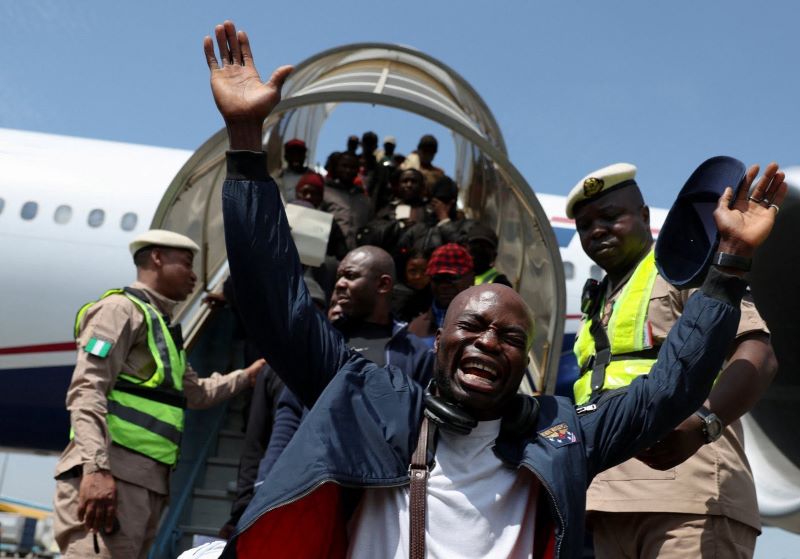
A man disembarks from a government-chartered flight repatriating Nigerian citizens fleeing attacks in South Africa, in Lagos on June 11, 2026. Photo credit: © Reuters/Sodiq Adelakun
One of the most painful realities of migration is that many Africans leave countries they genuinely love. They do not abandon their homes, their families, their languages, their food, and their communities because they prefer grey skies and freezing winters. They leave because staying has become untenable, and they believe they have no choice.
In 2024, former African Development Bank President Dr. Akinwumi Adesina warned that young Nigerians were “voting with their feet” and leaving the country in droves due to economic hardships. He called for major investments to reverse the accelerating youth brain drain.
“The rate and speed at which Nigerians are leaving the country – the so-called ‘Japa’ syndrome risks undermining Nigeria’s drive for economic rejuvenation and positioning for global dominance,” he said.
He is right. Across the continent, millions of young people face rising unemployment, weak institutions, poor healthcare systems, insecurity, and limited opportunities despite living in resource-rich nations. But who created the conditions that made leaving feel like the only rational choice?
This is not the failure of the people. This is the failure of leadership. We see how African leaders enjoy the benefits of functioning systems abroad while presiding over broken ones at home. They fly to Europe, America, and Asia for medical treatment in hospitals built on accountability and investment, systems their own policies would never allow to exist on African soil. They send their children to foreign universities while lecturers in public institutions back home go months without salaries. They loot public funds and then give speeches about patriotism, youth empowerment, and the dangers of brain drain.
The hypocrisy is staggering. Leaders who condemn migration are the same ones whose children hold foreign passports. Leaders who preach “buy African” are the same ones who shop in Dubai and London. Leaders who blame youth for leaving are the same ones who have failed to create jobs, security, or dignity at home.
Even with abundant natural resources, oil in Nigeria and Angola, gold in Ghana, cobalt in the DRC, fertile land across East Africa, the continent continues to lag behind. Not because Africans lack talent or ambition, but because public funds are mismanaged, institutions are weak, and corruption is treated like a cultural norm rather than a crime.
When citizens lose faith in public institutions, frustration grows. When governments fail to deliver services, anger grows. When leaders avoid accountability, distrust grows.
African leaders have created a system that pushes out its brightest minds, its hardest workers, its dreamers, the very people who could rebuild the continent. And until leadership changes, the cycle will continue.
The hard truth we must face as a global Black community is that no external force is coming to rescue the continent or its diaspora. No foreign country will fix Africa, no Western government will prioritize African lives, and no global institution will rescue us.
The violence and hostility Black immigrants face are not born from cultural differences. They are born from broken systems that fail everyone and then convince us to turn on each other. To stop the cycle, we must build accountability at home so that migration becomes a luxury of choice, rather than a desperate bid for survival.