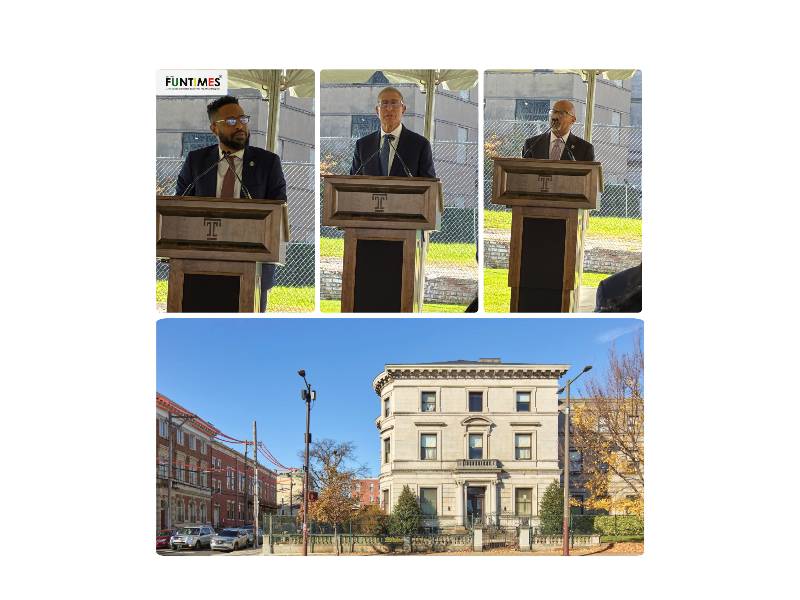
L-R: Jesse Lawrence, Philadelphia’s director of planning and development, Michael Spolan, and David W. Brown, executive director for community impact and civic engagement, at the October 22 naming ceremony for the Spolan Community Engagement Center. Photo courtesy of FunTimes Magazine.
Publisher’s Perspective
“I put that on us,” Temple University President John Fry said Thursday morning at Broad and Jefferson streets, acknowledging the university’s sometimes difficult relationships with its North Philadelphia neighbors.
“If we need to fix that, we will fix that.”
Behind him stood Burk Mansion, a landmark that has been vacant for more than 30 years. The building now has a new name, the Spolan Community Engagement Center, and a future purpose. Expected to open in early 2028, it will provide a more welcoming route to Temple’s programs, expertise, and services.
Fry described a “warm, welcoming front door” for the university’s neighbors. The work ahead will give residents and community organizations an opportunity to help shape what happens behind it.
1. What Temple plans to bring within reach
The center is intended to serve more than 175,000 people in the five ZIP codes surrounding Temple’s Main Campus and Health Sciences Center.
Fry described a practical improvement: residents and community organizations should no longer have to navigate numerous university offices to find the resources they need.
September planning drawings by MGA Partners Architects illustrate what the proposed space could offer. They include a 1,300-square-foot AI and media lab designed for 20 students, conference rooms, smaller meeting spaces, and a community kitchen.
The conservatory would accommodate different uses. One illustrated layout seats 93 people for a talk or film screening. Other configurations show space for classes, career preparation, and community exercise.
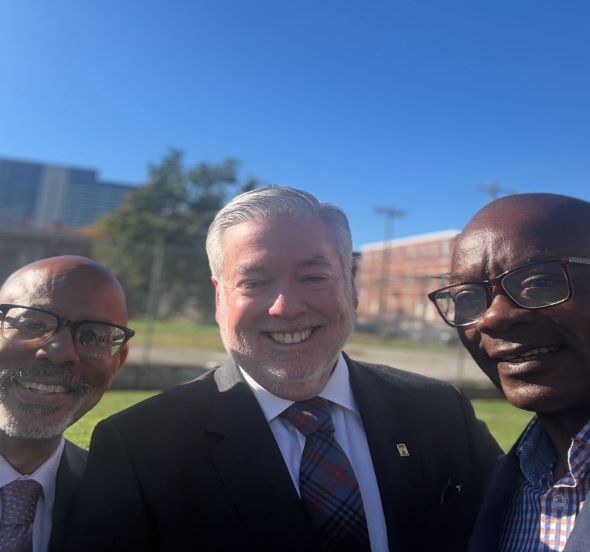
Dr. Eric Nzeribe, publisher of FunTimes Magazine, with Temple University President John Fry (middle) and David W. Brown, executive director for community impact and civic engagement, at the October 22 naming ceremony for the Spolan Community Engagement Center. Photo courtesy of FunTimes Magazine.
Outside, the proposals include an events lawn, a community garden, and accessible routes into the property, including a ramp from Jefferson Street. Burk Mansion Slide Deck 092026
The designs provide possibilities. Community conversations will help determine the programs and arrangements that make those spaces useful.
2. The neighborhood institutions shaping the opportunity
Fry asked the audience to look across Broad Street toward Progress Plaza. A short walk south stands the Columbia North YMCA.
These institutions already contribute to neighborhood life. The center offers Temple another way to work alongside organizations with established relationships and experience.
Temple has been discussing a possible YMCA presence at the center. Brown’s emphasis on listening and complementing existing organizations gives those discussions a practical direction.
3. Why David Brown will lead the work
Fry called David W. Brown “maybe the most credible person I could find to do this for us.”
Brown, Temple’s executive director for community impact and civic engagement, will lead the community engagement work.
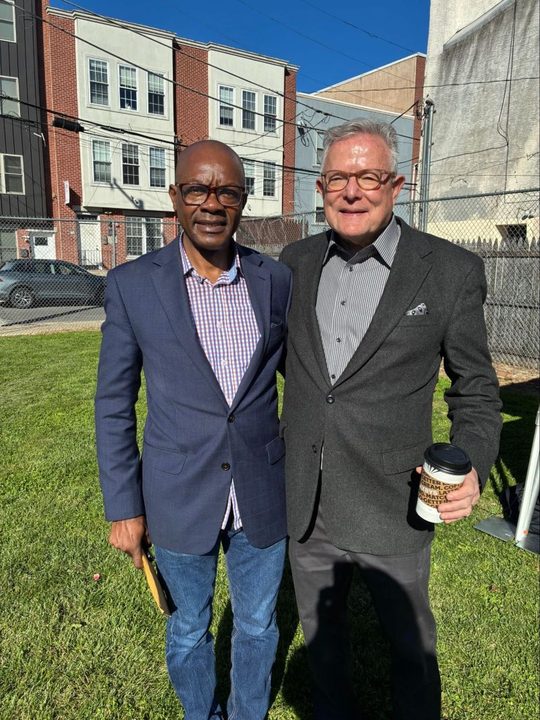
Dr. Eric Nzeribe with David Boardman, dean of Temple’s Klein College of Media and Communication and the university’s chief strategy officer, at the October 22 event. Photo courtesy of FunTimes Magazine.
Michael Spolan explained how he came to share Fry’s confidence. He had emphasized the importance of strong leadership, and Fry introduced him to Brown. Their first meeting was scheduled for half an hour and lasted approximately two and a half hours.
Both men are Central High School graduates. They discovered that their time at the school had overlapped, adding a shared Philadelphia connection to their conversation.
Brown calls his approach “listen first,” a phrase Fry also used. The next step is to work with residents and community partners to determine what the center should offer.
4. The Philadelphia family behind the gift
Spolan devoted much of his remarks to his parents, Harmon and Betty, who attended the ceremony.
His mother grew up in North Philadelphia with limited resources. She attended Gratz High School and received scholarship offers from Temple and the University of Pennsylvania. Harmon, already studying at Temple, encouraged her to take the Penn opportunity. She studied education and became a teacher.
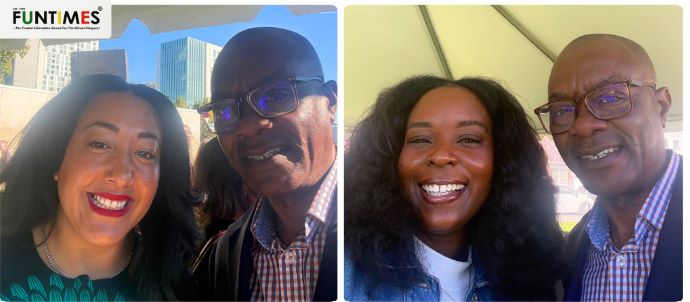
L-R: Dr. Eric Nzeribe with Ashley Bracey, and Dr. Eric Ezeribe with Portia Fullard, consultant of the Lenfest Institute for Journalism. Photo courtesy of FunTimes Magazine.
Harmon attended Temple for undergraduate studies and law school. Spolan described the value both parents placed on education, hard work, honesty, integrity, and fairness.
“I grew up here in Philadelphia,” he said. “I went to public schools. I took public transportation.”
“This is my home.”
Spolan’s introduction to Fry came through Kenneth Holdsman and Philadelphia Youth Basketball, initially around a workforce development discussion. As that meeting ended, Spolan mentioned his father’s Temple connection and his interest in honoring his family.
Fry followed up. Those conversations developed into support for a center intended to serve the city where the family’s story began.
5. How public and private support are coming together
The center will carry the Spolan family’s name in recognition of a major gift from Michael Spolan and the Spolan Family Fund. The amount has not been disclosed.
Fry said Spolan had asked Temple to match his contribution. He also announced a $750,000 Bank of America gift toward the project, following a conversation with the bank’s Jim Dever.
The Philadelphia Inquirer reports that the renovation will cost $30 million, with $15 million coming from the state. Fry credited Governor Josh Shapiro for supporting the project. www.inquirer.com
Jesse Lawrence, Philadelphia’s director of planning and development, spoke on behalf of Mayor Cherelle Parker. His remarks emphasized the value of restoring a historic property for both the university and its surrounding community.
6. How residents can help shape what comes next
For FunTimes readers who live, work, worship, or run businesses near North Broad, the center offers an opportunity to help shape a neighborhood resource.
Three questions will guide the publication’s continuing coverage.
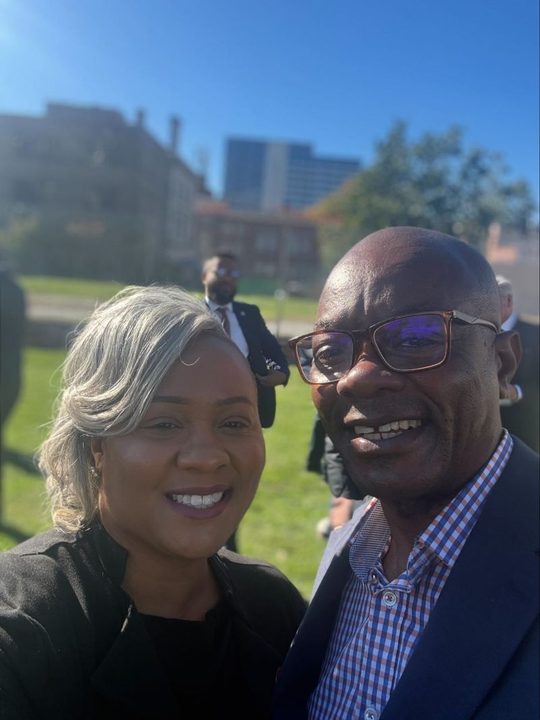
Dr. Eric Nzeribe with Temple University trustee Tiffany Wilson at the naming ceremony for the Spolan Community Engagement Center. Photo courtesy of FunTimes Magazine.
Which programs will residents help create?
FunTimes will follow how community ideas influence the center’s offerings and introduce readers to the people contributing those ideas.
How will residents reach the services?
As programming develops, coverage will explain hours, eligibility, costs, and how to participate.
What will Temple and its neighbors build together?
FunTimes will report on the collaborations taking shape and what residents gain from them.
The naming ceremony gives that reporting a starting point. The next chapters belong to the people who will help give the center its daily purpose.
What would you want behind that front door? Share your ideas with FunTimes. The publication will bring residents’ questions and suggestions into its continuing conversations with Temple.
Disclosure: The publisher holds a doctorate from Temple University. FunTimes has held preliminary discussions with Temple’s community engagement office about potential collaboration, including oral history.

Dr. Eric John Nzeribe is the Publisher of FunTimes Magazine and has a demonstrated history of working in the publishing industry since 1992. His interests include using data to understand and solve social issues, narrative stories, digital marketing, community engagement, and online/print journalism features. Dr. Nzeribe is a social media and communication professional with certificates in Digital Media for Social Impact from the University of Pennsylvania, Digital Strategies for Business: Leading the Next-Generation Enterprise from Columbia University, and a Master of Science (MS) in Publication Management from Drexel University and a Doctorate in Business Administration from Temple University.