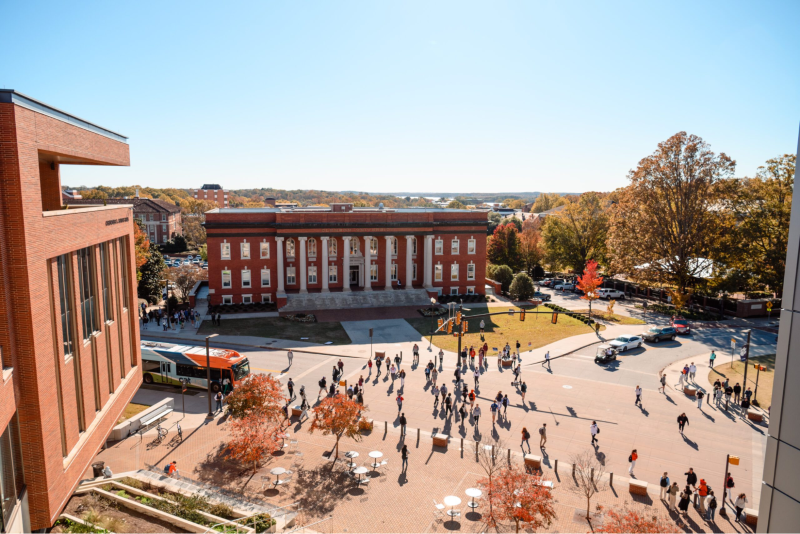
Image: Clemson University | Facebook
A Check in from Someone Who Went Straight Through
Jumping straight into graduate school after finishing a bachelor’s degree sounds like the most logical next step. It felt like a smooth, professional decision. However, halfway through this first semester, I have realized it is a massive adjustment, but it is teaching me things about my resilience and capacity. The tough part is not just the heavy reading; it is the subtle, unspoken changes in money, friends, and the school itself that can throw a person off. I wanted to share five lessons I have learned that no one told me before I started, but I am figuring it out as I go.
1. One Does Not Just Learn, One Becomes the Author…
In undergraduate studies, a student mainly learns how to repeat information, follow the rules, and write a solid paper using existing research. In graduate school, faculty suddenly expect one to become an expert. Students are not supposed to just read the content; they have to challenge it, synthesize it, and figure out what new thoughts they can actually add to the conversation. One has to be comfortable with asking questions that do not have answers yet. It is the shift from being a proficient student to a full-blown intellectual author, and that identity crisis can be intense and disorienting, but it is also where one discovers a scholarly voice.
2. The Isolation of the Specialized World
Undergraduate life was all about big social circles, random connections, and crowded campus life. Graduate school, however, can be lonely. The cohort is tiny, everyone is hyper-focused on a specific, niche research area, and the general social scene disappears completely. The isolation is real because those broad, readily available support networks are not provided anymore. One has to work hard to make friends or find community, and one quickly realizes that academic life is concentrated and siloed. This forced quietness has been an unexpected lesson in self-reliance.
3. The Constant, Hidden Financial Stress
Everyone discusses tuition, but no one ever mentions the persistent, low-grade money stress. If one is not on a fully funded stipend, the reality of having to financially support oneself while meeting the demands of this intense academic program is crushing. I have discovered how incredibly tough the job search is right now, requiring just as much effort as my coursework. Every spare hour is spent either reading a required text or searching for a practical, flexible job, and balancing those two things is easily the hardest lesson I have learned about capacity and time management.
4. The Loss of the Safety Net
In college, the system—the professors, the advising, the mandatory classes told a student exactly what to do and when. Here, they basically hand over the keys and say, “Figure it out.” There are no mandated courses to guide a student, and one has to chase down every administrative detail and bureaucratic requirement independently. It is not freedom; it is administrative ambiguity. One realizes the structure relied upon is gone, and one has to become an anchor, actively navigating the school as a complex system rather than just passively existing within it.
5. One Is Treated Like a Junior Colleague, Not a Student
The relationship dynamic with faculty shifts almost overnight. They stop treating a student like a pupil and start treating one like a junior colleague or a “nascent professional,” as they call it. This means they expect total professionalism in communication, informed critical debate in meetings, and that one knows the current dramas of the field. It is flattering, but it is also intense. One has to rapidly develop a mature scholarly identity while still trying to figure out who you are and where you want to go. It is an accelerated induction into the professional world, and frankly, learning that I can handle that pressure has been surprisingly empowering. Graduate school is certainly difficult, but I would not trade the experience!
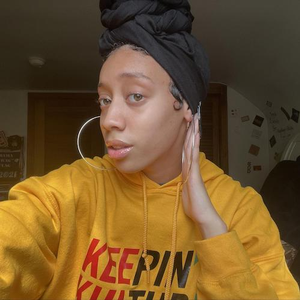
Kyrah Page is currently a student at Lincoln University. She is also the CEO and founder of her own brand called “Keepin’ It Kultured.” Where she combines art with activism to empower, inspire and educate the Black community. She advocates for change, promotes Black positivity, and addresses controversial issues. Kyrah is many things but most importantly she is an activist.