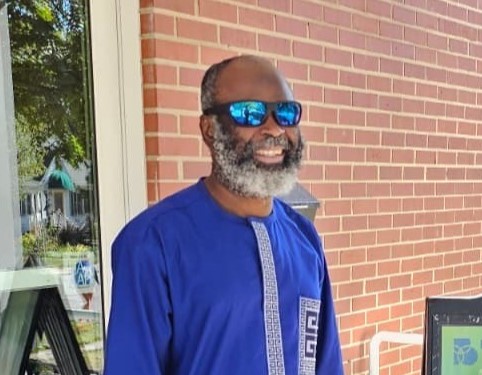
Born and raised in Imo State, Nigeria, Ikechukwu Okoro has spent his life proving that sight is not the only way to see the world. Totally blind since childhood, he has transformed what many consider a limitation into a source of purpose and excellence. Today, Ikechukwu is an accomplished scholar and lecturer in the Department of French and Italian at the University of Iowa, United States, where he teaches French language, literature, and culture with confidence, grace, and an unwavering belief in the power of inclusion.
His journey from Nigeria to one of America’s leading universities is one marked by determination, resilience, and an unshakeable love for learning. Before moving to the United States in 2021, Ikechukwu spent nearly a decade lecturing in the Department of French at Imo State University, Owerri, where he inspired hundreds of students with his intellect and humility. His areas of research include 20th-century French literature, cultural studies, postcolonial literature, and translation studies, disciplines that allow him to explore how language and identity shape the human experience.
Reflecting on his beginnings, Ikechukwu shared that his passion for languages started very early in life. “People thought studying French as a blind person was impossible,” he recalled. “But I started learning French in primary school. My teachers always made sure I was carried along.” He vividly remembers receiving his first braille books, especially those provided by an American organization known as the Lutheran Braille Workers, whose braille Bibles became an essential tool in mastering reading and pronunciation. These early experiences helped him discover that language could be a bridge not just between nations, but between abilities.
Throughout his academic journey, Ikechukwu has relied on a combination of assistive technologies to excel. Today, in his lectures, he uses screen readers such as JAWS, NVDA, and Window-Eyes, as well as a braille display connected to his laptop via Bluetooth. These devices allow him to prepare lessons, read academic papers, and grade assignments independently. “All my teaching materials are made accessible, and students submit their assignments digitally,” he explained. “This allows me to review their work and provide feedback without any struggle. Technology makes it possible for me to function effectively like every other lecturer.”
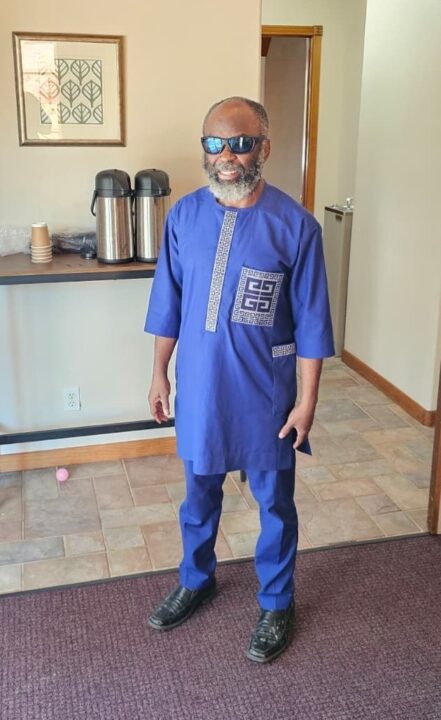
His approach to teaching goes beyond simply transferring knowledge. Ikechukwu believes in creating a classroom atmosphere where every student feels seen, heard, and valued. “When I teach, I rely on the power of voice and dialogue,” he shared. “I may not see my students’ faces, but I know their minds through their words.” His students describe him as patient, deeply knowledgeable, and inspiring, someone who teaches French and perseverance through example.
When asked about the difference between teaching in Nigeria and in the United States, Ikechukwu did not hesitate. “The difference in accessibility is like day and night,” he said. “Here in the U.S., all the assistive tools I need are provided free of charge and replaced annually. Every computer on campus is equipped with accessibility features for both staff and students with disabilities. But in Nigeria, after employment, a lecturer with a disability is often left to manage on their own.”
He described how the University of Iowa’s environment fosters equal opportunity and dignity. “My department treats me like every other faculty member. They focus on my skills, not my sight. That makes all the difference,” he said.
Despite being both Black and blind, Ikechukwu proudly noted that he has never faced discrimination in his department. “I am surrounded by positive people who are understanding and empathetic. They don’t look down on me,” he explained. He described both Nigerian and American students as respectful, crediting the Nigerian culture of respect for elders and the American culture of respecting personal boundaries and inclusion.
Beyond academics, Ikechukwu is also a mentor and a quiet advocate for persons with disabilities. Though he chooses not to be actively involved in disability rights campaigns, his success story is advocacy in itself. He supports other visually impaired individuals by sharing his experiences, guiding them on academic choices, and connecting them to assistive resources.
His advice to institutions is firm yet constructive: accessibility should not be optional. He urges the Nigerian government, the National Universities Commission (NUC), and the National Commission for Persons with Disabilities (NCPD) to make accessibility a mandatory criterion for accreditation. “Every educational institution should have a unit that ensures inclusion and accessibility for students and staff with disabilities,” he emphasized. “Without it, no school should be accredited. Inclusion must start from the system.”
Even as he thrives abroad, Ikechukwu remains deeply connected to Nigeria and to the idea that inclusive education can transform lives. He dreams of a Nigeria where blind and visually impaired children can attend school without fear of being left behind, and where learning materials are available in accessible formats across all levels.
For him, disability is not a barrier; it is a unique lens through which he perceives the world differently, with depth and empathy. “People sometimes expect me to be limited,” he said thoughtfully, “but my blindness has made me more focused. It helps me listen better, teach better, and connect more deeply with my students.”
To young people with visual impairments or any form of disability, Ikechukwu offers heartfelt words of encouragement:
“Be determined. Ask for help when you need it. The only thing that can hold you back is fear. When there is a will, there must always be a way.”
Through resilience, intellect, and faith, Ikechukwu Okoro continues to redefine what is possible. His story is about overcoming disability, breaking barriers, challenging stereotypes, and proving that true vision has little to do with the eyes, and everything to do with the mind.