
Jean Guillaume, Executive Director of Reclaim Hayti, Numa St. Louis, Haitian American government and community relations professional, Alain Joinville, Haitian American and Deputy Director at Philadelphia’s Office of Immigrant Affairs. Courtesy, FunTimes Magazine.
Haiti’s return to the World Cup is a soccer/football story. It is also a diaspora story, a Philadelphia story, and a story about what it means to be seen again. And in that sense, June 19 at the ‘Linc’ will be more than a match. It will be a declaration.
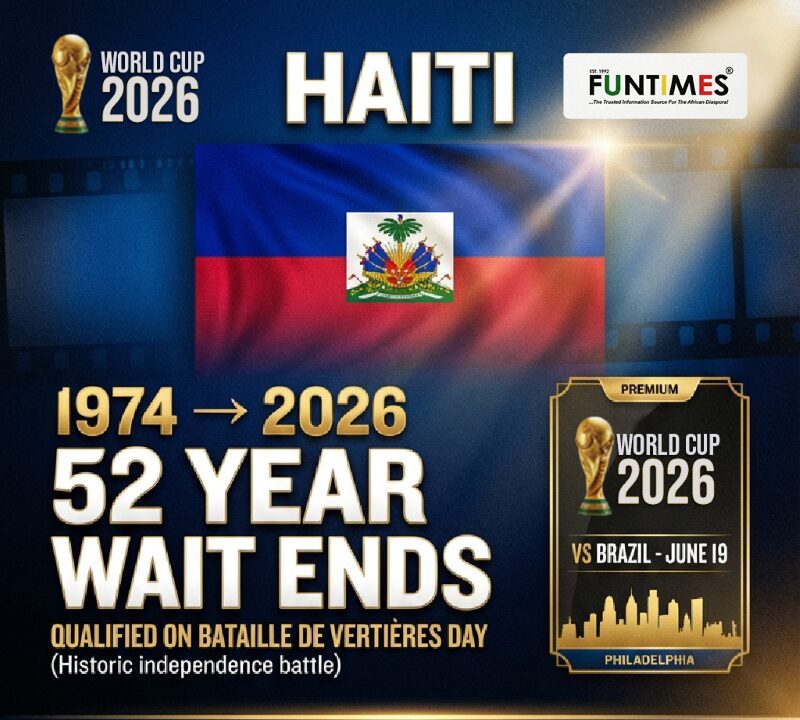
This is Haiti’s second World Cup appearance; the first was in 1974. Haiti did not arrive at the World Cup by miracle. The better word is that it earned its moment in the sun. And as the final whistle blows, the players will see the fans who made it and feel the millions who could not. In this journey, showing up is its own kind of victory.
The June 19 Convergence: More Than a Match
On June 19, 2026, the eyes of the world will turn to Philadelphia’s Lincoln Financial Field for a highly anticipated clash between Haiti and Brazil. The date carries its own layer of significance. Juneteenth, the day commemorating the emancipation of enslaved people of African descent in America, lends the match added symbolic weight.
For the Haitian community, this convergence is a powerful catalyst for hope and connection.
- Symbolic Freedom: The match becomes a public expression of cultural connection that moves beyond physical borders.
- Unified Energy: The “Linc” is expected to come alive with drumming, chanting, and dancing as diverse communities gather around the game.
- A Global Stage: For a nation often framed by adversity, this is a chance to present its talent, passion, and spirit to the world.
Alain Joinville, a Haitian American and Deputy Director at Philadelphia’s Office of Immigrant Affairs, gives this moment a personal dimension. He says Haiti’s qualification brought him joy, but also “vindication— for that kid who was teased. For every Haitian who kept their pride close even when the world made it hard.”
Courtesy: FunTimes Magazine
The Historical Bridge, Philly’s Revolutionary Heart
While the match happens in the present, the connection between Haiti and Philadelphia runs much deeper. But the bond with Philadelphia reaches back far beyond football.
In the 1790s, Philadelphia served as a major sanctuary for those fleeing upheaval in Saint-Domingue. That movement of people and ideas helped shape the city’s early Black life and political thought. To see Haiti represent itself with dignity on the same soil where the future of the first Black republic was once debated gives the match a sense of historical homecoming.
As Jean Guillaume, Executive Director of Reclaim Hayti, notes, this moment reveals that Haiti is “more than crisis headlines” and continues to produce courage, talent, discipline, and collective spirit.
Voices of the Diaspora
For leaders and residents in Philadelphia, the World Cup is a moment of immense pride and local activation.
“For me personally, Haiti’s qualification after 52 years means pride, dignity, and proof that Haiti still carries the strength the world often forgets,” says Jean Guillaume.
Numa St. Louis, M.A., a Haitian American government and community relations professional and a die-hard soccer fan, describes the emotions of this moment as overwhelming. For him, it is the fulfillment of a long-cherished dream to see Haiti step onto the world stage and showcase its talent, passion, and spirit before a global audience.
Joinville adds another layer, grounded in what he is seeing here in Philadelphia. He says the city may have a quieter Haitian community than Miami or New York, “but you wouldn’t know it right now.” He describes being pulled into watch-party plans and neighborhood celebrations, and points to what is happening between those events: “The WhatsApp chats. The phone calls. The way people who normally move through this city in parallel are suddenly finding each other.” Then he offers the phrase that best captures the emotional center of the piece: ansanm, together. “Haiti qualified for the World Cup, and just like that, nou ansanm. We are together.”
That insight gives this World Cup moment a distinct Philadelphia pulse. It is not merely about one match. It is about dispersed people finding each other again.
A Team Without a Home
Haiti’s journey is defined by a central paradox: it is competing on the world’s biggest stage without consistently playing matches on home soil.
- Adaptation: The team has often had to prepare abroad and build cohesion across borders.
- Identity as Home: “Home” becomes less about a stadium and more about a shared global identity.
- Invisible Barriers: Even as the team reaches the world stage, many supporters still face difficult travel realities and financial constraints that keep them from experiencing the moment in person.
That is what makes the diaspora response so meaningful. Haiti arrives with a people spread across cities, countries, and circumstances, yet still tied to one another through memory, language, culture, and pride.
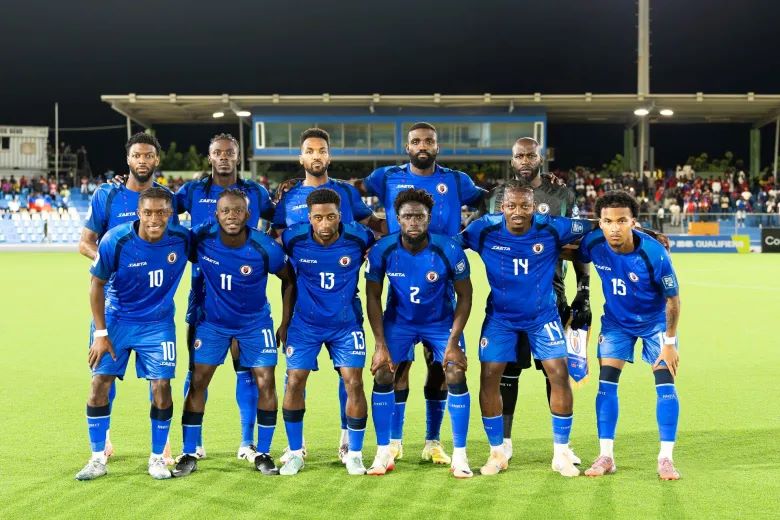
Haitian National Football Team. Courtesy, FHF Media.
Joinville sharpens that point by insisting that Haiti and the Haitian diaspora are “more than our circumstances.” He says that the spirit of Haitians remains alive “in our music, our faith, our food, our relentless ability to dream beyond what the world says is possible.” He compares this World Cup moment to seeing Wyclef Jean step onto the Grammy stage with the Haitian flag across his back, a public assertion that Haitians are “not defined by hardship,” but by creativity, talent, and tenacity.
Redefining Victory
This World Cup is a chance for Haiti to write its own story in real time, on the largest stage in sports. That may be the deepest meaning of the moment. Not just qualification. Not just a celebration. But a form of public self-definition.
For Haiti, success at the World Cup is not measured solely by the scoreboard. Success is visibility, representation, and inspiring the next generation to believe they belong on the world stage. That is what makes Haiti’s ascent more than a sports feature.

Dr. Eric John Nzeribe is the Publisher of FunTimes Magazine and has a demonstrated history of working in the publishing industry since 1992. His interests include using data to understand and solve social issues, narrative stories, digital marketing, community engagement, and online/print journalism features. Dr. Nzeribe is a social media and communication professional with certificates in Digital Media for Social Impact from the University of Pennsylvania, Digital Strategies for Business: Leading the Next-Generation Enterprise from Columbia University, and a Master of Science (MS) in Publication Management from Drexel University and a Doctorate in Business Administration from Temple University.