If you’re a shopaholic who loves sales, you will be familiar with the thrill that comes from waking up early in the morning to grab great Black Friday deals, from the latest tech gadgets to branded clothes and accessories.
This US celebration of consumption, which follows Thanksgiving on the last Thursday of November, has become arguably the most widely observed retail event, with at least 50-60% of countries taking part.
But have you ever wondered how the Friday after Thanksgiving became the biggest shopping day of the year?
There are plenty of rumors circulating online about its history, including debunked theories that it originated as a day for discounted slave trade or evolved from a 19th-century gold-selling scam.
One account claims that the first Black Friday recorded in history was in September 1869, and it had nothing to do with strangers quarrelling over discounted gadgets. Two Wall Street capitalists, Jay Gould and Jim Fisk, reportedly conspired to buy and sell as much gold as they could to drive up the price. However, the price plummeted, leading to financial devastation that severely impacted the U.S. economy. Newspapers called it “Black Friday” because of the devastation it caused.
According to another archived version, the earliest use of ‘Black Friday’ appeared in the trade journal, Factory Management and Maintenance, in November 1951, and had nothing to do with holiday shopping.
The most popular consensus about Black Friday is that it started in Pennsylvania in the mid-20th century. Around the 1950s and early 1960s, police officers used the term to describe the day after Thanksgiving, when the city would be flooded with tourists traveling for the Army-Navy game, causing overcrowding and massive traffic jams.
With the rowdy crowd came an increase in shoplifting and other crimes, which meant Philadelphia police officers had to work longer shifts to deal with the situation.
In a 1994 piece for a Philadelphia Inquirer article headlined, “This Friday Was Black With Traffic,” the late Joseph P. Barrett, a longtime police reporter and feature writer for the defunct Philadelphia Bulletin, shared his personal recollections regarding the use of Black Friday.
He stated: “In 1959, the old Evening Bulletin assigned me to police administration, working out of City Hall. Nathan Kleger was the police reporter who covered Center City for the Bulletin.
“In the early 1960s, Kleger and I put together a front-page story for Thanksgiving, and we appropriated the police term “Black Friday” to describe the terrible traffic conditions.
Many did not like the phrase as it sounded negative and chaotic. In the 1980s, retailers tried to rebrand it as “Big Friday,” but the name didn’t stick.
Over time, a new version of Black Friday was introduced, and just like that, the biggest shopping day as we know it today was born.

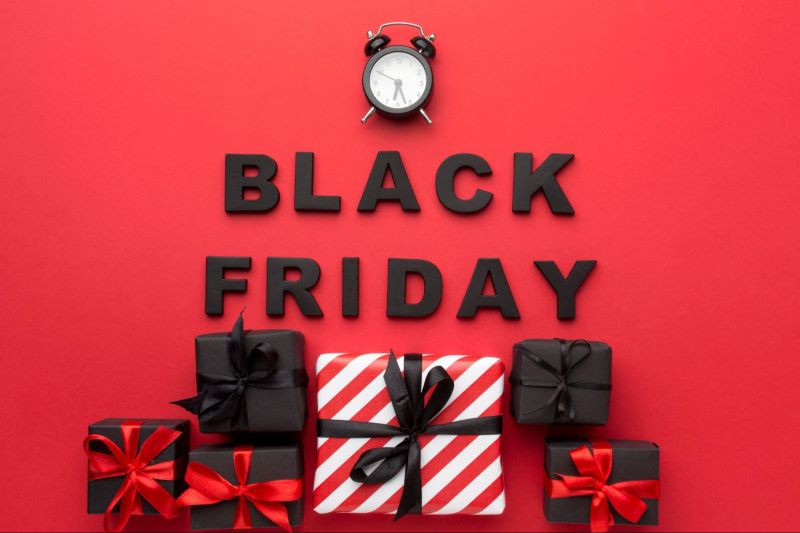
Image: DC Studio via Freepik
Fun Facts about Black Friday
Though the phrase may have started earlier, it wasn’t until the 1980s that the designation “Black Friday” started to be used outside of the Philadelphia / New Jersey area, and it didn’t become a national term until the 1990s.
Often touted as the biggest shopping day of the year, this notion about Black Friday didn’t become the norm until the early 2000s. Before 2001, it was the Saturday before Christmas (known as “Super Saturday”) that typically saw the most consumer spending.
In 2011, Walmart became the first retailer to break the Black Friday tradition by opening its stores on Thanksgiving evening.
In Mexico, Black Friday is referred to as “El Buen Fin,” which means “the good weekend.”
The Black Friday tradition has swept across the globe, spreading to more than 15 countries. In 2011, Mexico introduced “El Buen Fin” (The good weekend), its version of the ‘Black Friday’ shopping event. In the Middle East, they have White Friday, a four-day shopping holiday similar to Black Friday.
On Black Friday 2024, U.S. ecommerce sales crossed the $10 billion threshold for the first time, according to Adobe Analytics data.

Photo: AI-generated
Myths about Black Friday
Amid the Black Friday chaos and the sales lies a few myths that have continued to mislead shoppers.
Myth 1: Black Friday is named after a post-Thanksgiving slave auction.
This is false, and there is no historical evidence to support it. Black Friday did not get its name because of slavery.
Myth 2: It’s called “Black Friday” because retailers go from red to black.
The name Black Friday is thought to come from when retailers move from the ‘Red’ (losses) to the ‘Black’ (profits). That’s the retail rebrand story, not the origin. While it may be true that retailers depend on the Christmas season to make much of their yearly profits, there is no evidence to suggest this is the day when they go “into the Black”.
Myth 3: Black Friday is dying.
The traditional rush to the store very early in the morning may be declining, but Black Friday remains one of the biggest sales events. It is just evolving, as sales have largely shifted online.
Myth 4: Black Friday is named in honor of Rebecca Black, singer of the viral hit Friday.
Contrary to what some may assume, the term has been in existence long before Rebecca was born. In March of 2011, the 13-year-old girl made a song on YouTube titled Friday. The song went viral, and she became the most googled person in the world that year.