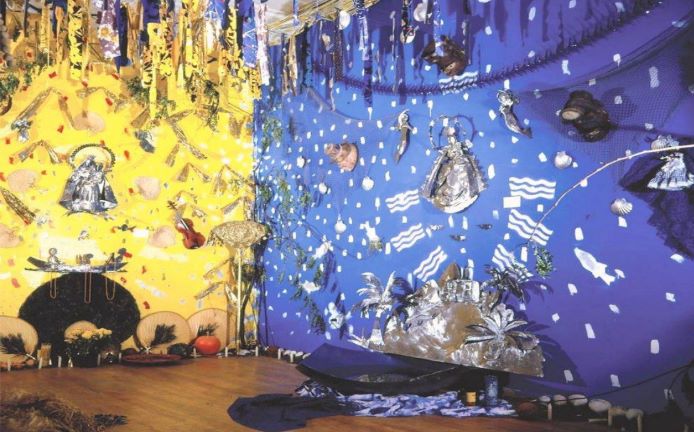
Orisha/Santos: An Artistic Interpretation of the Seven African Powers exhibit (Osun and Yemaya pictured)
PHILADELPHIA, March 17, 2026 – A powerful exhibit that depicts how African-descended people — enslaved and free — sustained their cultures and spiritual expressions through syncretism is hosted by Taller Puertorriqueno, 2600 N. 5th Street Philadelphia, until April 4th, 2026.
Created by artist Jorge Luis Rodríguez, Orisha/Santos: An Artistic Interpretation of the Seven African
Powers, explores the cultural intersections of spiritual traditions brought to the New World by enslaved Yoruba people from West Africa during the Transatlantic Human Trade.
First presented at the Museum of Contemporary Hispanic Art (MoCHA) in 1985, this exhibition was re-created on a smaller scale at Taller asits gallery’s inaugural exhibition. This version was produced in collaboration with two Philadelphia-based artists deeply connected to Santería: Yoanny Aldaya and Danny Melendez.
The Yoruba spiritual tradition was established and survived as Lucumi in Cuba; Shango Baptist in Trinidad-Tobago and Grenada; as Ettu in Jamaica; Kélé in St. Lucia and Candomble in Brazil. It also flourished as Santeria (worship of the saints) in Puerto Rico, Venezuela, Dominican Republic and Mexico. Many African Americans adhere to the tradition as practiced in Nigeria and Oyotunji Village in South Carolina. The Seven African Powers consist of the most powerful and revered Orishas that are invoked by people worldwide. The Orishas are the angelic forces who comprise specific aspects of Olódùmarè, the Yoruba name for the Omnipotent Universal God. They are charged by Olódùmarè to assist individual humans in moving towards their destinies.
Rodríguez is a pioneering multi-disciplinary artist whose career bridges minimalism, site-specific installation, and Afro-Caribbean cultural expression. After moving from Puerto Rico to New York in 1963, Rodríguez absorbed the city’s emerging art movements—minimalism, optical art, and later, environmental art— before “abandoning the canvas” in the 1970s to pursue sculpture. Following studies at the School of Visual Arts and New York University, he developed a visual language that fused formal precision with symbolic and cultural depth. His early works, shaped by Harlem and SoHo’s alternative art scenes, reflected a growing dialogue around multiculturalism and art in public space.
Rodriguez’s images of the Orisha depict the syncretism of the Yoruba spiritual tradition with Christianity in order to hide, preserve and protect it from enslavers. Through each deity’s interpretation, he challenges colonial narratives, highlighting the will and resilience of those who preserved their cultural identity against oppression. His work de-romanticizes colonialism, revealing how Africans resisted enslavement and sustained their beliefs, transforming survival into an enduring act of artistic and spiritual defiance.
Reprising his original method, Rodriguez painstakingly forms each deity from cut steel sheets that embody the potent syncretism between symbol and belief, each retaining the spirit and individuality of its ancestral form.
For example: Obatalá — one of the oldest and most revered Yoruba Orishas — is depicted as a dual figure representing both mercy and justice. To evoke this dual nature, Rodriguez carved the deity’s crown into sheets of steel, alluding to its royal and spiritual status, and merged it with the iconography of the Virgen de las Mercedes (Our Lady of Mercy). This synthesis bridges Christian and Yoruba traditions.
Now retired from teaching, Rodriguez continues to create in his New York studio, developing works that blend decades of artistic inquiry with deep spiritual and cultural resonance.
The exhibit opened Taller Puertorriqueño’s 2026 programming, “We Will Not Hide,” which is inspired by the 1976 “Sin Colonias March” in Philadelphia — also called the People’s Bicentennial — that united more than 40,000 African Americans, Indigenous activists, Puerto Ricans, and allies in a powerful demonstration of solidarity and resistance against a national narrative that ignored their presence, needs and contributions. The 2026 exhibitions, talks, and community programs highlight voices often silenced in national celebrations, insisting on inclusion, critique, and transformation as Philadelphia and the nation mark its 250th anniversary. For more information about upcoming events and programming, visit tallerpr.org/wewillnothide.
All are invited to the closing reception at 1PM, Saturday, March 28. Gallery hours are Monday 9AM – 5PM and Tuesday – Saturday 10AM – 6PM. Admission is free. For more information call 215-426-3311.
Taller Puertorriqueño is a community-based, cultural, non-profit organization whose primary purpose is to preserve, develop, and promote Puerto Rican arts and culture, grounded in the conviction that embracing one’s cultural heritage is empowering. Taller is also committed to the representation and support of other Latino cultural expressions and our common roots.