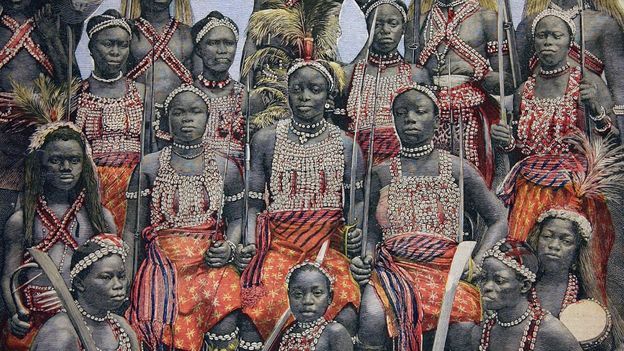
The Agojie Women Warriors. Photo courtesy of BBC
Dahomey emerged as a powerful state in the 17th century, with its capital at Abomey. Through military campaigns, centralized administration, and control of key commercial routes, its rulers gradually expanded their influence over neighboring communities. The kingdom developed a political structure in which the monarch exercised considerable authority over administration, commerce, and military affairs.
To defend its territory, pursue expansion, and maintain its position against rival powers, Dahomey required a standing army capable of carrying out the monarch’s military ambitions. In response, the West African kingdom developed a remarkable military institution that placed women at the center of its defense and expansion. They are known as the Agojie and are also associated with the term Mino, commonly translated as “our mothers.” This Black female military regiment became one of the most distinctive features of Dahomey’s political and military system.
Its existence challenged the assumption that organized warfare in precolonial African societies was exclusively a male responsibility. The rise of the Agojie warriors reflected Dahomey’s particular political, social, and military circumstances, where Black women occupied important positions within the royal establishment despite the kingdom’s predominantly patriarchal system of government.
The origins of the Agojie women warriors remain debated among historians. Some accounts trace their beginnings to Dahomey’s early development in the 17th and 18th centuries, although the precise circumstances surrounding their formation are difficult to establish.
One account links their origins to the reign of King Houegbadja (1645–1685), under whom women reportedly served in a specialized elephant-hunting unit known as the gbeto. Hunting elephants was a dangerous undertaking that demanded stamina, coordination, and considerable courage. Their experience confronting formidable animals may have helped establish women’s reputation as capable participants in the kingdom’s military affairs.
Another account credits Queen Hangbe, who is said to have governed Dahomey briefly between 1716 and 1718, with organizing a contingent of female palace guards. Although historical accounts of her reign and her precise contribution to the development of the Agojie women warriors remain contested, her name occupies an important place in the regiment’s origin stories.
The Agojie warriors of Dahomey became a more prominent and formally organized military institution during the 19th century, particularly under King Ghezo, who ruled from 1818 to 1858. Dahomey’s expansion brought it into repeated conflict with neighboring powers, including the Oyo Empire, placing considerable demands on its military resources. Warfare and the disruptions associated with the transatlantic slave trade also affected population patterns and the availability of men for military service.
Ghezo strengthened the female corps as part of his broader efforts to consolidate royal authority and improve Dahomey’s military capacity. Under his rule, the women warriors became an established component of the kingdom’s armed forces rather than serving primarily in protective or ceremonial roles. Estimates of their numbers vary, with some historical accounts suggesting that the regiment eventually numbered several thousand. Their presence reflected Dahomey’s distinctive military arrangements, in which the king exercised considerable control over both male and female soldiers.
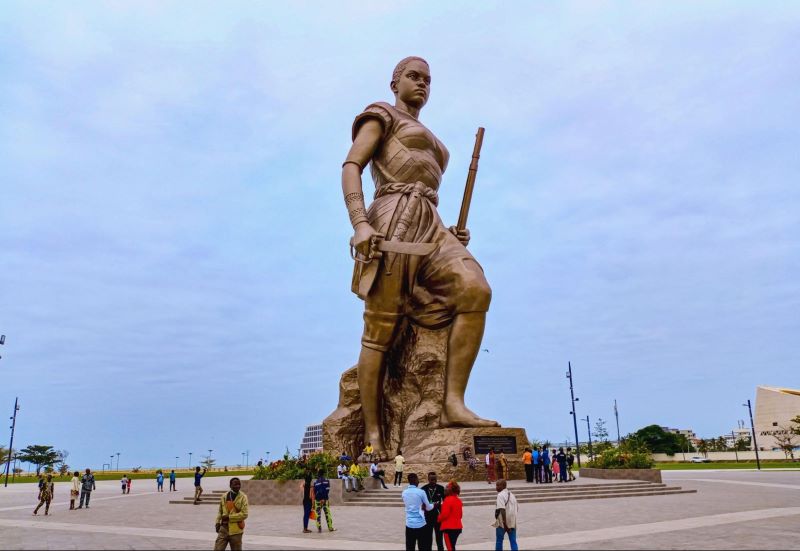
The Legend of the Dahomey Agojie. Photo courtesy of Landours Ghana
Recruitment into the Agojie followed different paths. While some women may have entered voluntarily, others were recruited through royal and community structures, and some accounts associate membership with captives incorporated into the kingdom’s military establishment. These circumstances demonstrate that the regiment’s history cannot be separated from the broader social and political realities of Dahomey.
Membership brought a distinctive position within Dahomean society. The women served the monarch directly and occupied a place within the royal establishment that distinguished them from ordinary subjects. Their military responsibilities, access to the palace, and association with the king afforded them a degree of prestige and authority beyond the domestic roles commonly expected of women. Historical accounts also describe special provisions, attendants, and privileges connected to their official status.
The Agojie’s effectiveness depended on sustained preparation, physical conditioning, and strict discipline. They had a training camp, and their training emphasized endurance, coordination, obedience, and the ability to function under the pressure of combat. Recruits faced demanding exercises and the expectations of a military organization that placed considerable importance on courage, discipline, and collective performance.
As Dahomey engaged with regional rivals and European powers, firearms became increasingly important to its military operations. Its soldiers used muskets and other guns available to the kingdom, although the quality and quantity of their weapons varied according to the period and available resources.
For close combat, Dahomean soldiers also employed blades, clubs, and other hand weapons. European descriptions of the kingdom’s military forces sometimes emphasized the formidable weapons associated with its fighters. However, sensationalized accounts of the Agojie’s weaponry and battlefield conduct should be treated cautiously, particularly when they lack reliable historical corroboration.
Their battlefield methods reflected the demands of warfare across West Africa’s forests, settlements, and open terrain. Surprise, coordinated movement, knowledge of the landscape, and the ability to advance under difficult conditions could provide tactical advantages. The regiment’s reputation rested not simply on its members’ willingness to fight but also on their capacity to operate within Dahomey’s wider military establishment.
Unlike armies assembled primarily during wartime, Dahomey maintained a permanent military force, of which the Agojie women warriors formed a distinctive part. Their presence in the royal palace and direct association with the king extended their responsibilities beyond the battlefield to include protecting the monarchy and preserving royal authority.
The history of the Agojie women warriors is a significant part of Africa’s military and political heritage. These women demonstrated that military organization and leadership were not exclusively male domains, securing a place in history that continues to challenge conventional narratives about women’s roles in precolonial societies. Yet their legacy must also be understood within the complexities of Dahomey’s expansion, warfare, and participation in the slave trade. Recognizing both dimensions offers a fuller understanding of their place in history.

Okechukwu Nzeribe works with the Onitsha Chamber of Commerce, in Anambra State, Nigeria, and loves unveiling the richness of African cultures. okechukwu.onicima@gmail.com