Source: Charmaine Ngatjiheue/dpa/picture alliance
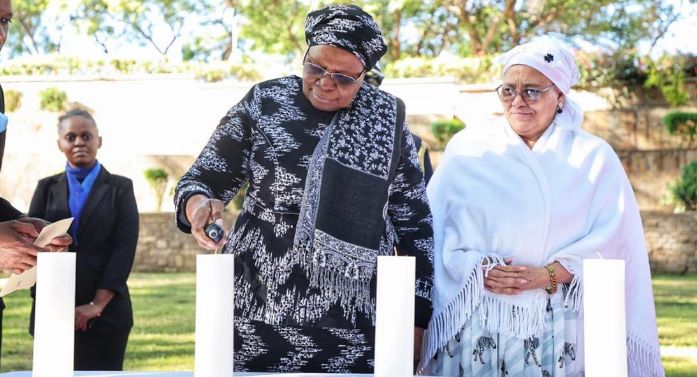
On May 28, 2025, Namibia observed its first Genocide Remembrance Day. President Netumbo Nandi-Ndaitwah, the country’s first woman head of state, lit a candle in the gardens of parliament in Windhoek for the estimated 65,000 Herero and 10,000 Nama people slaughtered by German colonial troops between 1904 and 1908. It is widely regarded as the first genocide of the 20th century, and more than 120 years later, the Herero people are still fighting for something Germany has never fully given them: reparations.
“We must remain committed that as a nation, we shall soldier on until the ultimate conclusion is reached,” Nandi-Ndaitwah told the crowd. That single sentence captures the Herero story better than any history book chapter could: a people who have survived attempted extermination and are still, generation after generation, refusing to let the world forget.
The Hereros’ story stretches back to the 15th century, when they migrated into Namibia from the east and settled as pastoralists. Their peace did not last long. In the 19th century, the Nama, armed with guns, pushed into their territory, sparking years of conflict.
European settlers arrived in the late 18th century, and by the 1880s, Germans were buying Herero land. An 1883 deal between merchant Franz Adolf Eduard Lüderitz and local leaders opened the door to full German colonial rule, and the region became German South West Africa. Tensions over land, water, and harsh colonial policies eventually exploded into the Herero Wars and the Herero and Namaqua Genocide. In 1904, the Herero and Nama rose up against German expropriation, but the rebellion was crushed by 1907. Around 65,000 Herero were killed, a devastating chapter that reshaped the community’s future.
Who are the Herero people?
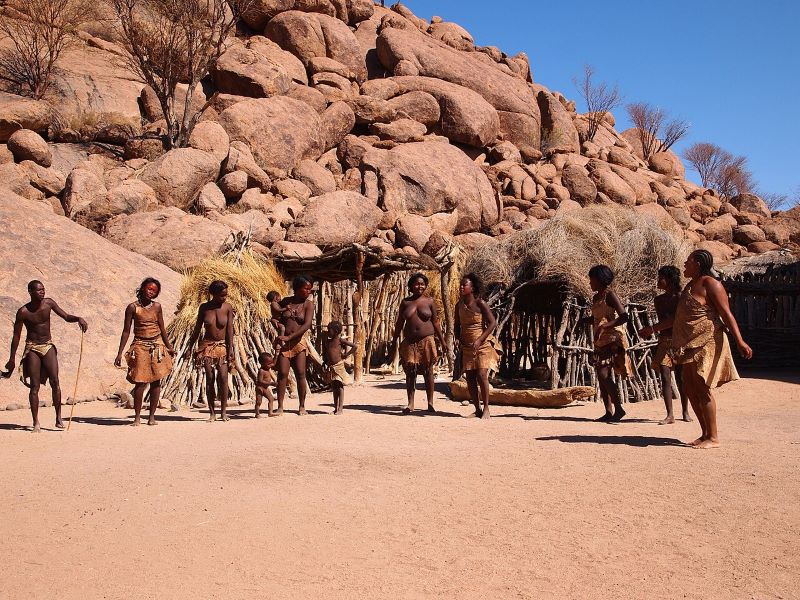
Also known as Ovaherero, they are a Bantu ethnic group with a vibrant history, hailing from the southern regions of Africa. With an estimated population of 250,000 in Namibia alone in 2013, the Herero have a significant presence there. They also have sizable communities in Botswana’s Maun region and surrounding villages such as Sepopa, Toromuja, Karee, and Etsha. Some communities are also in Mahalapye, Pilane, and the Kgalagadi South region. In Angola, Herero subgroups include the Mucubal, Kuvale, Zemba, Hakawona, Tjavikwa, Tjimba, and Himba. These Herero communities frequently cross the border between Namibia and Angola during their migrations, preserving their traditional way of life.
Unlike many other Bantu groups that primarily engage in subsistence farming, the Herero have traditionally been skilled pastoralists, historically tracing their cattle-keeping knowledge back to Cushitic herders in eastern Africa. Their livelihood revolves around tending to livestock, particularly cattle. The Herero have a deep connection with their cattle, considering them a symbol of wealth and status.ted milking practices from the Cushitic herders, either through direct interaction or indirectly through Khoisan intermediaries.
Source: Rosier, via Wikimedia Commons
The Herero people are not homogeneous but divided into several subdivisions, including the Himba, Tjimba (Cimba), Mbanderu, and Kwandu. Some, like the Tjimba, are distinct hunter‑gatherer groups who speak Herero but keep their own traditions and way of life.
Leadership is spread across eight royal houses, each led by a chief. Among the key ones are the Ovaherero Traditional Authority, the Maharero Royal Traditional Authority, the Zeraeua Royal Traditional Authority, the Ovambanderu Royal Traditional Authority, and the Onguatjindu Royal Traditional Authority.
At the top of Herero leadership is the Paramount Chief, a role meant to unify all Herero people. But in recent years, the position has been vacant and heavily contested. Two key figures have emerged as contenders: Hoze Riruako and academic Mutjinde Katjiua. In the meantime, Chief Vipuira Kapuuo has been serving as acting Paramount Chief following the 2021 death of Advocate Vekuii Rukoro.
Kapuuo, who is also the Ovitoto chief and chairs the Ovaherero Traditional Authority’s Chiefs’ Council, went to court in 2022 after he was allegedly removed from the acting role. He argued that tradition is clear: when a Paramount Chief dies or becomes incapacitated, the chairman of the chiefs’ council automatically steps in as acting leader.
It is a reminder that even the community’s internal politics carry the scars of colonial disruption. The position has never fully recovered its old stability since Germany first dismantled Herero leadership over a century ago.
The lineage of Paramount Chiefs among the Herero traces back through history, with leaders such as Kuaima Riruako, Clemens Kapuuo, Hosea Kutako, Samuel Maharero, and Maharero ka Tjamuaha playing pivotal roles in the leadership of the Herero people.
Source: Diaspora Insurance
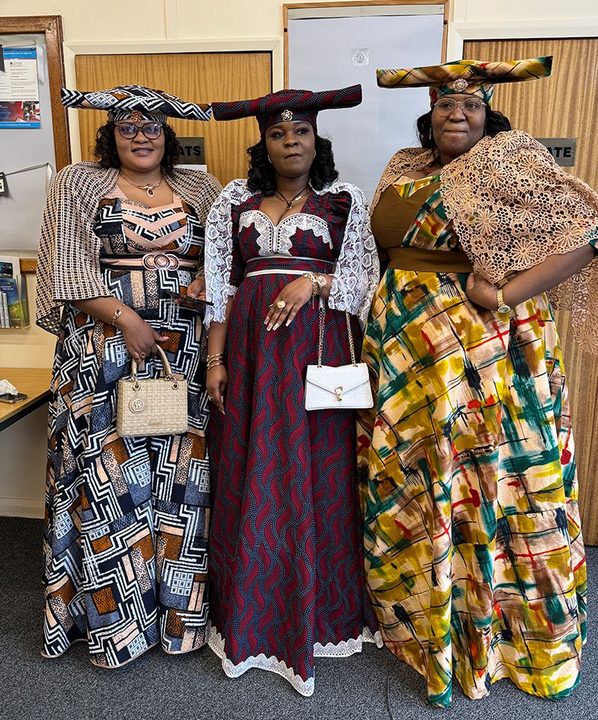
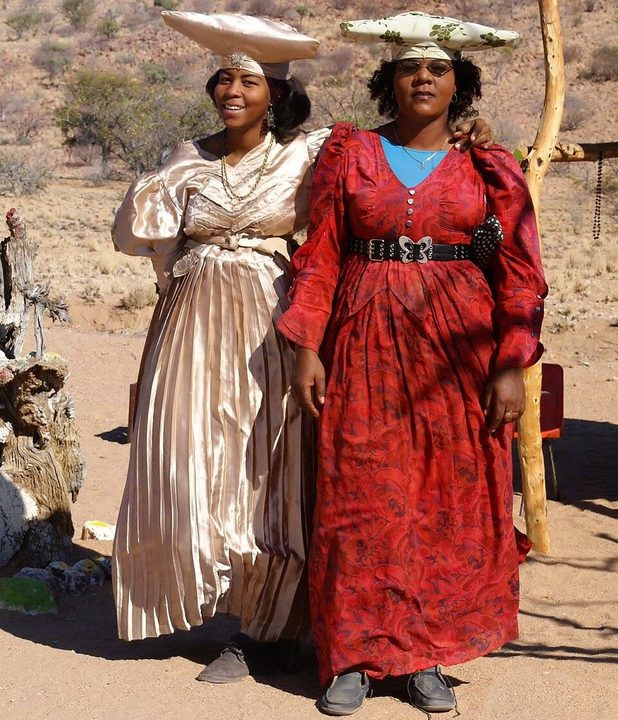
Their leadership did not only guide the Herero through major historical moments, it also helped preserve the cultural identity that remains central to Herero life today. That identity is expressed in Herero traditions, especially their distinctive dress. Herero women are known for their elegant attire, which includes long, flowing dresses with voluminous skirts made from bright, richly patterned fabrics, a style that has become one of the most recognizable symbols of Herero culture.
The most iconic element of Herero women’s dress is the horizontal horned headdress, the otjikaiva. This headdress pays homage to the cows that hold immense significance in Herero culture. The headdresses are often made from rolled-up newspaper covered in fabric and are carefully coordinated with the ohorokova, a long, structured Victorian-style dress introduced by German missionaries generations ago and reshaped into something entirely the Herero’s own.
But how much that tradition can evolve is an ongoing debate within the community. When Namibian designer Leah Misika and other young stylists began wearing the headdress without the full dress, or paired it with modern outfits, it set off a social media firestorm. Designers argue they are keeping the tradition alive for young people; elders argue that some things in a culture forged through genocide and exile should not be touched. Both sides are right in their own way, and the argument itself is proof that the culture is still very much alive.
In recent years, Herero culture and dress have also gained attention from fashion designers in urban Windhoek, showcasing the adaptability and evolving nature of their traditional attire.
The Herero people’s strong sense of identity is also carried through language. Otjiherero, a Bantu language with dialects like Oluthimba, Otjihimba and Otjikuvale, remains a unifying thread for Herero communities. Standard Herero is widely used in Namibian media and taught in schools across the country.
Spiritually, the Herero connect to their ancestors through Okuruo, the sacred fire believed to link the living with God. While these traditional beliefs endure, many Herero also practice Christianity, with Catholic, Lutheran and Born‑again denominations common today.
The Herero people have left their mark in their homeland, literature, and fiction. They are featured in various novels, including Thomas Pynchon’s “Gravity’s Rainbow” and Uwe Timm’s “Morenga.” Additionally, Guy Saville’s book “The Afrika Reich” explores an alternate history in which the Herero plays a significant role.
Source: Wikimedia Commons
The period when German settlers seized Herero land in the late 1800s, and the resistance that led to the killing of up to 80% of the Herero population, remains a defining wound. Survivors were driven into the desert or forced into concentration camps; some were beheaded and their skulls sent to Berlin for racist research. Namibia has fought for their return, with partial repatriations in 2011 and 2018.
Germany did not call it genocide until 2015, and only formally apologised in 2021, alongside a pledge of €1.1 billion in development aid paid out over 30 years, money Berlin insists is reconciliation, not reparations, and which Herero and Nama descendants say was negotiated without them at the table.
Namibia’s government pressed on anyway. In April 2026, President Nandi-Ndaitwah told parliament that a revised agreement is now under review by a cabinet committee and a chiefs’ forum, with reparations reframed as long-term support rather than a single payout.
Namibia itself has changed a great deal over the years. The Herero people have buried their dead, argued over their headdress, defended their language, and outlasted an empire that tried to erase them entirely. That they are still here in spite of it all says everything about who they are.ribute to their identity, while their historical experiences have shaped their worldview. The Herero continue to evolve and thrive in the modern world, carrying their heritage proudly into the future.
Anand Subramanian is a freelance photographer and content writer based out of Tamil Nadu, India. Having a background in Engineering always made him curious about life on the other side of the spectrum. He leapt forward towards the Photography life and never looked back. Specializing in Documentary and Portrait photography gave him an up-close and personal view into the complexities of human beings and those experiences helped him branch out from visual to words. Today he is mentoring passionate photographers and writing about the different dimensions of the art world.