Source: Wikipedia
On July 4, 1776, the American nation was born. The Continental Congress, made up of representatives from the thirteen American colonies, adopted the Declaration of Independence and officially severed all political ties with Great Britain. What followed was a war often referred to as the Revolutionary War between the former colonial power and a new nation determined to exist on its own terms. Among the many patriots who fought were African Americans, both free and enslaved, whose contributions helped secure the nation’s hard-fought freedom.
Over its 250-year history, Black Americans have remained an integral part of the nation’s journey toward liberty. In the heart of Philadelphia, the birthplace of American independence, where the language of freedom first took root, Black men and women played a vital role in building, shaping, and challenging the ideals that defined the United States, often at great personal cost.
Before 1776: Black Presence in the Birthplace of Liberty
From the seventeenth century, people of African descent arrived in the city initially as enslaved individuals transported from Africa or through the Caribbean. By the eighteenth and nineteenth centuries, the African American population in Philadelphia had grown significantly. Drawn by the promise of opportunity, African Americans nevertheless faced harsh realities, including discrimination, disenfranchisement, unemployment, and periodic race riots that led to the destruction of homes and livelihoods.
Despite these challenges, the Black community in Philadelphia continued to expand. However, this growth was met with systemic efforts to limit Black advancement. One such measure was the Black Codes of the 1720s, laws specifically designed to restrict the rights and mobility of Black people, particularly those who were not enslaved.
If the pre-independence era exposed the contradictions within the idea of American liberty, the years that followed revealed the determination of Black Philadelphians to redefine it. Denied access to white institutions, they created their own spaces where their community could thrive. At the forefront of this movement were two remarkable figures: Richard Allen and Absalom Jones.
From Enslavement to Institution Building
The passage of the Gradual Abolition Act of 1780 by the Pennsylvania General Assembly marked a turning point in the fight against slavery in Pennsylvania. It set in motion a gradual process toward emancipation and inspired a broader push for freedom among Black Philadelphians.
This momentum led to the establishment of the Free African Society (FAS) in 1787, the nation’s first independent Black organization founded by Richard Allen and Absalom Jones. The FAS provided social support, financial assistance, and a sense of community for African Americans, laying the foundation for organized Black activism. Its influence extended far beyond its initial mission. It contributed to the rise of major institutions and inspired broader movements, including early abolitionist efforts and the Underground Railroad.
Following experiences of racial discrimination at St. George’s Methodist Episcopal Church, where Black congregants were subjected to segregated seating, Allen and Jones led a historic protest. Black worshippers walked out in defiance of unequal treatment, an act that ultimately led to the establishment of independent Black churches, most notably the Mother Bethel African Methodist Episcopal (AME) Church. This was more than a religious decision; it was a bold declaration of autonomy and dignity.
Black church institutions soon became pillars of the community. They played critical roles in advocacy, education, and social welfare at a time when formal systems excluded African Americans. These institutions organized aid for the poor, championed abolitionist causes, and fostered a sense of unity. In these spaces, Black Philadelphians supported one another and embodied the principle of collective responsibility.
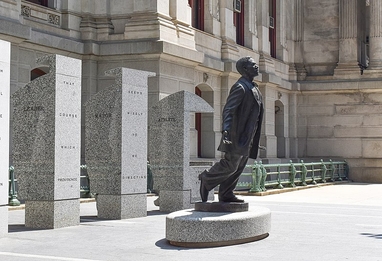
Branly Cadet, Foolish Productions Photography, Fair Use via Wikimedia Commons
Octavius Catto and the Battle for the Ballot
Following the Civil War and the growing population of Black Philadelphians, the demand for expanded civil rights grew more urgent. Issues such as voting rights, desegregation of public transportation, and equal access to education became central to the struggle. One of the leading figures of this movement was Octavius V. Catto (1839–1871).
Born to parents who had escaped slavery in South Carolina, Catto became a teacher, civil rights advocate, and community leader. He also served as a founder and captain of the Pythian Baseball Club, one of the earliest Black baseball teams.
During the Civil War, Catto worked alongside Frederick Douglass and other prominent leaders to recruit Black men into the Union Army. Through his efforts and with support from the Union League, he helped raise eleven regiments of United States Colored Troops, many of whom were his former students.
After the war, Catto turned his focus to civil rights at home. He played a key role in the desegregation of Philadelphia’s streetcars through acts of civil disobedience and became a leading advocate for the ratification and enforcement of the Fifteenth Amendment, which guaranteed Black men the right to vote.
However, these efforts were met with fierce resistance. Black voters were routinely intimidated, particularly during election periods. On October 10, 1871, while encouraging African Americans to exercise their voting rights, Catto was shot and killed by Frank Kelly, a white man.
Catto’s death marked a tragic moment in Philadelphia’s history. Yet, his funeral became one of the largest public processions the city had ever witnessed, drawing politicians, clergy, students, and thousands of mourners. His legacy became a powerful symbol of the ongoing struggle for civil rights in America.
The gap between the rhetoric of liberty and the reality of exclusion was not lost on Black Philadelphians. Rather than accept it, they challenged it through resistance, institution-building, and collective action, laying the groundwork for future generations.
America at 250 Years and the Fight for Historical Truth
As the United States prepares to commemorate its 250th anniversary, Philadelphia once again stands at the center of the national story. Historic landmarks across the city will attract visitors from around the world, all eager to engage with the legacy of America’s founding.
Yet, one of the greatest disservices to this history would be the omission of the diverse voices that shaped it, particularly those of the Black community, whose contributions have been essential to the nation’s development.
Ensuring that America’s story is fully told requires more than symbolic recognition. It demands a deliberate effort to acknowledge and integrate the experiences and contributions of Black Americans into the broader national narrative.
The story of Black Philadelphia and its heroes must not be confined to the margins of history books. It is a living legacy reflected in enduring institutions, vibrant communities, and ongoing struggles for justice. It also serves as a powerful reminder to future generations of Black men and women of their responsibility to continue the work of social progress and cultural contribution.
In honoring this legacy, America moves closer to the ideals it first proclaimed in 1776: liberty, equality, and justice for all.

Okechukwu Nzeribe works with the Onitsha Chamber of Commerce, in Anambra State, Nigeria, and loves unveiling the richness of African cultures. okechukwu.onicima@gmail.com