Source: ABC7 News
Georgia elected the nation’s first Black woman governor. Across the country, voters also expanded Black leadership in state government, elected new voices to Congress and changed who will hold power in Washington and Harrisburg.
Results checked November 6, 2026. This roundup covers major national outcomes, representation milestones and results affecting Philadelphia. Results reflect reported race calls and counts, not certified totals. Counting continues in several races.
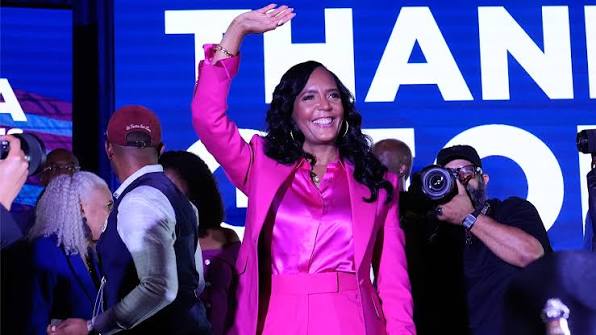
Keisha Lance Bottoms won Georgia’s governor’s race on November 3, becoming the first Black woman elected governor of any U.S. state. The former Atlanta mayor defeated Republican Rick Jackson and is the first woman and first Black person elected governor of Georgia.
Her victory belongs at the center of the election story. It also sits within a much larger change: five Black governors are set to serve at the same time, while Democrats won control of both chambers of Congress.
For FunTimes readers, the results range from a national barrier broken in Georgia to the people representing Philadelphia, the future of transit funding in Pennsylvania and a new Ethiopian American voice in Congress.
Bottoms will join a group of Black governors that includes Democrats and a Republican. The other winners were:
• Byron Donalds, a Republican, in Florida, the first Black Republican elected governor of a U.S. state.
• Aaron Ford, a Democrat, in Nevada, becoming that state’s first Black governor.
• David Crowley, a Democrat, in Wisconsin, becoming that state’s first Black governor.
• Wes Moore, a Democrat, who won reelection in Maryland.
Before this election, only three Black Americans had ever been elected governor: Virginia’s Douglas Wilder, Massachusetts’ Deval Patrick and Moore. Their terms did not overlap. Four newly elected governors will join Moore in office in January.
The winners span both major parties. Their elections expand Black representation, but their party affiliations do not point to one shared policy agenda.
Other Black candidates fell short. Republican John James lost Michigan’s governor’s race to Democrat Jocelyn Benson, and Republican Lisa Demuth lost Minnesota’s to Democrat Amy Klobuchar. Democrats Jermaine Johnson in South Carolina and Fred Love in Arkansas also lost.
Black women gain another seat at the Senate table
Illinois elected Democratic Lt. Gov. Juliana Stratton to the U.S. Senate. She defeated Republican Don Tracy and will succeed retiring Sen. Dick Durbin. Stratton will join Maryland’s Angela Alsobrooks and Delaware’s Lisa Blunt Rochester, who were not up for election this year. Her arrival will bring the number of Black women serving simultaneously in the Senate to three.
Illinois will also become the first state represented by two women of color in the Senate at the same time, with Stratton serving alongside Tammy Duckworth.
In her campaign, Stratton connected affordability to proposals on wages and health care, including addressing disparities in Black maternal mortality. Those proposals remain commitments voters can follow as she moves from campaigning to legislating.
New firsts for Native, Muslim and LGBTQ representation
Several other results widened access to offices that had never included people from those communities.
In New Mexico, Deb Haaland was elected governor and became the first Native American woman to serve as governor of a U.S. state. A former U.S. interior secretary, she told PBS NewsHour after the election that she wanted to expand access to existing child care and early education programs and address families’ costs.
Minnesota elected Peggy Flanagan, who will become the first Native American woman in the U.S. Senate. Michigan elected Abdul El-Sayed, the first Muslim elected to that chamber. New Hampshire elected Chris Pappas, the first openly gay man elected to the Senate.
Haaland’s interview put concrete proposals alongside the history. She said she wanted to enhance New Mexico’s child tax credit and working families tax credit while expanding access to child care. Those are plans for her administration, not benefits that her victory has already delivered.
Colorado’s 1st Congressional District elected Melat Kiros, a 29-year-old Ethiopian immigrant and lawyer. She will be the first Generation Z woman in Congress.
Kiros, a democratic socialist, won the general election after defeating longtime Democratic incumbent Diana DeGette in the primary. Her victory gives the African diaspora a particularly direct connection to this year’s generational change in the House.
NPR reported that Kiros argued for policies aimed at working people and warned that elected leaders face consequences when they fail to deliver material results. Her election brings both her immigrant background and those policy demands into the next Congress.
Young candidates won on the Republican side, too. Michael Alfonso, 26, won Wisconsin’s 7th District and will become the first person born in the 2000s to serve in Congress.
Democrats take Congress; Jeffries seeks the speakership
Democrats won the House and Senate. Their Senate victories included James Talarico in Texas, Adam Hamilton in Kansas, Josh Turek in Iowa, Annie Andrews in South Carolina, Sherrod Brown in Ohio, Roy Cooper in North Carolina and Troy Jackson in Maine. Jon Ossoff won reelection in Georgia.
The gubernatorial map changed beyond Georgia, too. Democrat Gina Hinojosa defeated Texas Gov. Greg Abbott, and Democrat Amy Acton defeated Republican Vivek Ramaswamy in Ohio.
The House result puts Hakeem Jeffries in position to become its first Black speaker, but that leadership election is still ahead. On November 4, he formally asked colleagues to support his candidacy. He has not yet been elected speaker.
In that letter, Jeffries identified affordability and oversight as priorities and called for action on housing costs and health care. Those are his proposed priorities for the new majority, not laws the election itself has enacted.
Pennsylvania’s results matter close to home
Gov. Josh Shapiro won reelection against Republican Stacy Garrity. Democrats also won the state Senate and retained the House, giving the party control of the governorship and both legislative chambers for the first time since 1993.
For Philadelphia, that result changes the negotiations over issues that have repeatedly stalled in Harrisburg. Shapiro identified raising the minimum wage and finding a new funding stream for mass transit among his priorities after the election. Passing those measures will still require legislative decisions and funding agreements.
Philadelphia also elected Democratic state Rep. Chris Rabb to succeed retiring U.S. Rep. Dwight Evans in Pennsylvania’s 3rd Congressional District. Rabb, a self-described democratic socialist, defeated independent Dennis Mahoney after campaigning on affordable housing and a living wage, among other proposals. More than half the district’s residents are Black, and nearly one in five lives below the poverty line. Rabb told WHYY that building relationships with Democratic caucus leaders would be his first priority in Washington.
The local ballot included decisions beyond candidates. Voters approved charter changes allowing preference for small, Philadelphia-based businesses in city contracting and making Creative Philadelphia a permanent part of city government.
Those measures give local business owners and arts organizations specific decisions to follow after the campaign signs come down.
Some consequential races remain unresolved
Mississippi’s Senate race requires patience. Democrat Scott Colom led Republican Sen. Cindy Hyde-Smith in returns reported November 5, but the contest remained unresolved. A Colom victory would make him the state’s first Black senator since Reconstruction. The state has until November 10 to resolve provisional ballots.
Alaska’s Senate race between Democrat Mary Peltola and Republican Sen. Dan Sullivan was also uncalled in local reporting published November 6. Both campaigns expressed confidence, but ballots remained outstanding. Alaska’s governor’s race was uncalled as well. Ranked-choice tabulation is scheduled to begin November 18 for races where no candidate clears 50%.
Kansas’ governor’s contest between Democrat Cindy Holscher and Republican Ty Masterson remained uncalled in the Associated Press’ November 5 update.
The next checkpoints include Mississippi’s provisional-ballot deadline and Alaska’s ranked-choice count.
For the winners, attention turns to the House speaker election, the governors taking office in January and Pennsylvania Democrats’ promised First 100 Day plan.

Victoria Ezechukwu-Nwagwu is an Associate Editor at FunTimes Magazine with a strong background in media, strategic communications, and editorial leadership. She brings a thoughtful, detail-driven approach to storytelling, content development, and collaboration, ensuring high editorial standards.
She plays a key role in shaping impactful narratives and driving creative innovation across the publication.