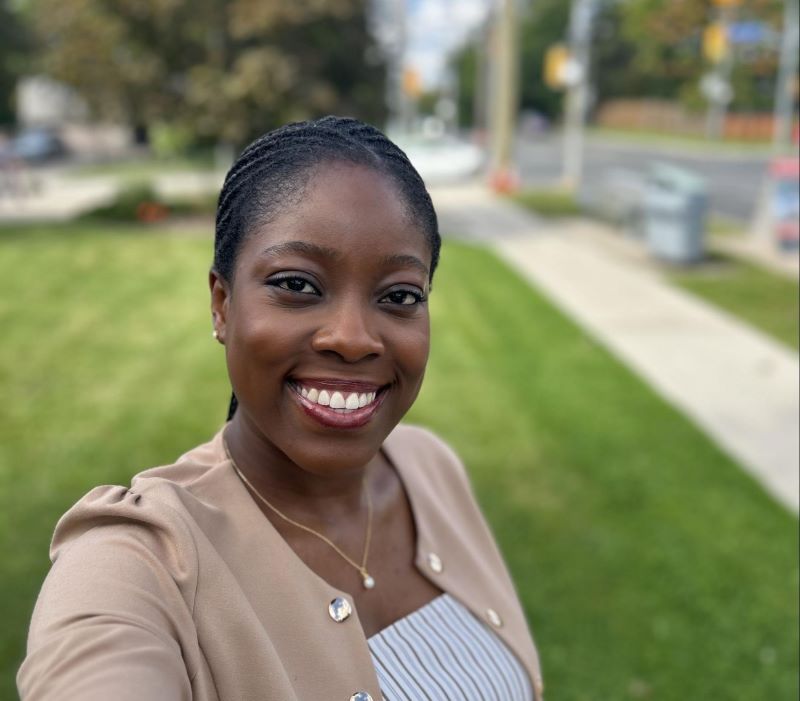

Photo credit: Gail Ncube
Every morning, Gail Ncube wakes up and asks her mother the same question: “Where am I going in November?” And every morning her mother answers, “Japan.”
She was about six years old when she relocated with her mom in 2006. The search for better opportunities has taken her from Zimbabwe to South Africa and now, potentially, to Japan. She has faced a stack of rejections because of the passport she holds. Her story will feel familiar to anyone who has ever chased a door that kept closing.
What has this journey taught you about resilience, identity, and finding your place as a Zimbabwean woman in another African country?
South Africa has been rather good to my family and me. Of course, there are ups and downs as a refugee, an asylum seeker, or a foreign person. Firstly, I would love to thank South Africa for the community. I have gotten to know so many different languages and cultures. It has humbled me and taught me the concept of Ubuntu, which is pride in being part of your community, sharing the space, and respecting one another. I would say that has been the biggest thing that has shaped me.
And of course, the struggles of living in a country that is not your home country have also made me into the kind of person I am. They have taught me perseverance, hard work, and drive, especially because educational opportunities can be very hard to come by if you don’t get a bursary. Bursaries and scholarships are harder to find if you are a foreign national.
Let’s talk about the financial barriers when you wanted to attend university. What was that period like, and how did you get through?
After I matriculated in 2017, it took me about two years to get to university. I paid the application fees and got accepted because my marks were good. However, I didn’t have the finances to pay for my education, so I had to take a two-year gap while I kept planning and pushing for bursaries.
Luckily, my sister knew of a magazine owner, someone with a small niche business in South Africa, who offered to sponsor my first year. They later offered me a bursary, and that was how I was able to register at university. After that, I had to get my marks really high to qualify for the university’s hardship funds. That was how I got through school: through bursaries within the university.
I also had a few personal sponsors. One of the biggest was my church community. In my third year, I struggled to get my university registration sorted because a lot of students were also applying for funds. I appealed to my church community, and they were able to assist. Some family friends also contributed to my fees, bringing me closer and closer to my goal until I graduated.
If a young person is facing that same financial barrier right now, what advice would you give?
I’m thinking back to the advice I would give younger Gail, which is to persevere and keep going for it. Help doesn’t always come when you want it to. However, there are still good people and good opportunities. Approach whatever platforms you have: church groups, friendship groups, anyone you can approach, and also the universities, to find out what help they can give or how they can chip in towards your registration.
What was it like establishing yourself professionally in South Africa as a non‑national, and did your nationality ever make opportunities harder to access?
Firstly, the job market in education in South Africa is already very tough. I know a lot of teachers, South Africans and foreign nationals alike, who have not had the opportunity to get even a year’s worth of teaching work because there aren’t enough teaching positions. As a foreign national, it’s much worse because preference usually goes to citizens first, and then foreign nationals.
But I was very lucky. I did my teaching practicals at one of the schools I taught at last year. After I finished, because I did an amazing job, they suggested I apply for a learnership after graduation, or for a teacher position if one was available. So that’s where I got lucky. But it is a very hard space to find yourself in. I have been in a teachers’ employment group for about two to three years now, and there are still teachers in it who haven’t found positions.
How about xenophobia in South Africa? Have you experienced it personally?
I haven’t had that experience myself, and I’m very grateful for that. However, I have a few friends who have experienced it, especially in places they have gone to, such as hospitals. I have always had a good circle around me and a really good community of people where I live.
Have you faced discrimination at school, in the workplace or in the community?
At work, no. It was absolutely stunning, very warm and welcoming. At school, none of that either. However, there are instances. You might get into a taxi and hear someone talking about foreign nationals while you are sitting there listening. Or sometimes at Home Affairs, you experience some hostility for being a foreign national. But it’s not so bad.
Now that you have finished your qualification, what made you look elsewhere to build your career? Why teach abroad, and why Japan?
Employment in South Africa is quite hard, even for South Africans, let alone foreign nationals. With everything currently happening, with people still experiencing xenophobic attacks and a whole lot of hostility for being born outside the country, it really made me think twice about the career I want to build here. I don’t want something shaky, where I feel my job could become unstable at any point. So I decided to look elsewhere, to a country where I would feel more needed, one that would appreciate my skills and look beyond the fact that I wasn’t born in South Africa. I wanted a country that would bypass that, and overseas seemed more open to who I am and accepting of me as a person, without minding the nationality attached to my name.
Read also: “I didn’t pay anyone. I did everything myself. I paid just N12,000 to pick up my passport”
Did you try other countries, and how many setbacks did you face before Japan finally clicked?
I tried so many places. I sent over two hundred applications every week and looked at the African continent as well, at Hungary, Thailand, Cambodia, Indonesia, a broad range of countries. But the limitations that come with the passport you hold made the journey deeply discouraging. What limits us sometimes is not that we aren’t skilled or professional enough, or that we don’t have the experience. It’s the mere fact that you don’t hold a passport from a certain country. That was a hard pill to swallow, especially seeing how, in the applications, things changed the moment they found out which passport you were using. Most of the rejections were due to the passport I was holding.
How many rejections did you get?
A boatload. Some would not even respond. Even on the application websites, they are very explicit about what they consider a native-language teacher. There’s a native and a non-native category, and they usually consider native teachers to be from about seven countries: the UK, Ireland, South Africa, the USA, New Zealand, and a few others I don’t remember. Anything outside those core countries, you just have to set yourself up for disappointment.
However, I’m a person who likes taking on a challenge. Despite knowing it might be a rejection, I refuse to let an opportunity pass me by simply because my passport said something else. I said, ” You know what, I might as well give it a go. If it’s a no, then it’s a no. If it’s a yes, awesome.”
What was the Japan process like?
The interviews were actually quite fun. Of course, it was nerve-wracking, but I believe that if something makes you nervous, it’s something you consider important. It was a challenge, but it was fun. The processes do take time, and they depend on the company and school you’re applying to, so each one was a different experience with different requirements. Some just required a CV and cover letter, and then you got an interview. Some required a lesson plan beforehand. Some required you to send in your passport before the interview so they could decide whether to interview you at all. And some required numerous interviews: one person at stage one, somebody else at stage two, and then stage three. The experience was very different from the procedures in South Africa. It is a different country and a different culture, so we expect it to be different.
You are moving to a very different culture and educational environment. What are you most excited and nervous about?
I am most excited about learning a new language. I have grown to love languages here in South Africa. Each one teaches you about the different kinds of people you’re dealing with. Seeing someone’s passion as they express themselves in their own language is so enticing to me. I want to be able to communicate with you in your own language and understand you. Because English is so universal, sometimes we don’t appreciate language as much. Going to a different country and having to relearn that process, being a student myself again, is the most exciting thing for me. I find it thrilling.
As for what I’m nervous about, it’s leaving home. I’ve been attached to my mom and my siblings from the day I was born. I have never been away from them, and I’ve never traveled far or out of the country and left them. That is the most nerve-wracking thing, along with being on my own for a certain period. But if you get too comfortable at home, you won’t grow.
You need 45,000 rand for your relocation costs. How are you approaching that financial difficulty?
I launched a crowdfunding campaign and began reaching out to different people, magazines, African societies, and anyone who might listen. I even contacted airlines, because why not try? When I have a challenge in front of me, I tackle it head-on. This year has taught me to confront challenges directly and to speak up, even when it feels uncomfortable. Sometimes we feel so ashamed of admitting that we need help. Opening that campaign pushed me to approach different communities. I also took a part‑time receptionist job to help get me there. I’ve managed to cover some basics.
I am reaching out to anyone who believes in the power of education and would be willing to support this journey, whether through financial assistance, flight sponsorship, travel assistance, relocation support, or connecting me with someone who can help. There might be someone interested in hearing from somebody as simple as me. You can reach out to me via gailncube4@gmail.com
What has the response been so far?
It’s been fifty-fifty, to be honest. There have been promises, but nothing has come through yet. Some people have said straight out that they’re not able to help, and I appreciate that. I always appreciate honest feedback. I always believe that if a door is not meant to be open, then it’s not the right one for me, and if it does open, then it’s the right one. It means I’m still finding my people and still connecting with people.
What would you want a young African woman who feels her financial situation has already determined her future to learn from your journey?
Firstly, I would ask her to take a seat and reflect on what her journey is pushing her to do. When you have a calling, as teaching is for me, you just have to keep going despite how hard things may seem.
Unfortunately, it’s easier to tell somebody to keep going than to do it. In their head, they’re thinking, “Do you understand the walls I’m facing? It’s rejection after rejection after rejection.” But as I said, when doors close, it may mean they aren’t the ones meant to open for you. Even with Japan, I thought, wow, nobody is taking me seriously. I was getting interviews left, right, and center, but not one job offer.
I don’t know who my reader might be, but if they’re faith-driven like me, prayer is a good thing. It helps you reflect, find yourself, and think deeply about what you want. I’d say don’t give up, despite how difficult it is. If you let your circumstances determine your lifestyle, it’s going to be a very hard life, without peace and without happiness.
Also, take the joy as it comes. In any moment, enjoy whatever situation you’re in. Don’t always look at the negative. If it’s not working out now, it might later. Take it one day at a time. A little positivity goes a long way, and so does encouragement from friends and family. Keep speaking about your dream.
Every morning. I wake up and ask my mom, “Mom, where am I going in November?” And she says, “I know you’re going to Japan.” And I say, “Yes, that’s exactly what it is.”