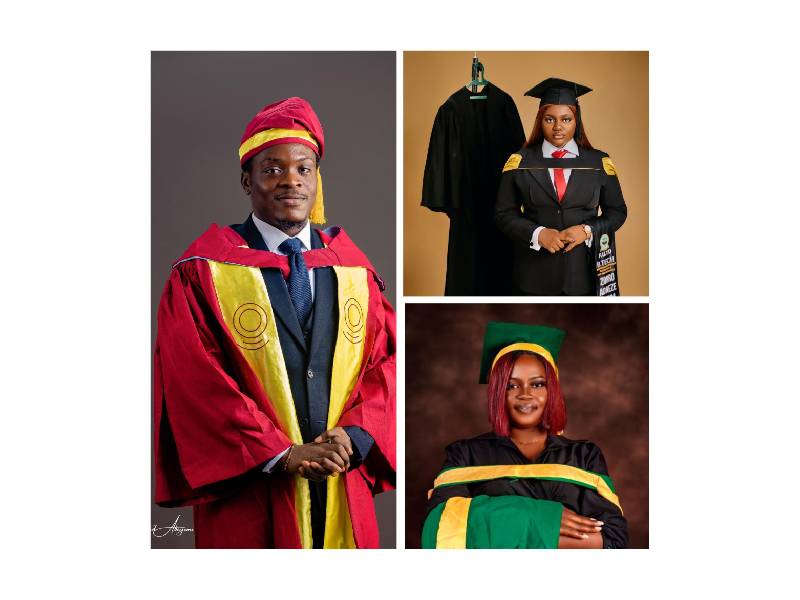
Image Source: FunTimes Magazine; L-R Adisa Damilola, Alphonsus Oluchi and Zorro Adaeze.
The cap comes off before the tassel does most of the time. Somebody’s mother is already crying into a phone camera, somebody’s grandmother flew in from Accra or Kingston or drove up from a town three hours south, and there is a photo being taken right now that will end up printed, framed, and hung somewhere in a living room for the next twenty years. Everybody in that photo is smiling. Almost nobody in that photo knows what happens in six months.
That gap, between the photo and the six months later, is where this piece actually lives.
I keep thinking about the week after commencement, the quiet one, when the dorm room is empty, and the group chat that used to buzz with study sessions and last-minute assignments goes still. School gave you a shape for four years. Wake up, go to class, turn in the paper, and show up to the group project. Then it just stops, all at once, and nobody warns you how disorienting that stopping actually feels. You made it count for four years by somebody else’s definition of counting. Now you have to figure out your own.
For a lot of the people reading this, that disorientation comes with an extra layer nobody talks about enough. If you are the first in your family to walk that stage, or if your parents crossed an ocean so you could be standing on it, the diploma was never really just yours. It belonged to a whole family’s calculation of what the sacrifice was for. African parents tend to hold especially high expectations for their children’s education and career paths, often steering them hard toward professions seen as prestigious and stable, according to career counseling research. That pressure comes from love, almost always. It still sits on your chest at two in the morning when the job applications are not turning into interviews.
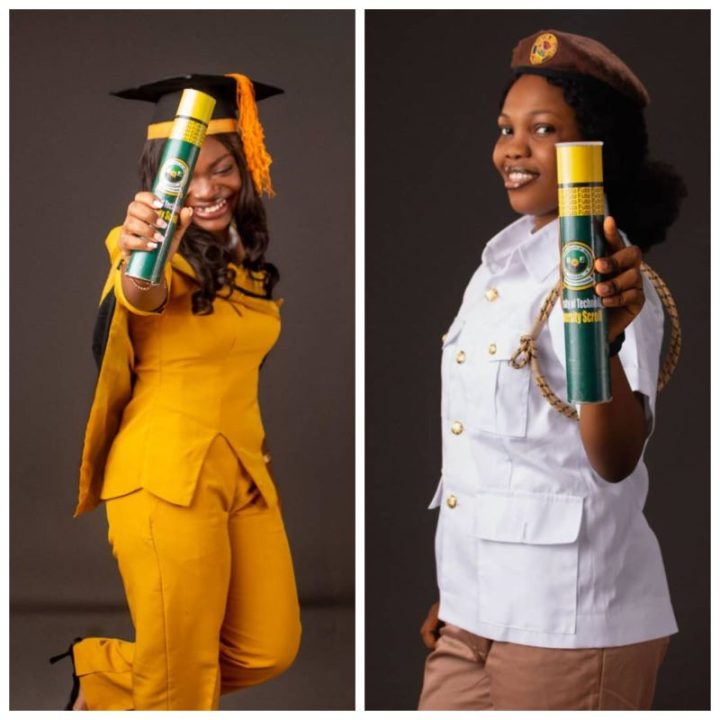
Image Source: FunTimes Magazine: L-R: Amadi Chinonyerem and Obasi Jane.
Black American families carry a version of this too, just built from a different history. The degree is not only a credential in that context. It is proof that a door once denied to someone in your bloodline is now open, and there is an unspoken expectation that you walk all the way through it rather than just stand in the frame. Nobody says this out loud at the graduation party. It is there anyway, in the way an uncle asks, “So what’s the plan,” like the plan should already be fully formed.
The job market the class of 2026 is walking into is genuinely rough. The unemployment rate for recent college graduates sat at 5.7% in the first quarter of 2026, according to the Federal Reserve Bank of New York, with underemployment, meaning graduates working jobs that do not actually require a degree, at 41.5%. Recent graduates have now faced higher unemployment than the overall national workforce for five straight years running, a reversal of the old pattern that used to make a degree feel like a guarantee, and one that was almost unheard of before this decade.
It gets heavier for Black graduates specifically. The Economic Policy Institute’s analysis of Q1 2026 labor data found the Black unemployment rate at 7.6%, a sharper deterioration than the year before, with Black women who hold college degrees among those hit hardest by recent losses. That is not a coincidence, nor a reflection of anyone’s effort. It is a labor market that has never distributed its pain evenly, doing what it has always done.
So if you graduated this year and you are still job hunting, or you are back in your childhood bedroom with your degree in a drawer somewhere, you are not failing while everyone else figures it out. You are living inside numbers that are genuinely working against you right now, alongside a huge number of your peers, Black and otherwise.
What gets lost in almost every graduation speech is the gap between the version of this year that shows up on Instagram and the version that actually happens in most houses. The Instagram version is the internship that turned into an offer, the moving-to-a-new-city post, the “excited to announce” LinkedIn caption. The real version, for a lot of people, is an inbox full of application confirmations and silence, a part-time job that has nothing to do with the major, and a low hum of comparison every time somebody else’s announcement post shows up on the feed.

Image Source; FunTimes Magazine: L-R: Amadi Annastecia, Akam Juliet and Awuzie Excellence.
There is something particular about walking back into your parents’ house after four years of independence, too. It can feel like a small defeat even when it is the smartest financial decision available, and even when your own parents never once framed it that way. The apartment with your name on the lease was supposed to be the proof that the degree worked. When that apartment does not materialize on schedule, it is easy to mistake a rough job market for a personal failure, which it almost never is.
I do not think “make it count” is really about landing the dream job by September. I think it is closer to something an HBCU career guide got right for this year’s graduates: four years at an institution built around resilience and community teaches you how to keep moving even when nobody hands you a clear route forward, and that skill does not vanish just because the first year out looks messier than expected. The counting happens in what gets built during the harder months. The part-time job that teaches you how a business runs from the inside. The rejection that forces you to actually sharpen the resume instead of coasting on the degree alone. The relationship with an alumni network, an aunt in HR, a professor who still answers emails, that turns into the interview six months from now that never would have happened through a cold application.
None of this makes the six months easier while you are inside them. But it might be worth remembering, on the nights when the group chat announcements start to sting, that almost nobody’s real first year looks like their announcement post. The photo from graduation day was real. So is everything that happens after it, even the parts nobody frames and hangs on the wall.

Anand Subramanian is a freelance photographer and content writer based out of Tamil Nadu, India. Having a background in Engineering always made him curious about life on the other side of the spectrum. He leapt forward towards the Photography life and never looked back. Specializing in Documentary and Portrait photography gave him an up-close and personal view into the complexities of human beings and those experiences helped him branch out from visual to words. Today he is mentoring passionate photographers and writing about the different dimensions of the art world.