Source: historyfirst.com
Across the world, historical works of art are always objects of fascination to tourists and visitors. Whether famous or not, these works of art have provided rich insight into the past, and in some cases, preserved the historical narratives, lifestyles, and cultures of people across generations.
In Africa, among the many great works of art, one stands out for its rich historical narrative. It tells the story of a culture and a civilization that thrived long before the advent of colonialism. That remarkable work of art is the famous Benin Bronze Head.
The Benin Bronze Head, is a historical sculpture that symbolizes the power and authority of the ancient and highly established Benin Kingdom in present-day Edo State, Southern Nigeria. It carries a deep story of royalty, spirituality, craftsmanship, invasion, and survival. It is a symbol of a civilization that understood power, identity, and artistic excellence.
The Ancient Benin Kingdom
The Benin Kingdom, located in Edo State, is one of the longest-standing kingdoms in West Africa. Ruled by an Oba (King), the kingdom’s history stretches back to the 1300s, if not earlier. The Obas were recognized not only as the heads of the Benin people, but also as their spiritual, political, judicial, and economic leaders.
As a kingdom, Benin had immense wealth and influence. Its reach extended across West Africa as it engaged in various forms of trade along the continent’s western corridor. The kingdom was among the most organized and culturally advanced empires in West Africa, known for its structured administration, military strength, urban planning, and remarkable artistic traditions. At the centre of this artistic excellence were the guilds of craftsmen who produced several royal objects of brass, bronze, ivory, and wood.
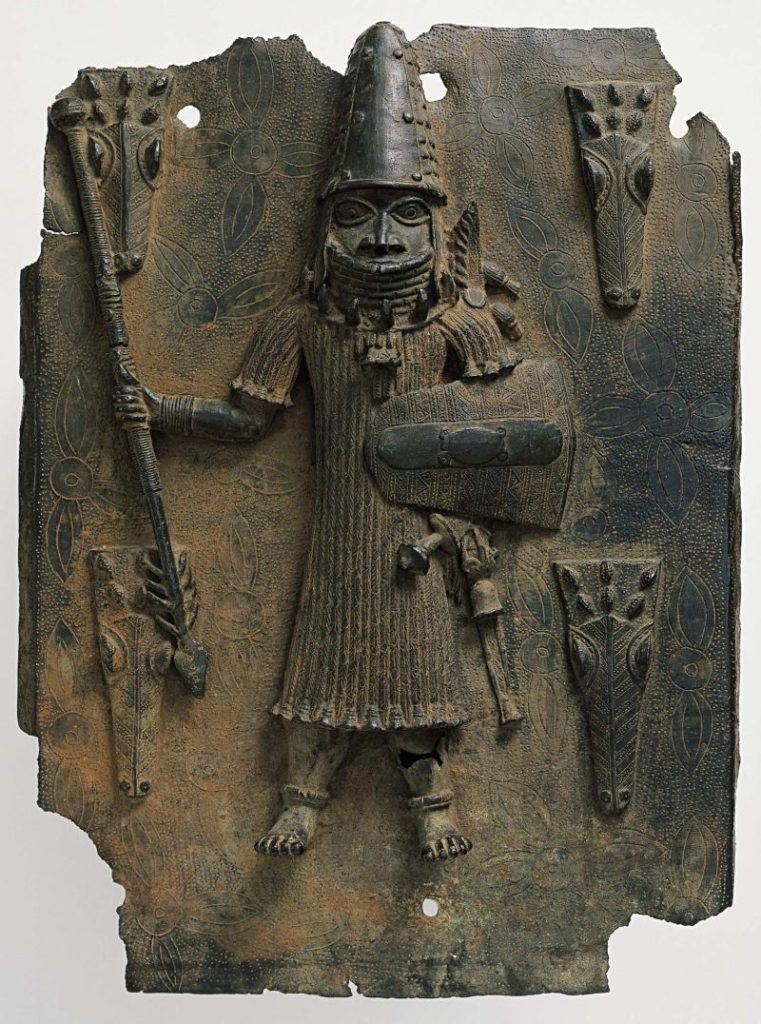
Highlighting their importance, Nigerian experts Kokunre Agbontaen-Eghafona, Osaisonor Godfrey Ekhator-Obogie, and Patrick Oronsaye, discussing the Benin objects from the Museum Rietberg in Zurich, Switzerland, note that “the brass casters stayed in a special room in the palace to commission and produce work such as an Oba (king) depicted on a plaque. The importance of brass in Benin lies in the belief that “Brass never rusts” (Eronmwon ei-moton).
The commemorative connotation of Benin royal art is inherent in the Edo idiom: Sa-e-y-ama – “To cast a plaque, to make something permanent, to preserve an image.”
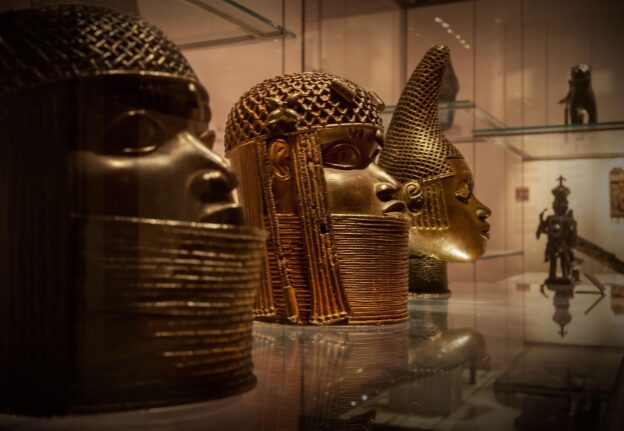
These craftsmen were also known to produce the famous Benin Bronze Heads. These bronze heads symbolized the authority once held by deceased monarchs. They were placed on ancestral altars and displayed during ceremonies held in honor of Benin kings. Within Benin’s belief systems, ancestors remained spiritually connected to the living.
These bronze heads did not necessarily reflect the exact facial likeness of past kings. Instead, they were designed to embody dignity, authority, wisdom, and the continuity of the Benin monarchy.
Source: MuseumRietberg
Even the material itself carried significance. Bronze was valuable, durable, and difficult to produce. Creating such works required technical expertise, patience, and access to resources. The existence of these advanced bronze casting techniques in Benin showcased the people’s technological sophistication in metalworking and foundry arts.
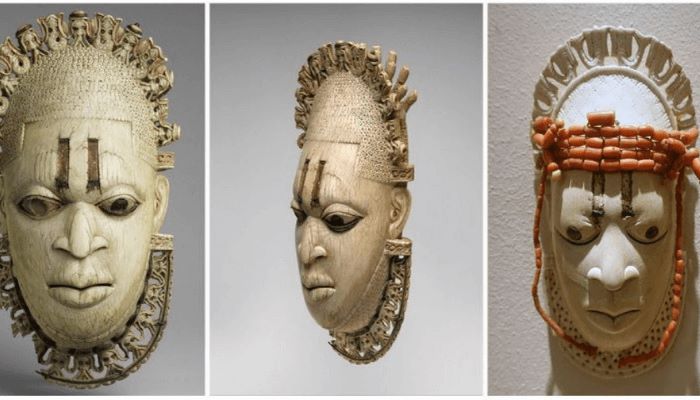
Every detail was carefully considered, from the symmetry of the face to the intricate coral bead regalia often depicted around the neck and crown.
Those coral beads, also known as Ivie (the high-value coral worn by Benin Kings), were far from decorative accidents. In Benin tradition, coral beads symbolized wealth, prestige, and royal authority. They were deeply associated with the Oba and the royal palace. To wear them was to carry visible evidence of status and sacred kingship.
In describing their value, Oreoritse Tariemi, in a publication by Guardian Life Newspaper, noted that “Ivie is considered the most important type of coral bead in the Benin culture, worn only by Benin Obas and Chiefs. This precious coral can be polished to bring out its beautiful red rose or pink colour. On the other hand, Ekan (coral bead of lesser value) resembles stone and is greyish.
While the Oba of Benin controls the use of Ivie beads, certain shapes and patterns are reserved for members of the ruling group and cannot be worn by other members of the tribe. The weight of corals in the royal regalia signifies dominance. And some rare jewellery, regalia and accessories are reserved for special ceremonies and festivals, and cannot be worn for mere public appearances.”
That is why, to this day, Benin kings continue to appear in the same regal fashion.
Plunder and Theft
In 1897, British forces launched the Benin Expedition, a violent invasion of the Kingdom of Benin. In a bid to expand commercial influence and strengthen their reach along the West African corridor, the British pressured Oba Ovonramwen in 1892 into signing what many historians regard as an illegitimate treaty of protection.
When resistance to British demands persisted, colonial officials set out for the ancient Benin Kingdom to persuade or compel the reigning monarch to comply. Upon receiving news of the intended visit, the Oba instructed them to postpone their mission due to the sacred Igue festival, and they ignored that directive.
The visiting party was subsequently ambushed, and several British officials, alongside members of their entourage, were killed in the process. In response, Britain dispatched troops on what it described as a punitive expedition against the Benin Kingdom.
While the justification for the expedition was framed as an attempt to depose the Oba and assert British authority, it quickly evolved into a campaign of plunder and destruction as British troops attacked homes, sacred sites, and the royal palace itself.
Source: BusinessDay
Troops ransacked the palace and looted between 3,000 and 5,000 artworks and objects of immense cultural value from the palace compound and across the kingdom. Among the stolen treasures were bronze heads, plaques, ivory carvings, ceremonial objects, and sacred artefacts that carried centuries of Benin history.
Taken to Britain, many of these stolen items were later sold to help offset the costs of the expedition. This explains why, across countries such as the United States, Germany, the United Kingdom, and France, numerous artworks from the ancient Benin Kingdom remain on display in museums and private collections.
For decades, Nigeria and cultural advocates across Africa have continued to push for the return of the Benin Bronzes to their homeland. The debate surrounding restitution has remained active and has become one of the most significant cultural conversations in the world today.
Supporters of restitution argue that these artworks are not merely museum decorations. They are sacred historical objects tied to identity, spirituality, heritage, and the history of the civilization from which they were taken. Removing them from their original context stripped communities of an important part of their cultural memory.
On the other hand, some Western institutions argued for years that the artifacts were safer in European museums or that they had become part of a global heritage accessible to international audiences. Others raised legal and logistical concerns surrounding ownership and preservation.
Several Western nations, including Germany, have made conscious efforts to repatriate some of these items back to Nigeria, while universities and museums in the United States and the United Kingdom have also initiated repatriation efforts. Yet the process remains slow, as thousands of Benin artifacts are still scattered across museums and private collections worldwide.
While conversations around restitution continue, the Benin Bronze Head has gradually earned recognition as one of the finest artworks ever produced in Africa. Art historians have praised its realism, technical brilliance, and cultural depth, while museums worldwide proudly display it as a global masterpiece.
Yet, beyond the admiration lies a lingering truth: the people from whom it was taken still long for its return to its rightful home.

Okechukwu Nzeribe works with the Onitsha Chamber of Commerce, in Anambra State, Nigeria, and loves unveiling the richness of African cultures. okechukwu.onicima@gmail.com