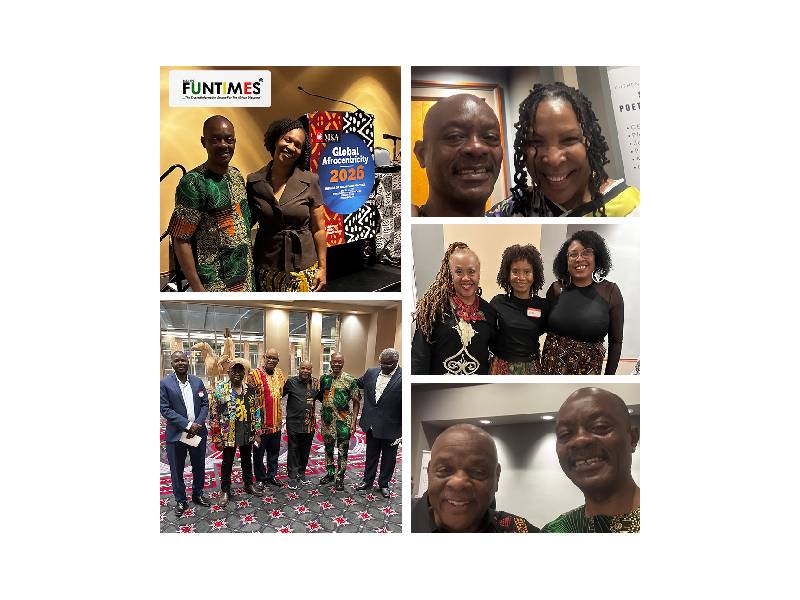
Photo caption: FunTimes Collage clockwise: Dr. Eric Nzeribe and Dr. Donnetrice Allison; Dr. Eric Nzeribe and Dr. Ayo Sekai; Omilade Janine Bell, Ana Yenenga and Dr. Yesenia Escobar; Dr. Molefi Keke Asante and Dr. Eric Nzeribe; Drs, Hadi, Eric, Asante, Tanutamon, Steiner, and Tugu.
Organized by the foundational architect of Afrocentric theory, Professor Molefi Kete Asante, Chair of the Department of Africology at Temple University and founder of the Molefi Kete Asante (MKA) Institute, the gathering at the Pennsylvania Convention Center for the Global Afrocentricity Workshop and Symposium radiated an intense, focused energy. The auditorium held an assembly of continental and diasporic African academics who gathered to execute a rigorous, unsparing audit of global Black education. Some of the sharpest evaluations targeted Historically Black Colleges and Universities (HBCUs) – the premier institutions of Black intellect. And the case is, if HBCUs’ education teaches them only to navigate Eurocentric spaces without challenging their core logic, they remain untethered.
Presenting this systemic introspection was Dr. Jelani Ghana, whose ancestral ties to Cheyney University, the oldest institution of its kind, gave his insights the authority of a dedicated insider. The core question was; are these historic institutions actively operating within an authentic African identity, or have they compromised their foundations?
The Sovereign Fortress on Shifting Foundations
Consider a historic stone fortress, constructed by survivors of a generational storm to serve as a sovereign laboratory of the mind. It was designed to cultivate liberation away from the oversight of oppressors. For generations, this sanctuary stood firm.
Over time, however, a quiet remodeling has occurred. While the outer walls still bear ancestral crests, the internal foundation has been systematically replaced with foreign stone. The sanctuary risks becoming a sentimental venue -structurally beautiful yet training its occupants to serve an ecosystem that does not belong to them. This is the crisis facing the modern HBCU: celebrating the occupancy of the space while surrendering the sovereignty of the ground.
The Illusion of Assimilation
The first component of this institutional audit addresses the contemporary obsession with assimilation metrics. Institutions frequently emphasize rising enrollment numbers, corporate partnerships, and corporate alumni as validation of success.
Yet, this celebration hides a profound paradox. Graduates achieve individual accolades while losing institutional ground. The system produces skilled professionals but fails to anchor their consciousness.
“They are coming out with degrees, but they are like a piece of paper in the whirlwind of white supremacy. They are getting blown all over the place.” –Dr. Jelani Ghana
An education must prepare a student to master the whirlwind, not merely survive it. When an HBCU functions primarily as a finishing school for external corporations, it sends its brightest minds into the world unprotected. A student can graduate with highest honors, enter a corporate boardroom, and remain an intellectual transient. Proximity to power is not power. True sovereignty means controlling, sustaining, and defending our own spaces.
Intellectual Amnesia
This reality exposes the second framework: the Eurocentric alignment within our own institutions. Scholars at the symposium asked why our classrooms continue to center the worldviews of historical oppressors.
The disconnect is profound. Students walk across historic campuses vibrant with Black culture, yet enter classrooms where that identity is marginalized. Students graduate with degrees in psychology, business, or political science while remaining illiterate in foundational Black thought.
- Universities offer courses in Western languages but omit indigenous African languages such as Twi, Yoruba, or Swahili.
- Students earn psychology degrees without ever analyzing the work of the Black Psychology Association, Dr. Na’im Akbar, or Dr. Frances Cress Welsing.
- While Predominantly White Institutions (PWIs) expand their departments of Africology -as pioneered by Temple University- our own institutions frequently underfund the fields meant to protect African cultural intellectual heritage.
If the classroom functions merely as a replica of a Eurocentric university, it ceases to be a sanctuary. It becomes an engine of assimilation.
The Sovereignty of Mind
Reclaiming the space requires a return to our original design. The blueprint exists within the history of the Philadelphia region. When Cheyney University was established in 1837, it was not built to copy Eurocentric academies. It was explicitly founded as The African Institute.
The founders understood that education stripped of an African mindset results in sophisticated compliance. The original architecture was designed to stand as an immovable fortress against assimilation.
To reclaim this fortress, our universities must move beyond the metric of mere survival. We must demand absolute psychological sovereignty. Before any student receives a diploma from a Black space, they must be securely anchored in an Afrocentric consciousness. They must control their narratives and recognize that their genius belongs to their community, not to the global marketplace.
Rebuilding the Fortress
The Global Afrocentricity Symposium at the Pennsylvania Convention Center delivers an inescapable mandate. The next generation of global genius is currently walking our campuses. We cannot afford to let them merely pass through the system. We must cease seeking validation from structures that historically sought our containment. It is time to rebuild the fortress.
Join the Conversation
This is an essential internal dialogue. Your input is required to shape this blueprint.
What is the primary objective of an HBCU in the twenty-first century?
- To operate as a pipeline for corporate placement and social mobility within mainstream society.
- To serve as a sovereign, African-centered laboratory of the mind, prioritizing cultural identity and intellectual independence.
- A complete, uncompromised synthesis of both frameworks.
State your position in the comments below, share this article, and let us anchor our future.

Dr. Eric John Nzeribe is the Publisher of FunTimes Magazine and has a demonstrated history of working in the publishing industry since 1992. His interests include using data to understand and solve social issues, narrative stories, digital marketing, community engagement, and online/print journalism features. Dr. Nzeribe is a social media and communication professional with certificates in Digital Media for Social Impact from the University of Pennsylvania, Digital Strategies for Business: Leading the Next-Generation Enterprise from Columbia University, and a Master of Science (MS) in Publication Management from Drexel University and a Doctorate in Business Administration from Temple University.