
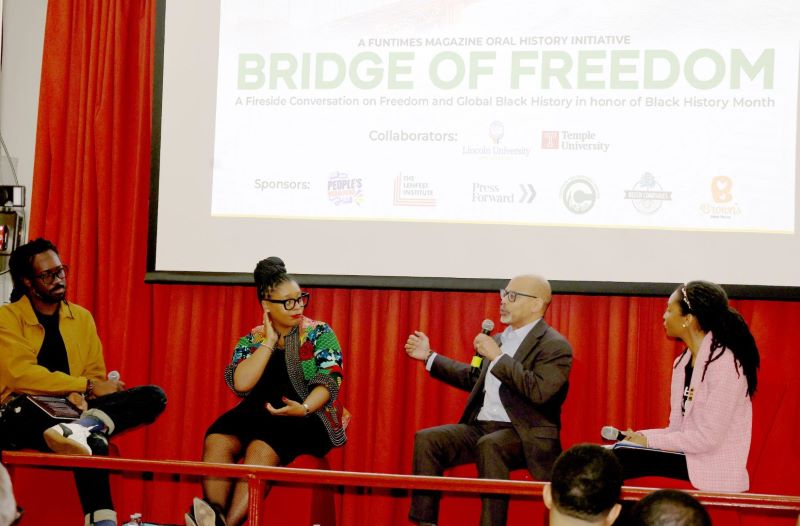
On February 19th, the sanctuary of Mother Bethel AME Church felt less like a venue and more like a living room. One large enough to hold generations.
Hosted by FunTimes Magazine, the Fireside Conversation marked the launch of the Bridge of Freedom Oral History Initiative, in collaboration with Lincoln University and Temple University. As the United States approaches its 250th anniversary, the initiative seeks to document the untold stories of African and Caribbean co-leadership in the U.S. Civil Rights Movement, histories that have shaped this country but are too often footnotes in its official narrative.
Dr. Jack Drummond, the evening’s violinist, opened the program with a tender, stirring performance, setting a tone of warmth and reverence. Vendors lined the sanctuary walls, greeting guests and sharing resources, friends paused to embrace. Laughter interrupted formalities, photos were taken, not staged, but joyful. People were genuinely happy to see one another.
Dr. Eric Nzeribe, the host and publisher of FunTimes Magazine, in his welcome address, reminded the audience that FunTimes Magazine’s mission has always been to inform and connect the diaspora. He emphasized that as America reflects on 250 years, any celebration of democracy must include the full scope of who built, defended, and expanded it. “We are still creating history right now,” he said. “And we have a responsibility to capture it.”
The Moderator, Mikhael Simmonds, who traveled from Trinidad for the event, gently pushed the room beyond familiar narratives. His diasporic lens framed the night with depth and intention. “What stories do we tell each other that tie us together through joy, not just pain?” he asked. He reminded us that 100 years ago, there was Black History Week. Fifty years ago, Black History Month. “What does this moment require of us?” he continued. “Storytelling has the power to heal. How has it helped us come together?”
His questions shifted the tone from commemoration to responsibility.
At the center of the conversations were Dr. Tiffany Pennamon, an Assistant Professor of African American Literature at Lincoln University, whose work explores the intersections of African American and African Diasporic art and Black liberation, Prof. David W. Brown, an Associate Professor and Assistant Dean for Community and Communication at the Klein College of Media and Communication at Temple University, and Rev. Carolyn C. Cavaness, First Female Pastor of Mother Bethel A.M.E. Church in Philadelphia.
The Work of Preservation
Prof. David W. Brown brought both academic insight and pastoral grounding to the conversation. As a scholar of communication and a pastor, he spoke about freedom as something embodied.
“As a Black man,” he shared, “I cannot walk into any space without knowing that someone might question whether I belong. But I have learned that sometimes freedom is simply showing up and saying I do.”
He also spoke about the responsibility of modeling freedom for the next generation. “If we limit ourselves internally,” Brown said, “we don’t need cages. We create them ourselves.” His words were instructional.
He further added another layer about preservation: “We fight to hold onto buildings and landmarks, and we should. But we also have to hold onto the stories. Because if the story disappears, the structure becomes empty.”
Faith, History, and Holding On
Rev. Carolyn C. Cavaness spoke with the clarity of someone shepherding both a congregation and a legacy. Standing in the very church founded in 1794 by Richard Allen, she reflected on what it means to protect sacred history. “Sometimes it’s not the thing itself that is important,” she said. “It’s the story behind it.”
She spoke of communion tables, walking sticks, framed programs, and objects that hold spiritual and communal memory. “If we lose the story,” she continued, “we lose the testimony.”
Mother Bethel exists because Allen, alongside Absalom Jones, refused to accept segregation in worship. The church is not simply historic; it is a cornerstone of the Black diaspora’s spiritual autonomy. Rev. Cavaness reminded the audience that preservation requires vigilance, legal protection, financial investment, and intergenerational stewardship.

Archives as Living Memory
Dr. Tiffany Pennamon, on the other hand, grounded the discussion in archival practice. Her scholarship centers on Black literature, memory, and diaspora studies, and she emphasized that archives are not confined to university basements.
“Our first archive is often our grandmother’s living room,” she said. Photographs on walls. Names handwritten inside a Bible. Letters tucked into drawers. She encouraged attendees to document intentionally by writing dates on the backs of photographs, preserving voice notes, and consciously deciding where their histories will live.
“We are building our archives in real time,” Dr. Pennamon explained. “And we cannot leave the next generation with silence.”
She also spoke about the Lincoln University archives and the historic relationship between HBCUs and Black churches, institutions that have long stood side by side as intellectual and spiritual anchors of Black life.
Community Questions, Community Wisdom
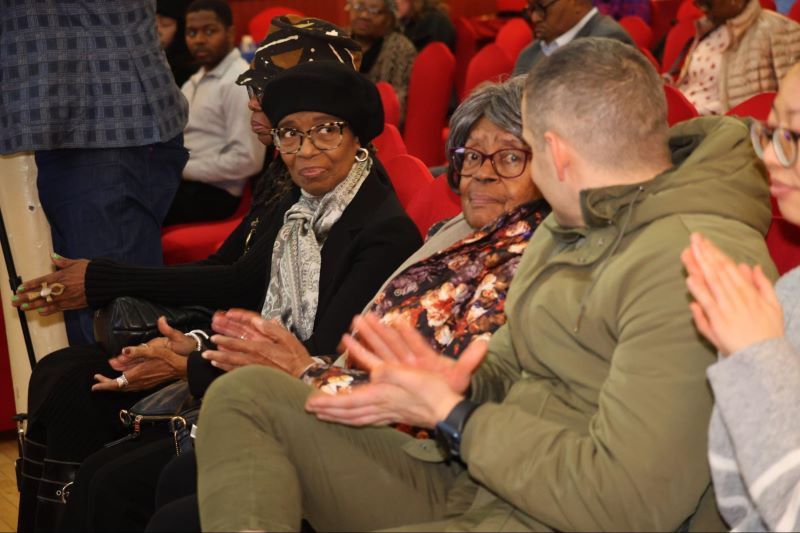
The audience deepened the evening with thoughtful questions. Questions like how someone who grew up in foster care, automatically disconnected from their biological family history, can bridge the gap of freedom. The panel acknowledged that when personal lineage is fragmented, communal institutions, churches, archives, and museums can hold memory on behalf of the collective.
Another question addressed the use of augmented and virtual reality to preserve history, while avoiding the use of artificial intelligence tools that might distort the truth. The panel agreed: technology must serve preservation, not manipulation.
Other questions about how to ensure youth understand that Black history extends far beyond slavery, got a unified response: tell fuller stories, stories of invention, scholarship, governance, migration, artistry, theology, and global leadership.
Philadelphia is home to several institutions committed to that fuller narrative, including the African American Museum in Philadelphia, the Johnson House Historic Site, the Paul Robeson House & Museum, Mother Bethel’s own museum and archives, and the archival collections at Lincoln University. These spaces preserve brilliance alongside struggle.
Partnership in Practice
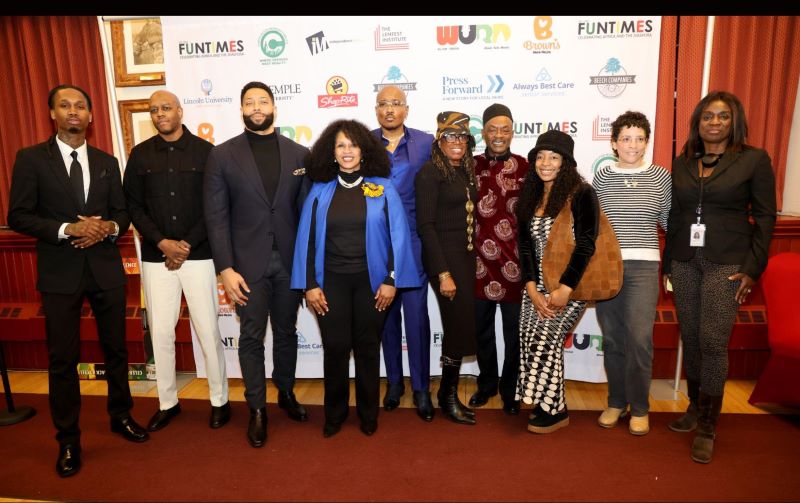
The evening reflected collective investment. Support from The Lenfest Institute for Journalism, Lincoln University, Temple University, Mother Bethel AME, Brown’s Chef’s Market, The People’s Media Fund, Campaign for Working Families, Press Forward, Beech Companies, National Association of Black Journalists, Philadelphia Chapter, The Department of Behavioral Health & Intellectual Disability Services, Association of Black Social Workers, Delaware Valley Association of Black Psychologists, Optimist Coffee Traders, United Negro College Fund, WURD, and North Philly Black Freedom Jawn underscored that preservation requires resources, relationships, and shared responsibility.
After the formal discussion, guests made their way into the fellowship hall, where the walls are lined with portraits of every pastor who has led Mother Bethel. From Rev. Richard Allen to Rev. Cavaness today.
As the evening closed, what remained was an affirmation. Freedom is not a static date in 1776. It is the decision to document your grandmother’s handwriting. It is the courage to walk into rooms that were not built for you. It is the discipline to protect institutions with legal foresight and collective funding. It is the understanding that sometimes the object is small, but the story it carries is enormous.
Through the Bridge of Freedom Oral History Initiative, FunTimes Magazine is ensuring that as America reflects on 250 years, the diaspora’s voice is not an afterthought. It is central. And inside Mother Bethel that night, beneath violin strings and ancestral portraits, the past and future met in motion.

Diamond Jones joined the FunTimes family as an intern while earning her Bachelor’s degree from Temple University. After graduating in 2018, Diamond decided to stay with FunTimes continuing her role as a writer and content creator for social media. In addition to writing, she also enjoys reading, traveling, and art. Working at a magazine has always been a dream. As a child, she would collect and study popular entertainment publications such as Word Up and Teen Vogue. Diamond hopes to continue to create content that will inspire and entertain.


This piece is interesting and well written and edited. Congratulations!