
Still from Within Our Gates (1920), Public Domain
The world of cinema has always remained a vehicle where stories and narratives are not only told but also instrumental in shaping opinions and educating the uninformed about societies, and cultures.
Perhaps one of cinema’s biggest triumphs is in providing a platform where Black artists can address the many misconceptions about their histories that have been fuelled by slavery and colonialism.
Movies like Amistad (1997), 12 Years a Slave (2013), Glory (1989), and Roots (1977) all tell a poignant story about the struggle of Black people against slavery and their quest for freedom. More importantly, as the movie industry began to take shape, producers of Black origin began to leverage its popularity to put out stories that questioned stereotypes and challenged the ills of racism.
Some of the movies they produced were not only unsettling for many of their non-Black viewers, but they also caught the ire of censorship boards for being produced outside the movie industry. This led to several of them being censored and over time, parts of these movies were partially or entirely lost.
While many might argue over the relevance of these movies especially for the messages they portrayed, some still believe that perhaps a great disservice has been done to viewers who should have been left to form their own opinions.
Movies Lost/Banned
One of such movies that was lost was the 1920 film “Within Our Gates” produced by Oscar Micheaux. The movie, which was in response to the 1915 production of “The Birth of a Nation”, a film rightfully deserving condemnation, provided a worrying description of African Americans as unintelligent and sexually motivated to exploit White women. The movie attempted to elevate White supremacy through the depiction of the Ku Klux Klan (KKK) (a White supremacist hate group) as saviours of White women and the White race.
Many of the Black characters in the Birth of a Nation movie were played by White actors wearing Black face paint. Oscar Micheaux’s “Within Our Gates” would respond by showing the struggles of Black lives in the United States while also bringing to the fore the brutality of Whites in post slavery America.
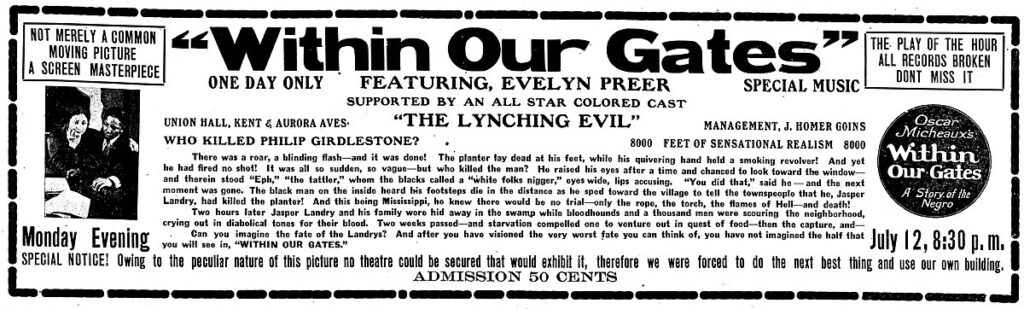
Newspaper advertisement for Within Our Gates, 1920. Micheaux Book & Film Company, Public domain, via Wikimedia Commons
The film highlights the racial struggle of Blacks and their migration during the Jim Crow years. It follows the story of Sylvia Landry, a young mixed-race woman, who faced betrayal, loss in her journey. After failed romance and family treachery in the North, she returns South where she meets Rev Jacobs, a minister running a school for Black children. Due to a lack of funds, and the school struggling, Sylvia offers to head back North in an attempt to raise funds to support the school.
She would later meet philanthropist Elena Warwick, who donated $50,000 to save the school, and Dr Vivian whom she would come to fall in love with. Torn between Rev. Jacobs and Dr. Vivian, Sylvia chooses the latter.
Threatened by her criminal cousin Larry, she flees North. Flashbacks from her past emerge where her adoptive parents were lynched, her family destroyed, under the wrongful accusation of her father murdering Philip Gridlestone. To escape being lynched by a White mob, Sylvia would come face to face with Philip’s brother, Armand Gridlestone who tried to rape her discovering a scar on her breast which led him to realize that she was his mixed-race daughter who was born to his marriage to a local Black woman.
The movie “Within Our Gates” was one of Oscar Micheaux’s groundbreaking productions. It was rejected by the Board of Censors in 1919 when Oscar attempted to submit the film. Over time large portions of this movie would be lost with four of the original parts (Intertitles) surviving.
Another one of Oscar Micheaux’s movies that was lost was the 1919 Black and White film “The Homesteader”. The story follows an African American homesteader Jean Baptiste who falls in love with Agnes whom he presumes to be White because she is the daughter of Jack Stewart a White Scotsman who had come the way of Jean.
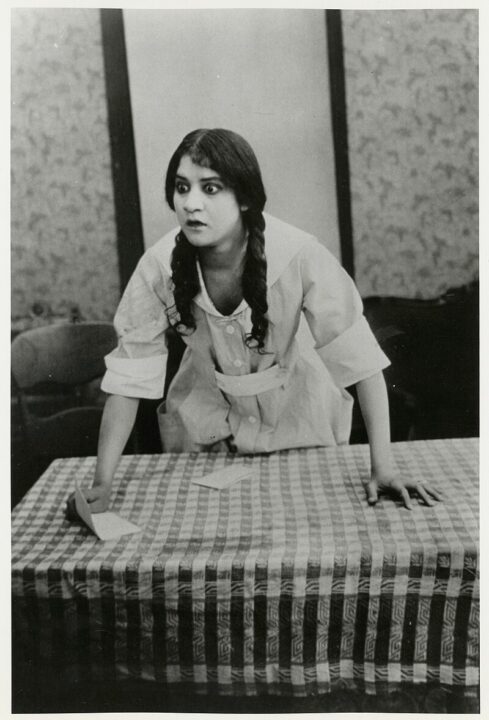
Evelyn Preer as Orlean in The Homesteader From The New York Public Library, Public domain, via Wikimedia Commons
Due to the existing laws banning intermarriage between persons of different races, Jean is left with no choice but to find love among his people and ends up marrying Orlean, the daughter of a vain, deceitful, and hypocritical preacher McCarthy.
Fuelled by his daughter’s choice of husband, McCarthy extended praises towards Jean in hopes that the Homesteader would extend the same towards him. Unknown to Jean, McCarthy craved the adulation of people. This seeming nature of Jean not to reciprocate in contrived praises did not sit well with McCarthy.
Having realised the disposition of Jean, McCarthy along with the support of his other daughter Ethel would go on to persecute Jean and cause him great pain. Orlean, driven mad by guilt, ultimately rights a wrong that frees Baptiste. Returning to his land, he reunites with Agnes, later discovering her true racial identity, allowing their love to finally find fulfillment.
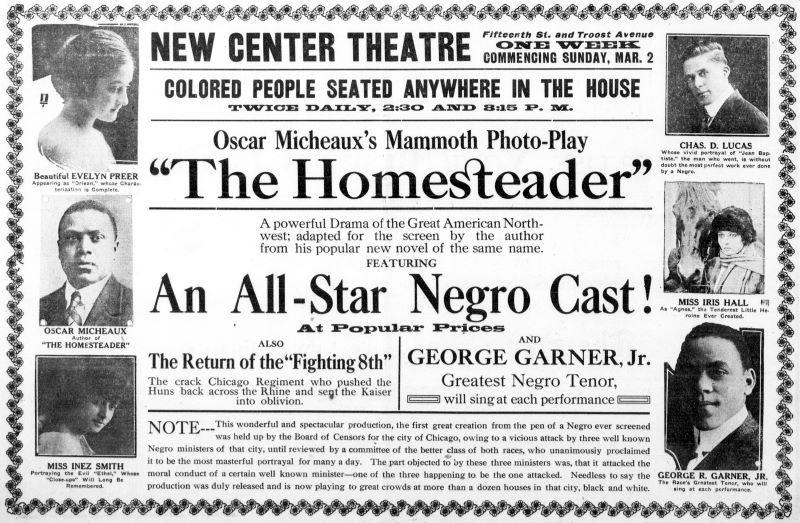
Newspaper advertisement for The Homesteader (1919)
Micheaux Book & Film Company, Public domain, via Wikimedia Commons
Evolution of The Movie Industry
As Hollywood has evolved over the years, attention to movie production has gone beyond the single purview of a censorship board. In the United States, film censorship is done by industry experts rather than a government-appointed censorship board.
In modern-day Hollywood, movies are not banned though efforts were made to censor and control content that was shown on screen. Associations such as the Motion Picture Association of America (MPAA)’s Classification and Rating Administration (CARA) provide ratings such as G, PG, PG-13, and R as a guide for audiences to choose movies that they would like to see.
Beyond these associations, many other groups like Rotten Tomatoes, National Society of Film Critics, Alliance of Women Film Journalists (AWFJ), IndieWire, among many other groups provide reviews on various movies. While many of their ratings can have an impact on the movie’s debut in cinemas, the ultimate decision still resides with the public.
This in turn has helped Black films that have been viewed as controversial such as Shaft (1971), BlackkKlansman (2018) among others continue to survive controversy and enjoy viewership from members of the public willing to see such movies with an open mind.

Okechukwu Nzeribe works with the Onitsha Chamber of Commerce, in Anambra State, Nigeria, and loves unveiling the richness of African cultures. okechukwu.onicima@gmail.com