Source: FunTimes Magazine
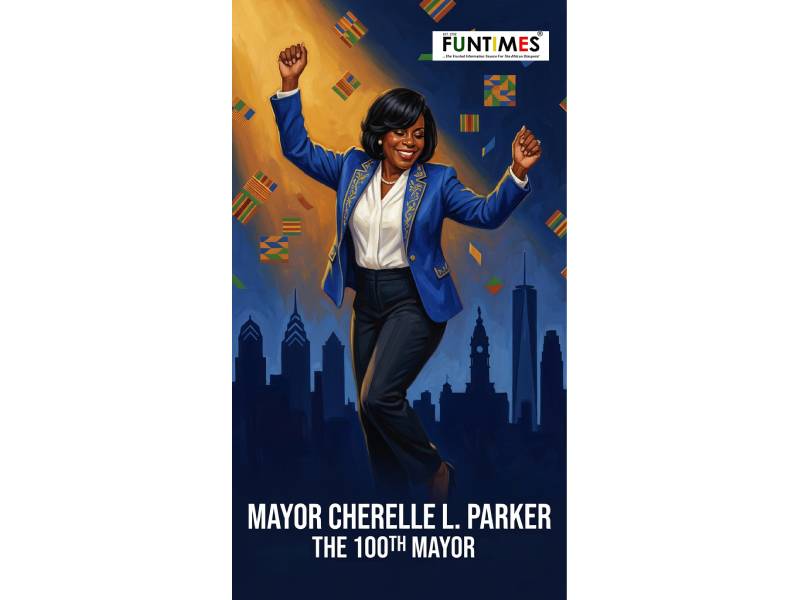
Mayor Cherelle L. Parker dances. She does not do so as a gimmick; she does so as a signal. Whether at the Odunde Festival, the Super Bowl send-off, or the grand opening of Level Up Records, her public joy is the posture of a city that finally understands its own worth.
As we move through March 2026, the world has officially arrived at our doorstep. The Wall Street Journal and the New York Times have validated what the African Diaspora has known for generations: Philadelphia is the premier global destination of 2026. But for FunTimes readers, this is a tourism boom and a reclamation of the very narrative of “Becoming America”.
Becoming America: The Philadelphia Story
As the nation prepares for its 250th anniversary, the “Becoming America – Philadelphia Story” serves as our intellectual and cultural anchor. This is not merely a birthday party for a document signed in 1776; it is an examination of how a global metropolis was forged through migration, resistance, and the persistent pursuit of equity.
The Penn Press has highlighted this evolution in a landmark three-volume series that spans from the Indigenous Lenape roots to the modern waves of Caribbean and African immigration.
This narrative asserts that Philadelphia’s significance was not “discovered” because 250 years have passed. It was built daily in the crowded slave cabins, the bustling markets, and the first African Methodist Episcopal (AME) congregation established in 1794.
Our story is the “Philadelphia Story”, one of bold innovations that gave the world its first abolitionist society and the first degree-granting HBCU, Lincoln University. We are the hosts of this global season because we are the primary architects of the city’s soul.
Philadelphia has hosted major events before. However, 2026 stands apart as national, global, and civic moments converge over a few transformative months.
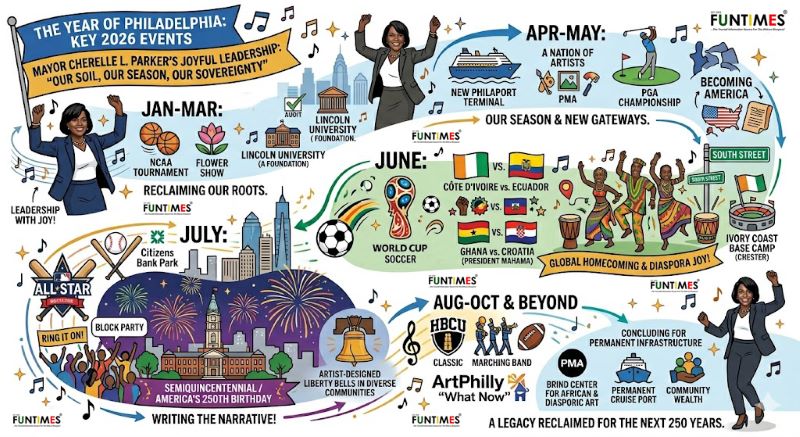
World Cup in Philadelphia: The FIFA World Cup will be held from June 14 to July 4, 2026. Philadelphia will host six matches during this period, including a knockout fixture on July 4, according to both FIFA and the local host committee.
MLB All-Star Week: The Philly’s All-Star information page places events across Citizens Bank Park and the Pennsylvania Convention Center from July 11-14.
PGA Championship: Scheduled from May 11 to May 17, 2026, at Aronimink Golf Club, as confirmed by the PGA Championship.
Cruises departing from Philadelphia (starting April 16). Norwegian Cruise Line’s announcement and PhilaPort’s release confirm that this homeport activity begins on that date.
America 250, locally funded. City Controller reporting describes nearly $120 million in Philadelphia’s FY2026 budget across funds tied to 250th-related spending categories.
On paper, this is a civic victory: visitors, energy, media attention, and spending. The question is how much of that wave gets converted into durable value for neighborhoods, and how much stays concentrated in the usual places.
The part that predates 2026
A 250th anniversary year can tempt a simplistic story: Philadelphia as “birthplace,” 1776 as the start line, Independence Hall as the center of gravity.
That story leaves out the communities that built Philadelphia’s civic muscle and moral arguments long before 2026 arrived.
Philadelphia’s Black institutional history is structural:
- The Free African Society was founded in 1787 by Richard Allen and Absalom Jones as a mutual aid society serving Philadelphia’s free Black community.
- Mother Bethel AME, founded in 1794, stands as a core site in the city’s Black religious and organizing history, and is widely cited as the oldest AME congregation in the nation.
- Lincoln University was chartered in 1854 and is widely cited as the nation’s first degree-granting HBCU.
That lineage matters because it reframes 2026: the city is not being introduced to history. The city is being re-examined in public.
Courtesy: FunTimes
June 14: the day the whole thesis becomes visible
If one date captures the Year of Philadelphia, it is Sunday, June 14, 2026.
ODUNDE’s official schedule lists Festival Day as June 14, 2026, following a week of programming. FIFA’s Philadelphia host-city coverage ties Philadelphia’s World Cup run to match activity beginning June 14.
An iconic African and African American cultural gathering will coincide with a global sports audience arriving to watch international football. This is no coincidence. It is what happens when a city with longstanding diaspora communities becomes a global stage.
The overlap goes further. The Philadelphia Union and the local host committee announced that Côte d’Ivoire selected Subaru Park and the adjacent sports complex in Chester as its official Team Base Camp training site, with group matches in Philadelphia.
That selection changes the story from “Philadelphia hosts games” to “Philadelphia hosts a living presence.” Training, lodging, local movement, fan energy, and media follow. The opportunity is obvious. The responsibility is also clear: diaspora communities should be treated as hosts, not as a background color.
Ring It On, and what “neighborhood inclusion” actually means.
City messaging for 2026 emphasizes celebration that reaches beyond the historic district. The mechanism matters more than the slogan.
The FY2026 budget discussion around 250th-related spending is substantial. Controller reporting cites nearly $120 million across city funds, with breakdowns by category including public safety and special events.
The city also lists specific neighborhood-facing programs. One example: the “Block Party Bonanza,” where 250 block party applicants will receive “Life, Liberty, and Happiness” kits designed to spark local celebrations.
Another example: “Bells Across PA,” where Philadelphia announced 20 replica Liberty Bells painted by local artists in partnership with Mural Arts, designed to highlight neighborhood histories and cultures.
These are real levers, not because they solve everything, but because they create measurable questions:
- Which commercial corridors receive foot traffic support that lasts beyond a weekend?
- Which immigrant- and Black-owned businesses receive vendor access and promotional lift during peak moments?
- Which neighborhoods become part of the official visitor map, and which remain invisible?
- Which stories get told in the “America 250” frame, and whose history gets treated as decoration?
A Year of Philadelphia series earns its credibility by consistently tracking those questions.
A new travel gateway: cruises from Philly
There is another shift hiding in plain sight: the return of meaningful cruise homeport operations from Philadelphia.
Norwegian Cruise Line’s 2024 announcement describes Philadelphia as a new homeport with voyages beginning April 16, 2026.
PhilaPort’s release adds detail on homeport timing and the ship operating from Philadelphia.
For readers, this becomes service journalism gold: parking, hotels, transportation, and what to know about embarkation days.
For the city, it is a structural shift in tourism. A traveler who starts in Philadelphia often books a hotel night, eats out, and moves through neighborhoods before departure. That is another place where neighborhood benefits can be planned or missed.
What remains after the fireworks
Every city that hosts major events learns the same lesson: the crowds leave quickly. What remains is what was built intentionally.
Some of the “legacy” will be physical (public art installations, neighborhood clean-and-green work, operational upgrades). Some will be relational (new cultural networks, repeat visitors, diaspora tourism pathways). Some will be editorial: those who documented the year with accuracy and respect, and those who reduced it to selfies at Independence Hall.
One important correction is worth keeping in view: some cultural infrastructure will come after 2026. For example, the Philadelphia Museum of Art describes the Brind Center’s permanent gallery timing as planned for late 2027.
That is not a weakness. It is a reminder that legacy is multi-year.
The FunTimes coverage promise
This first feature sets the frame. The reporting series should keep returning to one practical idea:
2026 is the Year of Philadelphia. The scoreboard is visitors and headlines. The real outcome is who captures durable benefit.
Upcoming installments can follow that logic:
- A diaspora matchweek guide tied to real corridors and real businesses, anchored around June 14
- ODUNDE week as an economic and cultural ecosystem, not just a festival day
- A “where the money went” audit of 250th-related spending and neighborhood distribution
- A cruise-from-Philly service guide tied to local business opportunities
- All-Star Week and “visitor routing” that moves people beyond the stadium bubble
Mayor Parker’s dancing works as a lead image because it communicates the mood of a city entering a loud year with confidence. The deeper work is making sure that confidence produces shared opportunity, especially for the communities that have been Philadelphia’s constant long before 2026 arrived.

Dr. Eric John Nzeribe is the Publisher of FunTimes Magazine and has a demonstrated history of working in the publishing industry since 1992. His interests include using data to understand and solve social issues, narrative stories, digital marketing, community engagement, and online/print journalism features. Dr. Nzeribe is a social media and communication professional with certificates in Digital Media for Social Impact from the University of Pennsylvania, Digital Strategies for Business: Leading the Next-Generation Enterprise from Columbia University, and a Master of Science (MS) in Publication Management from Drexel University and a Doctorate in Business Administration from Temple University.