
Photo source: Facebook/NFL
Dressed in a billowing white dress, singer Ledisi gave a captivating performance of Lift Every Voice and Sing at the start of the 2025 Super Bowl in New Orleans on Sunday, February 9, making it the fifth year it has featured in the National Football League championship game. She was backed by a choir of 125 New Orleans high school students in yellow robes to celebrate the song’s 125th anniversary.
There was an outburst on social media, with calls to boycott the Super Bowl over the song, which critics have labeled as divisive. The controversy was made worse when it emerged that the NFL was removing its ‘End Racism’ signs from the end zone for the Super Bowl.
Lift Every Voice and Sing, otherwise known as the Black national anthem, has been a flashpoint of conflict, drawing threats and fueling conspiracy theories since it was first used by the NFL in 2020 for pre-season opening games, following the murder of George Floyd by a Minneapolis police officer.
There has been some controversy over the song being called the Black national anthem. Before it was performed at the 2023 Super Bowl, Rep. Lauren Boebert, a Republican from Colorado, tweeted: “America only has ONE NATIONAL ANTHEM. Why is the NFL trying to divide us by playing multiple!? Do football, not wokeness.”
History of the Black National Anthem
Before Beyoncé sang it at Coachella, before the NFL made it a regular part of pre-game ceremonies, and long before its powerful presence in civil rights marches, a group of school children in Jacksonville, Florida, performed Lift Every Voice and Sing for the first time in history. It was sung in celebration of President Abraham Lincoln’s birthday on February 12, 1900.
It was originally written as a poem by American poet James Weldon Johnson in 1900 to commemorate Lincoln’s birthday. He incorporated themes of freedom, suffering, and joy.
It turned into a powerful hymn when it was set to music by his brother, John Rosamond Johnson, in 1905. The song, which speaks to the enduring faith and resilience of Black Americans against racial oppression in the United States, was later adopted by the National Association for the Advancement of Colored People (NAACP) and declared the “Negro National Anthem” in 1919. Today, it’s known as the Black national anthem.
“Lift every voice and sing, Till earth and heaven ring, Ring with the harmonies of Liberty.”
With lyrics that speak of faith and freedom and pay homage to the endurances of our ancestors while looking forward to a future of equality, the hymn gained popularity among Black communities and became a powerful anthem during the Civil Rights Movement in the 1950s and 1960s.
In 2021, Rep. James Clyburn (D-SC) brought some extra attention to Lift Every Voice and Sing. He sponsored a bill proposing that it be designated as the national hymn of the United States.
“My goal is to make a contribution to trying to bring this country back together. I just think that if we were to make this hymn our national hymn, it will help us to really create a climate within which we can find common ground,” he told CNN’s Don Lemon on Silence Is Not an Option.
A Resurgence of the Black National Anthem in the Modern Era
The song has continued to gain popularity over the years, becoming a regular feature at major sporting events like the National Association for Stock Car Auto Racing (NASCAR) and the NFL, where it has been performed as a regular part of the Super Bowl since 2021.
It has been performed by a number of stars and groups, from Alicia Keys to the Tabernacle Choir. It has also been incorporated into various commemorations.
Here are some of the key moments where the Black national anthem has been featured over the years.
In 1985, Al Green and Deniece Williams recorded a version of Lift Every Voice and Sing for Black History Month.
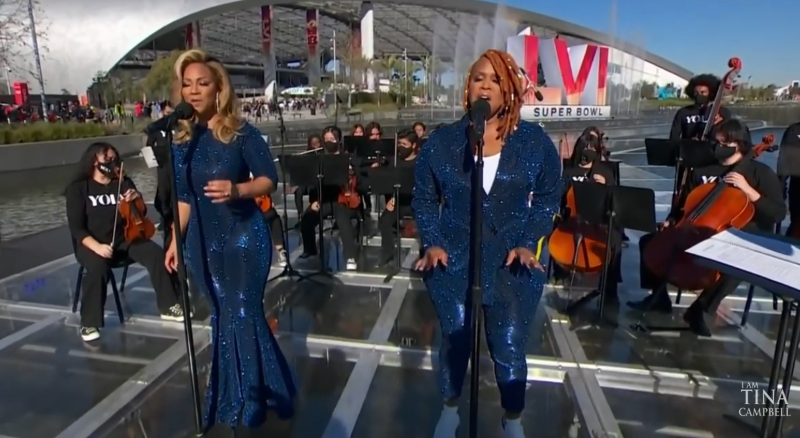
Photo source: YouTube/Tina Campbell
The Queen of Soul, Aretha Franklin, sang the hymn at the Fox Theater. The audience was so moved by the performance that they also joined in from their seats.
Lyrics from the song were incorporated into Barack Obama’s 2009 inauguration ceremony, where civil rights leader Rev. Joseph Lowery included a paraphrased rendition during his benediction.
The Tabernacle Choir performed the song at the NAACP national meeting in 2018.
In 2018, Beyoncé sang it at the Coachella music festival in California, highlighting Black culture to a largely white audience.
Grammy-winning artist John Legend gave a soulful virtual performance of the hymn for the Morehouse School of Medicine 2020 commencement ceremony.
Alicia Keys filmed a beautiful rendition of the song that premiered for the NFL in September 2020.
In 2021, Laurin Talese gave a stirring performance of the hymn on the Orchestra’s digital stage as the Philadelphia Orchestra opened its new season.
In 2022, gospel duo Mary Mary (Tina and Erica Campbell), accompanied by the Youth Orchestra of Los Angeles, performed the hymn at Super Bowl LVI, outside the SoFi Stadium in California.
In 2023, Abbott Elementary star Sheryl Lee Ralph captivated the crowd with her performance of the song at the Super Bowl in State Farm Stadium in Arizona.
In 2024, Andra Day moved millions of viewers around the world with an emotional rendition of the timeless song at Super Bowl LVIII.
In 2025, Ledisi, a Grammy award-winning singer and songwriter, sang the song as part of Super Bowl LIX’s pregame festivities.
Lift Every Voice and Sing has carried generations through struggle, celebration, and transformation. More than a century after James Weldon Johnson wrote it, a lot of things have changed. Slavery has been abolished, Black Americans have the right to vote, attend the same schools, and board the same buses as Whites. However, the fight for equality is far from over, as systemic challenges and racial injustice still exist.
This hymn constantly reminds us that even in the face of these challenges, we can achieve great things, especially when united.
Though it may not have been Johnson’s goal when he wrote the poem 125 years ago, Lift Every Voice and Sing has gone far and wide. What began as a poem for a birthday celebration has grown to become an anthem of hope for not just the Black community, but also marginalized people around the world.
Whenever we hear those lyrics that inspire hope and unity, we are reminded of the journey from oppression to liberation, uniting generations in a shared vision of freedom.