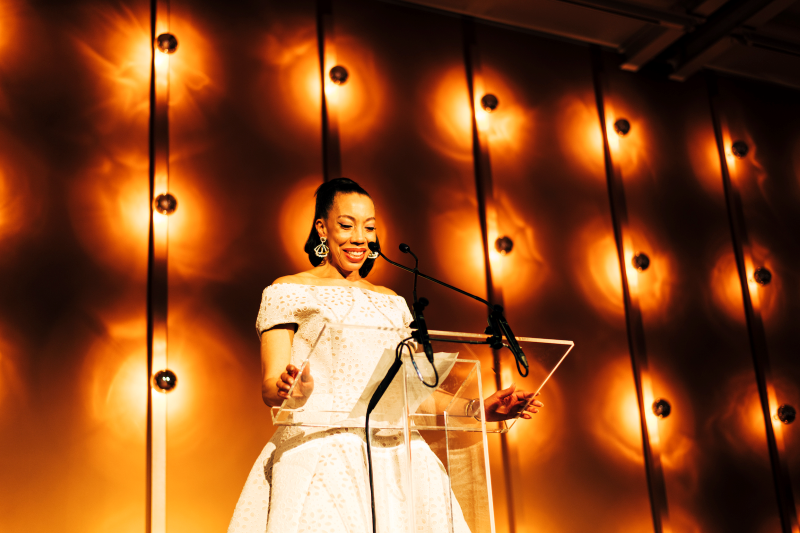
Image: Alyssa Greenberg / Getty Images
Source: Sherald cancels Smithsonian show citing “culture of censorship” – Salon.com
An interpretive survey examining how the American Sublime is resonating with a new generation of Black figurative painters
On a November afternoon in 2024, visitors filed into the fourth floor of the San Francisco Museum of Modern Art to witness something unprecedented: nearly fifty paintings by Amy Sherald, arranged across six thematic galleries, each canvas a meditation on Black American life rendered in her signature palette of gray-toned skin against saturated color fields. The exhibition, American Sublime, would travel to the Whitney Museum the following spring, drawing record crowds before an abrupt institutional crisis forced a reckoning about artistic freedom and representation.
By July 2025, Sherald withdrew the show from its scheduled September opening at the Smithsonian’s National Portrait Gallery. “These concerns led to discussions about removing the work from the exhibition. While no single person is to blame, it’s clear that institutional fear shaped by a broader climate of political hostility toward trans lives played a role,” the statement said. The controversy centered on Trans Forming Liberty (2024), her portrait of a transgender woman holding a torch, which museum officials reportedly considered removing to avoid political backlash. The cancellation reverberated across the art world, raising urgent questions about whose stories get told in America’s most prestigious institutions and whose visual languages might be silenced before they can fully take root.
Yet the formal innovations Sherald has spent two decades refining continue to echo in studios from Lagos to London, Accra to Brooklyn, as a rising cohort of Black figurative painters grapple with similar questions: How do you paint dignity without sentimentality? How do you center Black subjects without reducing them to their racial identity? How do you create what Sherald calls a “resting place” where Black figures can simply exist?
The Architecture of Stillness
Sherald, born in Columbus, Georgia, in 1973, gained international recognition in 2018 when the National Portrait Gallery unveiled her portrait of former First Lady Michelle Obama, a monumental work that positioned Obama in a geometric dress against a soft blue ground, her grayscale skin rendered with the precision of early Renaissance grisaille technique. But American Sublime reveals the depth and range of a practice that extends far beyond celebrity portraiture into more complex terrain: childhood innocence, queer joy, public and private selves, self-possession in the face of historical erasure.
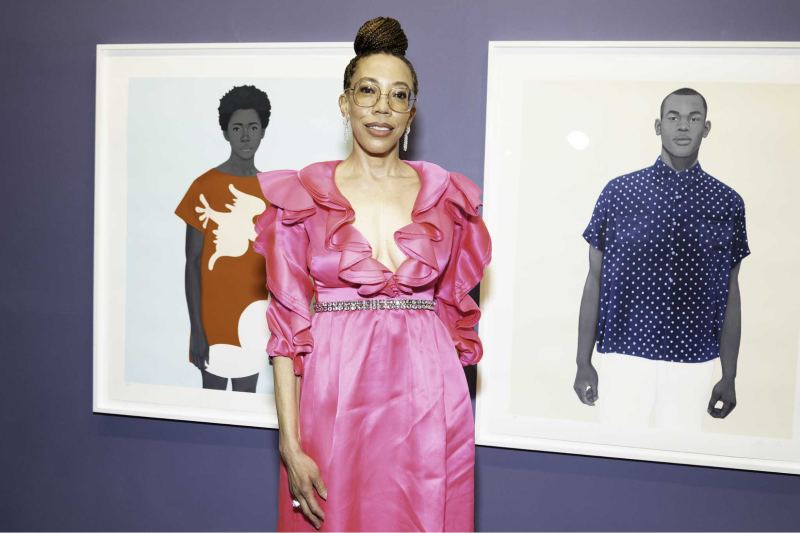
Source: Amy Sherald: American Sublime’ to premiere at SFMOMA
The formal architecture of Sherald’s work operates through careful restraint. She renders skin in mixtures of black and Naples Yellow, creating subtle variations of gray that sit in stark contrast to boldly saturated backgrounds such as cerulean blues, butter yellows, and deep burgundies. This choice, rooted in centuries-old painting techniques, deliberately redirects viewers’ attention away from skin color as the primary marker of identity.
The subjects themselves, ordinary people Sherald encounters on streets or invites to her studio, adopt poses that reference everything from Charles C. Ebbets’s 1932 photograph Lunch atop a Skyscraper to Alfred Eisenstaedt’s famous Times Square kiss. But unlike the dynamic energy of those source images, Sherald’s figures exist in a kind of suspended present tense, their gazes meeting viewers head-on with what curator Sarah Roberts describes as “she’s stagecrafting“. The stillness is strategic.
Painting Subjects, Staging Selves
In As American as Apple Pie (2020), a couple stands before the promise of suburban domesticity: a vintage car, a yellow house, white picket fence. One wears a denim jacket and chinos; the other flaunts a rose-colored skirt and a T-shirt reading “Barbie” is a sartorial collision of masculine and feminine codes, normative and camp aesthetics. The grayscale skin flattens their racial particularity even as their poses and costumes amplify their specificity. They meet the viewer’s gaze with expressions neither confrontational nor submissive, simply present, claiming space.
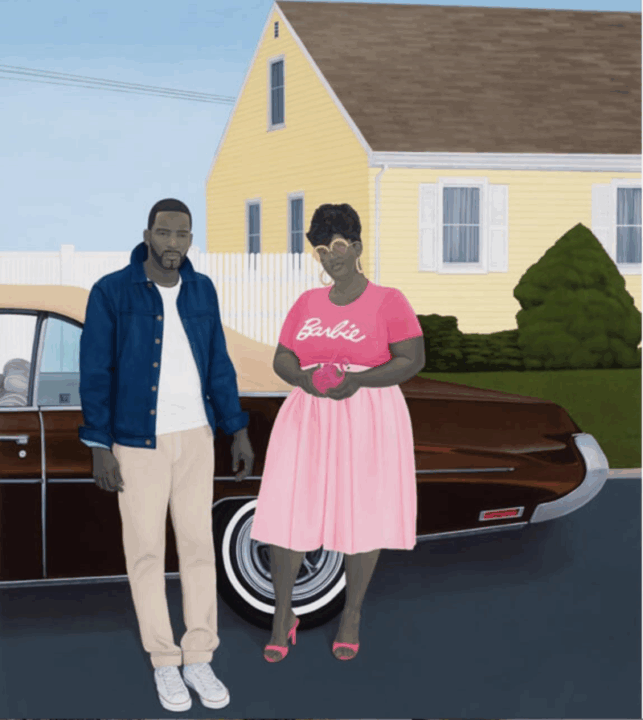
Source: As American as apple pie by Amy Sherald on artnet
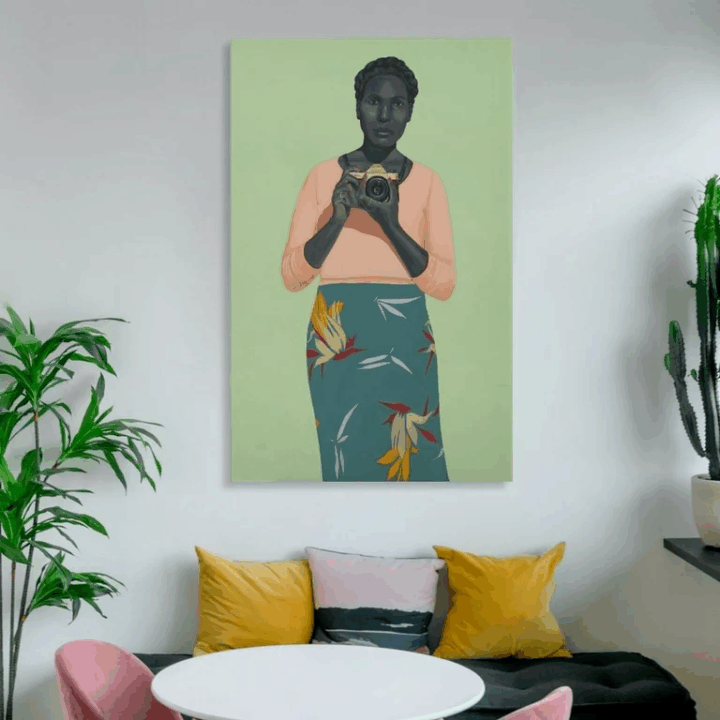
What’s different about Alice is that she has the most incisive way of telling the truth (2017) captures a woman with a shy smile holding a Pentax film camera close to her chest, adjusting the lens with a manicured hand. The title which is long, poetic, and almost conversational, functions as a kind of portraiture itself, assigning interior life and narrative dimension beyond what the painted surface reveals.
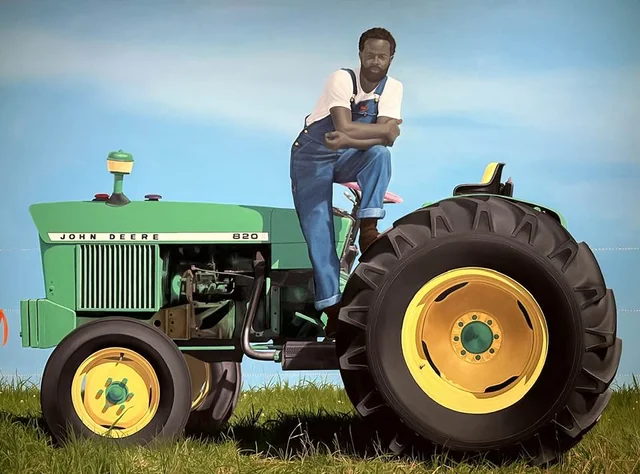
The exhibition’s standout piece, A God Blessed Land (Empire of Dirt) (2022), stretches eight feet by eleven feet. A Black farmer seated on a John Deere tractor, the machine’s yellow wheels rendered with the meticulous precision of Charles Sheeler’s industrial paintings. Here Sherald’s stylization meets documentary realism, the grayscale skin contrasting with the tractor’s brilliant chrome and enamel. The painting connects to American pastoral traditions while interrogating who gets positioned as steward of the land, whose labor counts as sublime.
Source: Reddit
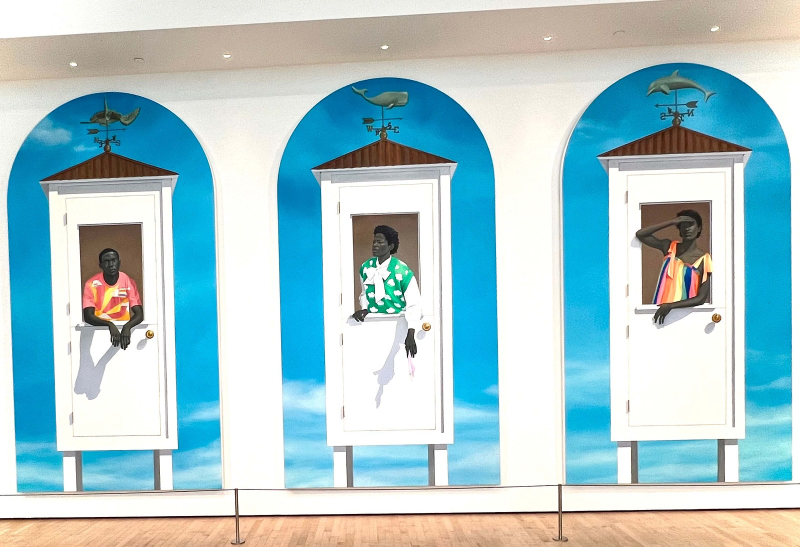
In her first triptych, Ecclesia (The Meeting of Inheritance and Horizons) (2024), Sherald departs from her signature format. Three large panels with rounded tops, each containing a life-sized figure gazing out from a copper-roofed tower, compose a mélange of carefully constructed illusions. The figures look toward something beyond the picture plane, engrossed in something other than and perhaps more profound than intercepting our demanding stares. This refusal of direct address troubles the confrontational intimacy of Sherald’s earlier portraits, suggesting new directions in her evolving visual language.
Institutional Pressure and Atlantic Dialogues
The Smithsonian controversy exposed fault lines that extend beyond one artist or one institution. When Sherald described being told that “internal concerns had been raised” about including her transgender Statue of Liberty portrait, she articulated what many artists working across the African diaspora already know: visibility comes with conditions. Museums and galleries function as gatekeepers, determining which representations of Blackness circulate and under what terms.
The incident recalls broader debates about how African contemporary art navigates global markets. A September 2025 essay in Contemporary titled “Dignity Under Duress” argued that “to be seen on the world stage, it seems that [art from Africa] must be shaped and often distorted by external systems of validation”. The essay called for “building locally grounded, globally engaged, self-sustaining systems of validation” rather than depending on Western institutional approval.
Sherald’s decision to move her exhibition to the Baltimore Museum of Art represented one response to these structural constraints. But the larger question persists: How do visual languages cross borders and oceans when institutional power remains concentrated in New York, London, and Paris? When African galleries and museums struggle for resources while Western institutions extract cultural labor and aesthetic innovation?
Living Language
On opening night at the Whitney in April 2025, Sherald stood before a packed gallery and declared: “We stand here tonight, in defiance of erasure. We stand in the presence of beauty, of history, of ourselves, and we will not be moved”. The statement captured something essential about her project, not just representing Black Americans but insisting on their right to occupy visual space on their own terms, without apology or explanation.
Whether that insistence finds direct echoes in Accra studios or Johannesburg galleries remains to be documented through future scholarship and sustained critical attention. What seems certain is that Sherald has helped articulate a set of formal possibilities, grayscale dignity, sartorial storytelling, and the quiet power of a returned gaze that other painters may adopt, adapt, or resist as they work through their own questions about representation and selfhood. The language she’s developed over two decades belongs now to a broader conversation, one taking place across continents and contexts, in studios where artists ask similar questions about what it means to paint Black life beyond trauma, beyond spectacle, in all its ordinary sublimity.

Anand Subramanian is a freelance photographer and content writer based out of Tamil Nadu, India. Having a background in Engineering always made him curious about life on the other side of the spectrum. He leapt forward towards the Photography life and never looked back. Specializing in Documentary and Portrait photography gave him an up-close and personal view into the complexities of human beings and those experiences helped him branch out from visual to words. Today he is mentoring passionate photographers and writing about the different dimensions of the art world.