
Photo source: Thomas J. Price
She is Black, bold, and beautiful, standing 12 feet tall with hands on her hips and an unapologetic gaze. A bronze statue of a plus-size Black woman in everyday clothes and braided hair in the heart of Times Square has been generating a lot of controversy across social media and newsrooms.
Called “Grounded in the Stars,” the statue is the work of British sculptor Thomas J. Price and was made in partnership with Times Square Arts.
It was on view from April 29 to June 14, 2025, on the Broadway plaza between 46th and 47th Streets.
Who is the Black Woman Depicted in the Statue?
“Who is this woman?” “What did she do to get a statue? A nice one, too!” Fox News host Jesse Watters asked.
She has no name. She is not a popular figure, not a celebrity, and not a historical icon. She is the everyday Black woman, especially plus-size women, who are so often overlooked in art, let alone cast in bronze for the world to see. This fictional Black woman is more than just a sculpture. This work of art challenges traditional ideas that only certain people are worthy of being commemorated with a statue.
For Price, the statue is not based on anyone in particular, but is meant to “challenge who should be rendered immortal through monumentalization.”
In his Artnet feature by Adam Schader, Price said: “The work is a composite fictional character, unfixed and boundless, allowing us to imagine what it would be like to inhabit space neutrally without preconceived ideas and misrepresentation.”
However, the reception might’ve been far from what he intended, as it was not welcomed by everyone with open arms. While some appreciated the bold celebration of Black womanhood, others criticized it. It soon set off debates about size, race, and representation.
What do People Think of the Statue of a Black Woman in Times Square?
When Times Square NYC and Times Square Arts posted the statue on Instagram, it generated a mix of love-it-or-hate-it comments. One of the commenters screamed, “TAKE IT DOWN!!” Another went as far as suggesting they start a petition. The debate did not escape Price’s notice. On May 9, he reposted a slideshow from the popular real_toons account on Instagram. The first slide captured the two major sides in the debate. Two Black women were on opposite sides of the sculpture. One, a plus-sized woman, said, “I love this!” while the other, a slim lady, declared, “Wow, I hate this.”
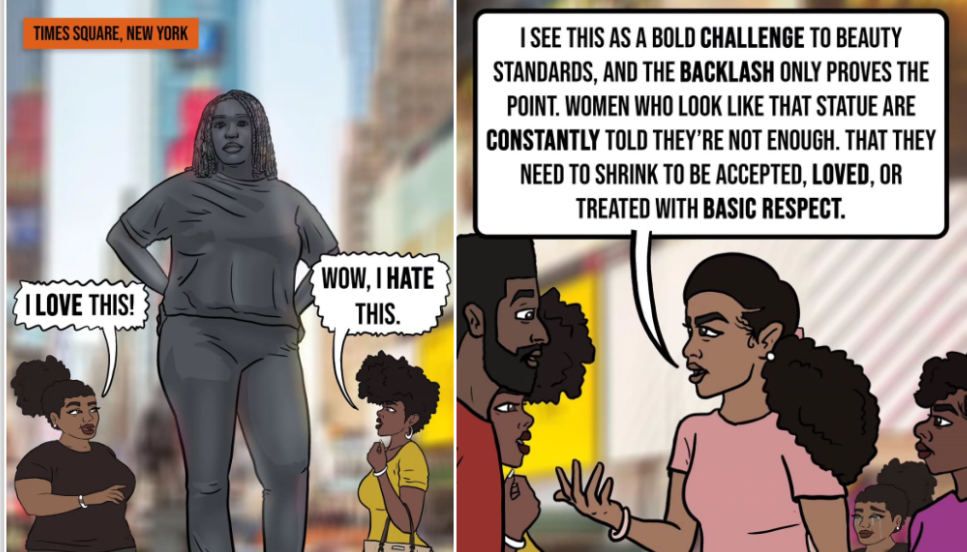
Photo source: Instagram / real_toons
Each new slide ignited a more heated discussion, with one lady noting, “That’s not a representation of us, while another piped in, “Why did the artist, who isn’t even African American, choose this. He has done other sculptures of Black women that look way better.”
This debate mirrored larger conversations happening across the U.S. that mostly box Black women into certain stereotypes. It showed how very uncomfortable some people are with seeing Black women, especially those who don’t fit societal beauty standards, featured prominently in public art.
For many Black women, the statue felt like being finally seen, especially in a world with biased beauty standards that rarely make room for them.
“I literally look like this. I’m an artist, and I think it’s very telling that my body makes everyone so upset. Sighhhhh. Black artists and sculptors have depicted White people through the arts too. Too much, maybe. It’s sad that it takes one British White guy making a sculpture of a human being to throw a whole cultural sphere into shock. That means it’s good art. Whether you like it or not. Art provokes,” Camille Atkinson, a Brooklyn artist, commented on Price’s post.
More comments rolled in: “I love this. She looks like me… and I think we both are beautiful.”
“She’s big, challenges beauty standards, and she’s Black. What’s not to love? Also, let’s celebrate being human. I see her as a normal everyday person. Maybe if we placed our everyday-ness with high regard – make our being human monumental – we might not dehumanise the everyday person so easily.”
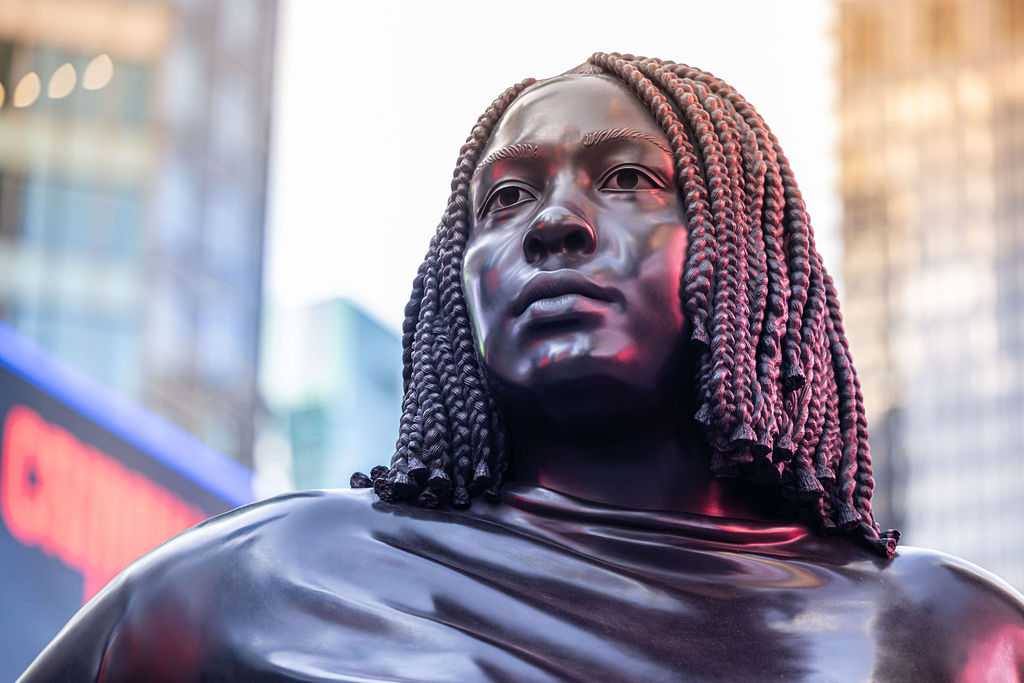
Photo source: Instagram / Times Square Arts
Other Black commenters saw the statue as a victory, especially in a place dominated by monuments of white male figures. Grounded in the Stars was a stark contrast to the more traditional statues nearby in the area, like those of playwright George M. Cohan and another showing Father Francis J. Duffy, both white men commemorated for their contributions to American culture and religion.
Some others did not see it the same way as they complained about the “unflattering representation.” They were of the opinion that she had an “attitude,” one who looks stereotypically angry. A number of people claimed she was not an accurate representation of the Black woman.
“I h8yte your statue as it’s not an accurate representation of Black American Women. We come in all shapes and sizes and you have her plainly dressed looking angry. You’re British and know nothing of Black American Women. You should be ashamed of yourself,” Izzie Bee commented on Instagram.