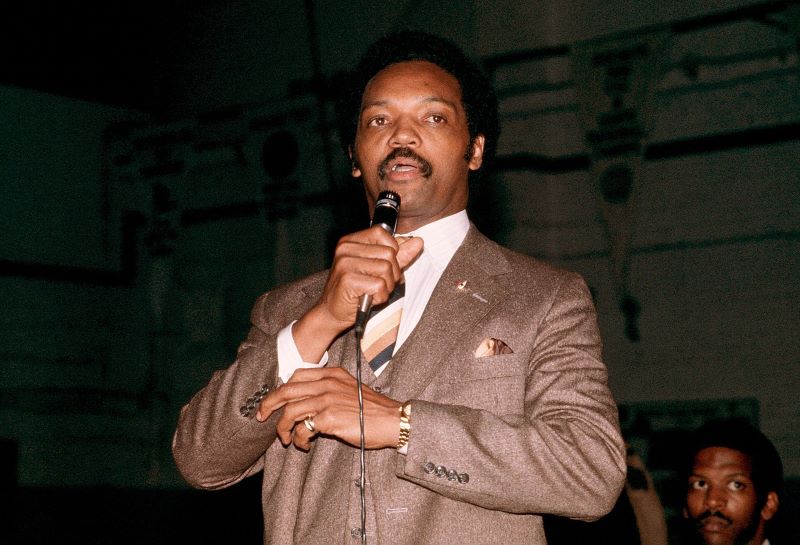
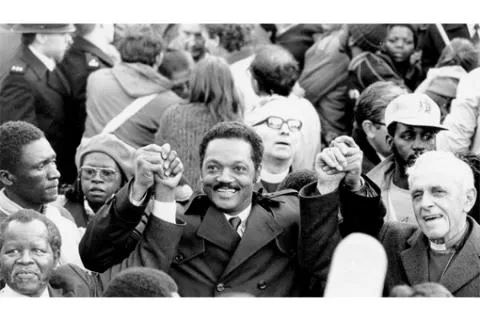
National Archives at College Park – Still Pictures , Public domain, via Wikimedia Commons
The air inside the convention hall in Atlanta during the summer of 1988 felt electric. Thousands of delegates hung onto every cadence as Reverend Jesse Jackson, wiping sweat from his brow, demanded that a fractured nation “keep hope alive.” Decades later, that same resonant demand echoes across the globe. When Reverend Jesse Jackson, a towering figure in modern Black politics, died on February 17, 2026, leaders from Chicago to Cape Town reflected on a life spent pivoting protest into power. He was a man who expanded the horizons of what was politically possible for the African diaspora. Today, scholars and civil-rights leaders are framing his death as “the end of an era,” marking the loss of a titan whose complicated, transformative legacy still shapes our world.
According to Rev. William Barber, “Jackson showed us how love can always be a potent force in public life.”
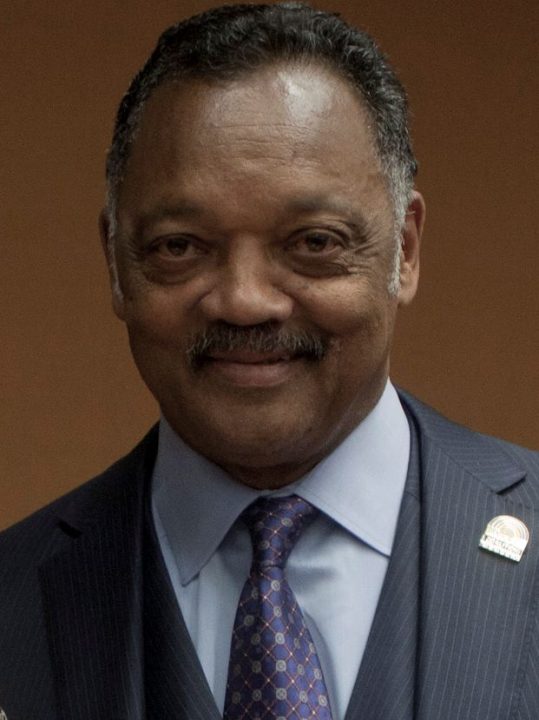
Source: Wikimedia
Who Was Jesse Jackson?
Jesse Louis Jackson was arguably the most visible civil rights activist of the late 20th century. Born in Greenville, South Carolina, in the Jim Crow South, he rose to become a leading civil rights activist, the founder of the Rainbow/PUSH Coalition, and a two-time presidential contender.
Beyond his national campaigns, his work transcended borders, connecting the struggles of Black Americans with anti-colonial and anti-apartheid movements across Africa. He also famously served as a District of Columbia shadow delegate and shadow senator in the 1990s, relentlessly advocating for D.C. statehood. To understand what Jesse Jackson did for Black politics is to look at a blueprint of modern coalition-building.
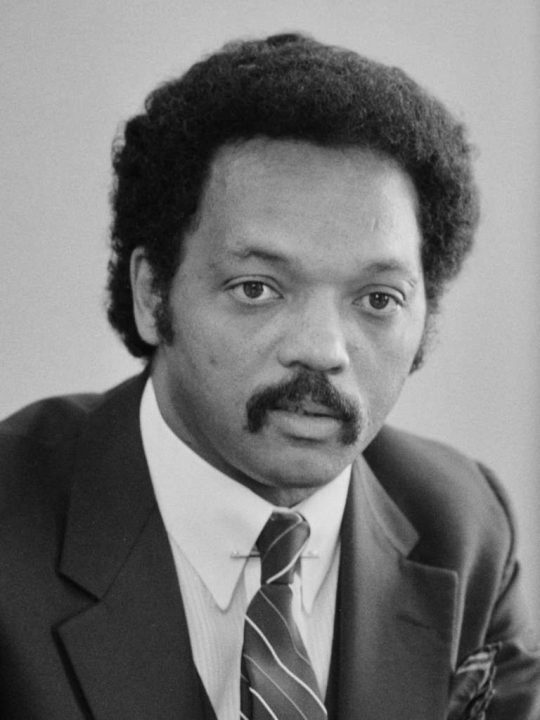
Source: PICRYL
How Did Jackson Shift Black Politics from Protest to Power?
Jesse Jackson’s apprenticeship in activism was forged in the crucible of the 1960s civil rights movement. Working closely with Dr. Martin Luther King Jr., Jackson was present in Memphis on the tragic day of King’s assassination in 1968.
“I was traumatized, full of pain and anger and sorrow and desperation and many emotions at the same time,” Jesse recalled. In the aftermath, Jackson emerged as an ambitious and sometimes controversial heir to the movement.
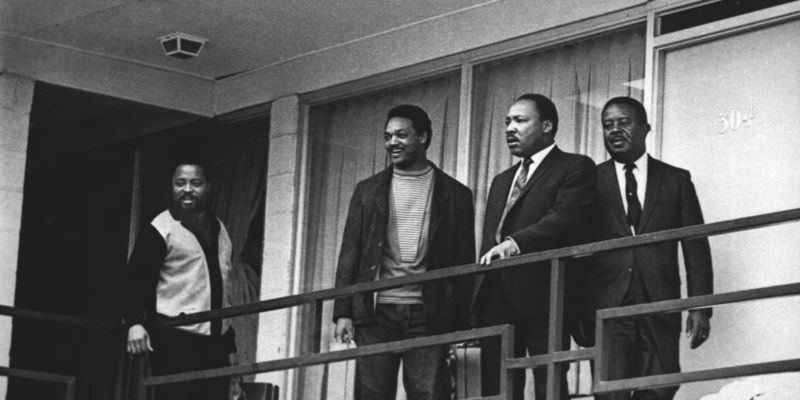
Source: Flickr.com
However, Jackson’s most profound pivot was recognizing that the marches of the 1960s needed to translate into the voting blocs of the 1980s. He shifted the focus of Black political history from demanding basic rights to demanding institutional power. His voter registration drives enfranchised millions of new Black voters across the American South and urban North. These newly registered voters elected a generation of Black mayors, congressional representatives, and local officials, fundamentally altering the demographic makeup of American politics.
Rainbow, PUSH, and Political Strategy
The foundation of Jackson’s political strategy was the Rainbow/PUSH Coalition. What started as Operation PUSH in Chicago, focused on economic boycotts and the empowerment of Black businesses, evolved into a national organizing powerhouse.
During his 1984 and 1988 presidential campaigns, Jackson ran as a Black candidate and also as the leader of the “Rainbow Coalition.” He explicitly brought together Black Americans, working-class whites, Latinos, Arab Americans, Native Americans, and the LGBTQ+ community.
“Jackson’s coalition politics expanded the ideological boundaries of the Democratic Party.” — Northwestern University scholars
Though he did not win the nomination, he won roughly 7 million votes and 11 primaries/caucuses in 1988. He forced the Democratic Party to adopt more progressive platform planks, reformed the delegate allocation process to be more proportional, and laid the groundwork for the eventual election of Barack Obama through grassroots organizing.
What Was Jesse Jackson’s Impact on Africa and the Diaspora?
Jesse Jackson’s reach extended far beyond the borders of the United States. For African readers and the broader diaspora, Jackson is remembered as a fierce global activist.
In the 1980s, when the U.S. government under Ronald Reagan pursued a policy of “constructive engagement” with South Africa’s apartheid regime, Jackson vehemently opposed it. He toured Southern Africa, stood shoulder-to-shoulder with frontline states, and demanded crippling sanctions against the apartheid government. He famously met with Oliver Tambo and Nelson Mandela, helping to elevate the Free Mandela movement to the top of the American foreign policy debate.
Jackson also operated as a freelance diplomat. He successfully negotiated the release of hostages and political prisoners in Syria, Cuba, and Yugoslavia, often drawing the ire of the U.S. State Department but winning the admiration of the international human-rights community.
Source: Jesse Jackson with Tambo and Huddleston | South African History Online
Tracing His Impact Today
Jesse Jackson’s legacy is not confined to history books; it is an active, practical framework used today.
- Voting Rights: The ongoing fight against voter suppression draws directly from Jackson’s playbook of mass registration and legal challenge.
- Corporate Accountability: Rainbow/PUSH’s Wall Street Project pioneered the modern push for DEI (Diversity, Equity, and Inclusion) in corporate boardrooms.
- “We Must Keep Hope Alive”: This iconic slogan remains a rallying cry for progressive organizers globally facing political headwinds.
Reverend Jesse Jackson’s life (1941–2026) was an unyielding testament to the power of showing up. He was a man who refused to be told where he belonged, whether that was a segregated lunch counter, the debate stage for the presidency, or the global diplomatic table. He leaves behind a complicated but undeniably monumental legacy that transformed how Black power operates in the modern world.
Reference:
- Reverend Jesse Louis Jackson | The Presidency
- Jesse Jackson with Tambo and Huddleston | South African History Online
- How Does Jesse Jackson Do It?
- ““My Two Years with Jesse Jackson Sr.”, Part 4” by Preston Love Jr.
- Rev. Jesse Jackson remembers witnessing the assassination of Dr. Martin Luther King, Jr. on 50th anniversary – CBS Chicago
- Jackson Becomes the First Major Black Candidate for U.S. President | History | Research Starters

Anand Subramanian is a freelance photographer and content writer based out of Tamil Nadu, India. Having a background in Engineering always made him curious about life on the other side of the spectrum. He leapt forward towards the Photography life and never looked back. Specializing in Documentary and Portrait photography gave him an up-close and personal view into the complexities of human beings and those experiences helped him branch out from visual to words. Today he is mentoring passionate photographers and writing about the different dimensions of the art world.