
Christmas vigil in Lalibela, Ethiopia
Tanjagari, CC BY-SA 4.0, via Wikimedia Commons
December has always remained an anticipated month every year. For many businesses, it is the time of the year to wind down all its financial dealings and take stock of the profit or losses of the year in question, for individuals, it is the much anticipated time of the year when the hustle and bustle comes to a final stop and the opportunity to kick back, relax, and enjoy a well deserved rest.
The month of December also ushers in the Christmas celebration, an annual festivity celebrated worldwide. In Africa, the 25th of December is a day to commemorate the birth of Jesus Christ and to engage in special activities with friends, families, and loved ones.
While many Christians in Africa hold this special day in December, Orthodox Christians in Ethiopia follow the Tewahedo Church calendar which places Christmas on January 7th, twelve days after the rest of the world has put a close to the festivities. This Christmas festival in Ethiopia is “YeLidet Be’al” or Genna which translates to “imminent” expressing the coming of the Lord for the redemption of mankind.
Tracing the History
Christianity in Ethiopia is said to have been introduced by the Ethiopian eunuch who was baptized by Philip as noted in Acts Chapter 8 of the Bible. Founded in 328 AD, the first bishop of the Ethiopian Orthodox Church was Frumentius who was a Syrian brought up in the palace under the ancient kingdom of Axum.
Under his stewardship, many religious individuals would come to have considerable influence in the shaping of the Orthodox Tewahedo church by introducing the monastic lifestyle, translating several texts and books from Hebrew and Aramaic into the Geez language, and also expounding several beliefs.
“Tewahedo” which is the one-person, one-nature doctrine espoused by St Cyril is a doctrine that the Oriental Orthodox church like the Coptic Orthodox Church or Armenian Orthodox Church also shares.
Unlike their peers in the Christian faith, the Ethiopian Orthodox Church still makes use of the ancient Julian Calendar which pegs Christmas in January as compared to the Gregorian calendar. In the Church, the feast “Lidet” (the Birth of Our Lord and Saviour Eyesus Kristos) is always celebrated on Tahsas or Tahisas 29 (Julian calendar) which is January 7 on the Gregorian calendar.
Providing historical clarity on this the Ethiopian Orthodox Church, Medhane Alem in Canada notes that, “according to the Ethiopian Church, the 5,500-year period from the beginning of Adam to Our Lord Eyesus Kristos’ birth was counted down to zero. When the year 5500 arrived at zero, Our Lord Eyesus Kirstos’s birth took place on Tuesday, Tahisas 29 E.C (January 7) at midnight. From Adam to Noah is 2256 years; from Noah to Moses is 1588 years; from Moses to Solomon is 593 years; and from Solomon to Christ is 1063. Altogether totalling 5500 years.”
Henok Gizachew, CC BY-SA 4.0, via Wikimedia Commons
Celebrating Genna
Preparations for Genna begin with what is referred to as “The Fast of the Prophets” (Tsome Nebiyat), the basis being that the coming of Christ prophesied by the prophets was fulfilled. The event which commences from 15th Hedar (November 24) is actively participated in by all faithfuls who are interested until its conclusion on Christmas Eve 28th of Tahsas (January 06).
During this period abstinence from foods that include meat, dairy, wine, and eggs is observed with vegan meals mostly adhered to. The Fast of Advent which occurs the day before Christmas marks the start of the Genna festivities. The fast is unique as it is a day to cleanse the body and soul and to prepare oneself for the day of the birth of Christ. Also, fasting is a reminder of the devotion of the Prophets who during their time were longed for the advent of Christ.
As highlighted by the Mahibre Kidusan (an association in the name of Saints) “in the Old Testament Prophets prophesied about “The Holy Son” to be born, migration to Egypt, His baptism in the Jordan river, suffering for the salvation of mankind, crucifixion, resurrection, ascension, and second coming on Judgment day.
The Prophets prayed and fasted with the hope of the salvation of humans vowed to Adam. Though they had not witnessed the “Birth of Lord Jesus Christ” with their own eyes, they had faith in the fulfillment of the redemption of humans. Thus, we fast this fast with the hope of the Lord Jesus Christ’s birth and the fulfillment of the prophet’s prophecy.”
On the eve of Christmas or early in the morning, people gather for the mass celebrations wearing a traditional garment called a Netela or Shamma. This garment, worn like a shawl or toga, is an all-white piece of clothing with brightly coloured stripes across the ends.
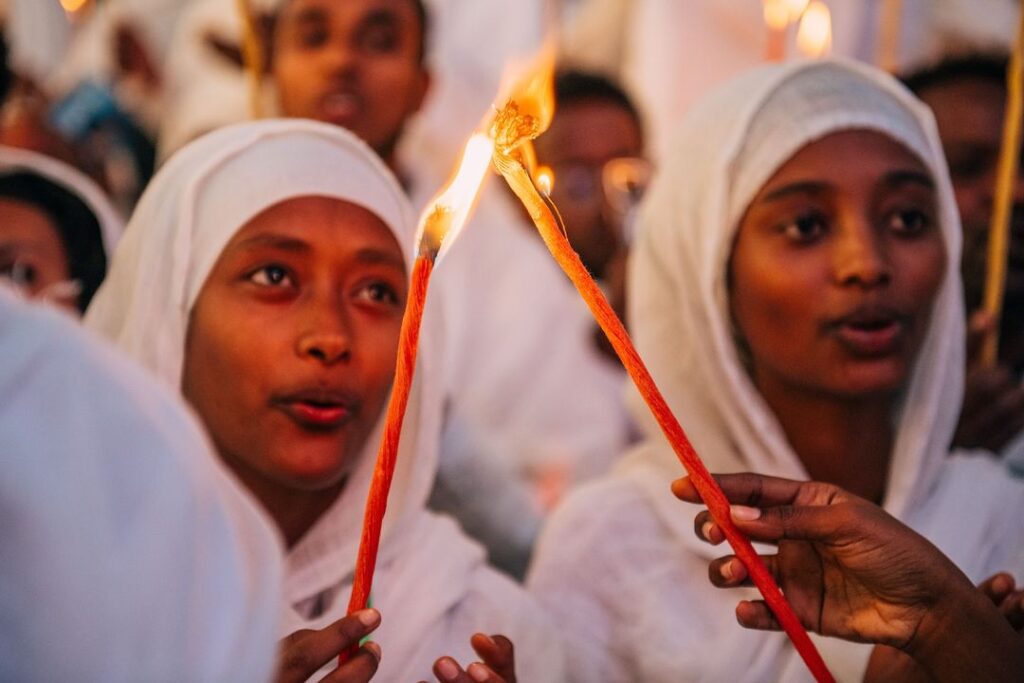
At the start of the mass celebration, people remain standing for up to 3 hours as clergy and debtera scholars lift their voices in liturgical hymns and chants as well as the voices of the faithful. Handed a candle, along with the priests carrying the Tabot (the symbolic ark of the covenant) on his head, the faithful walk around the church three times in a solemn procession amidst ululation and the chiming of church bells.
At the conclusion of mass celebrations, families disperse to their various homes to break their fast with special meals like the Doro Wat, a spicy stew prepared with hard-boiled eggs, meat, and vegetables, and eaten with Injera, a flat dough-like bread which is used to scoop up the Doro Wat.
Made from Teff, a nutrient-packed grain grown in Ethiopia, the teff flour is fermented for several days giving the bread its unique flat characteristics and taste. Due to its flat nature and spongy characteristics, the bread can easily soak up sauces and stews served on it.
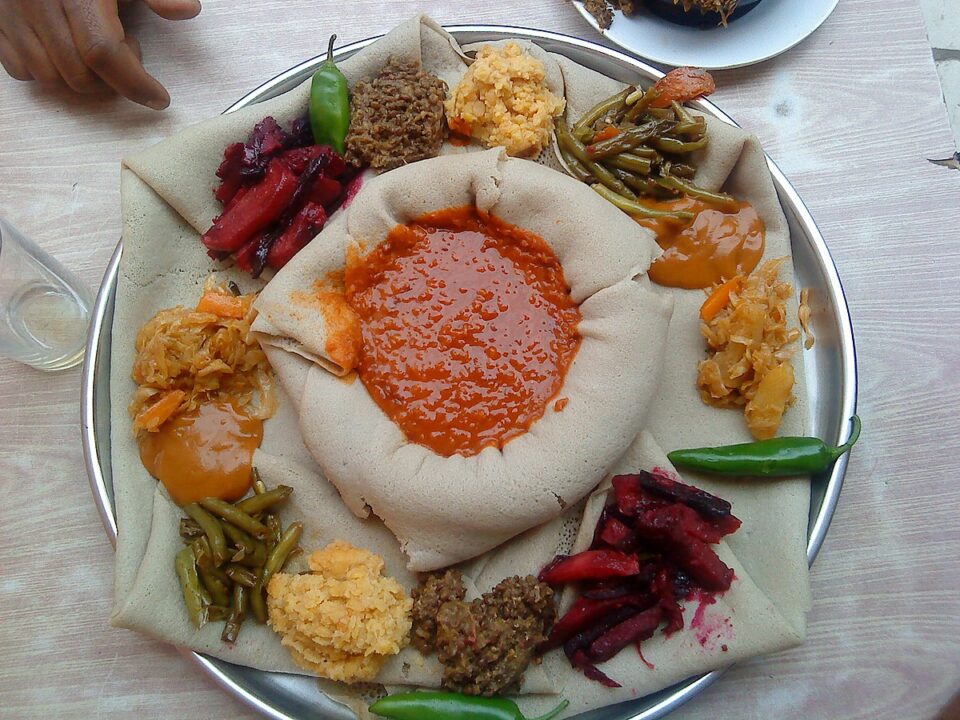
Injera served with various stews on top.
Dawityirga, CC BY-SA 4.0, via Wikimedia Commons
In Ethiopia, Injera is not just any ordinary food but a communal meal as well. As noted in an article – The Role of Injera in Ethiopian Culture and Cuisine by neforwebdesign, “Injera is much more than a staple food in Ethiopia—it is deeply intertwined with the country’s culture and social practices. In Ethiopian homes, meals are typically shared from a communal platter, with injera laid out as the base.
Various stews, vegetables, and meats are placed on top of the injera, and diners use pieces of the bread to scoop up the food, feeding themselves and each other. This communal way of eating symbolizes unity, community, and respect. The act of breaking off a piece of injera and offering it to another person is considered a gesture of friendship and hospitality in Ethiopian culture.”
Combined with local wine drinks, families share this meal together enjoying the communal gatherings and family reunions.
Part of Genna festivities is the Ye’GenaChe’wata (the game on Gena). Played mostly in the rural areas, the game which shares a similarity to hockey is played between two teams in different halves. Using a curved stick, each team sets out to knock a wooden ball into a hole in the ground. Stories have it that the shepherds to whom the Angel of the Lord appeared to announce the birth of Christ were engaged in similar sport.
Another game enjoyed by the locals is “Yeferas Guks” which is a horse riding activity where players sit on horseback while shooting ceremonial lances at each other to the applause of spectators.
Rural VS Urban Genna And Diaspora
As modernization continues to grow around the world, certain activities associated with the Genna celebrations are less pronounced in the urban areas than in rural ones. Expanding cities and time constraints impact traditional games like the Ye’GenaChe’wata.
Also, with the growing influence of westernization, activities like visits from Santa Claus, setting up of Christmas trees, and consumerism associated with western economies are beginning to feature in urban celebrations unlike the rural areas where the celebrations remain traditional.
While the Ethiopian Orthodox Tewahedo Church (EOTC) has a vast majority of its adherents in Ethiopia, it still has established churches in Germany, Canada, Sweden, the United Kingdom among others.
With eight dioceses established outside the country, Ethiopians in diaspora are opportune to participate in the Genna celebrations though some key aspects like the Ye’GenaChe’wata and the “Yeferas Guks” are not participated in.
Generational Genna
Among the young and the old, Genna celebrations could take a different shape. While the older generation focuses intensely on the sacred activities associated with the celebration, the younger generation invests time and energy in preparation for the games and activities after the conclusion of the church service.
Older generations continue in the traditional rites and requirements of the festival laying less emphasis on the commercial aspect while this is not the same for the younger generation who understand the economic opportunity the festival presents especially in the urban cities and look for ways to capitalize on it.

Thomas Fuhrmann, CC BY-SA 4.0, via Wikimedia Commons
Boosting Tourism
Famous for its rock-hewn churches, Lalibela is a UNESCO World Heritage site that houses eleven medieval monolithic churches carved out of rock. Unlike most modern Churches, the Lalibela Churches were hewn from monolithic blocks. Chiselling out windows, columns, doors, roofs, etc, these magnificent structures have attracted tourists from around the globe.
Thousands of Ethiopian faithful also visit this iconic site to experience the cultural heritage of this famous city. For them, Christmas is a deeply spiritual moment, reminding them of the redemption of man through the birth of Christ Jesus.
According to the Regional Tourism Bureau, “the Genna Festival not only holds deep religious significance but also plays a vital role in boosting the local tourism industry.”

Okechukwu Nzeribe works with the Onitsha Chamber of Commerce, in Anambra State, Nigeria, and loves unveiling the richness of African cultures. okechukwu.onicima@gmail.com