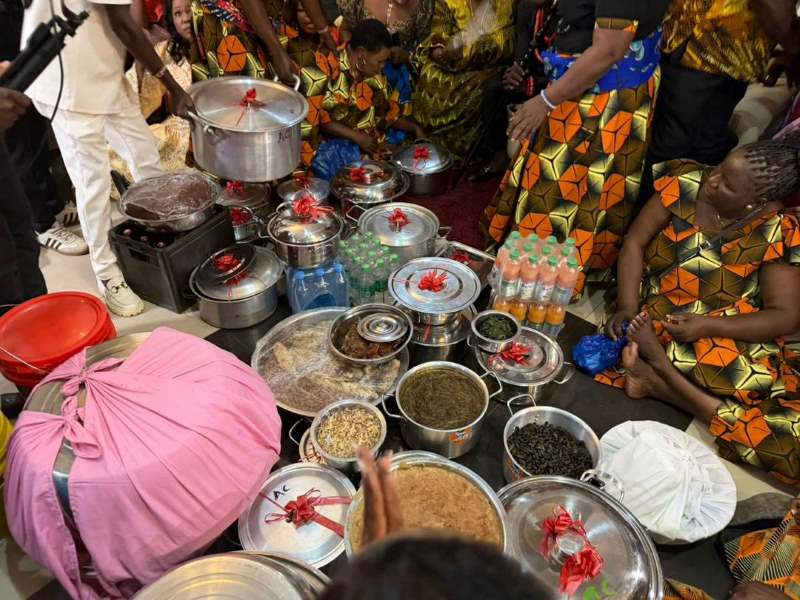

Image: Gemini AI
How relevant is the payment of bride price in modern-day African relationships? Or perhaps the question should read, Should bride price still have a place in the traditional marriage process in African societies?
Perhaps one of the most controversial arguments in modern-day African marriages, bride price payment has stirred up heated debates. With many viewing the practice as irrelevant and outdated especially as it confers an unnecessary pressure on young couples, more so the men, who feel the need to go the extra mile and in some instances, engage in unexemplary acts all in a bid to acquire enough financial capital to be able to meet up with the bride price requirements as well as marital expenses, several others not only applaud the practice but reaffirm its importance in the marriage rites of the respective cultures in question.
Bride Price Practices in Africa
While it’s difficult to put a mark on the historical background of bride price payment, it has remained a common practice across many African countries and cultures with each having its own distinct form. Below are examples of bride price practices in some African societies.
Bride Price (Southern Africa)
Countries within the Southern region of Africa like Botswana, South Africa, Eswatini, and Zimbabwe practice what is called Lobola. This is a marriage tradition where the family of the groom makes a down payment to the bride of a family. This is also known as bridewealth and includes the presentation of cattle. Importantly, Lobola is not regarded as payment for the purchase of their daughter or “buying a wife” but as a sign of the agreement between families and a symbol of their ties.
While modern-day practice replaced the presentation of money in place of cattle, especially in urban locations, the cultural significance of lobola as a symbol of respect, unity, and value still holds to this day.
Bride Price (Western Africa)
In Western Africa, bride price payment differs across countries. In several cases, it also differs among various cultures within a specific country. Take Nigeria as an example, the bride price practice amongst the Igbo of Southeastern Nigeria differs from the practice among the Yoruba of Southwestern Nigeria or the Hausa of Middlebelt and Northern Nigeria.
Among the Igbo tribe, “Ego Isi Nwanyi” (bride price payment) is usually a small amount that is presented after representatives of the groom meet with representatives of the bride. Negotiations commence with the bride’s representatives calling out a huge amount which the representatives of the groom are expected to counter.
This process goes on with both parties exchanging proverbs and banters until an insignificant sum is arrived at. Once the funds have been presented to the head of the family, the father of the bride takes the money and returns it to the groom while telling him that they do not sell their daughter but that it is his responsibility to look after his child. The process is concluded with prayers and continued feasting.
In discussing the bride price process in Ghana, the relationship platform PG Sebastian Coaching notes “In Ghana, bride price is commonly practised among various ethnic groups, such as the Akan, Ewe, and Ga-Adangbe. Families of the bride and groom typically negotiate the bride price, which often includes cash, livestock, and material goods, as well as symbolic items like kente cloth or traditional drinks. Though specific requirements may differ, the overarching principle is that the bride price demonstrates the groom’s ability to provide for his new wife and her family”.
Read also: CELEBRATION OF LOVE – AN IGBO WEDDING
Bride Price (Eastern Africa)
In East African cultures that practice Islamic rites, the practice of Mahr which is a direct gift from the groom to the bride which forms part of the Islamic marriage contract also referred to as Nikah, is a request made by the bride to the groom and can be in the form of money, property, gold, or anything of sentimental value.
The gift can only be accepted by the bride and no one else in her family except those whom the bride appoints to receive on her behalf. Unlike the earlier ones mentioned, the gift is strictly for the benefit of the bride.
Debating the Relevance of Bride Price in Modern Times
Many arguments continue over the relevance of bride price payment as a cultural practice. Perhaps for the older generation and those rooted in upholding cultural values, bride price payment is seen through the lens of being an act that extends a token of appreciation from the family of the groom to that of the bride. Beyond that, the practice is also viewed as an act that creates unity, strengthens the bond between families and reaffirms the capacity and readiness of the groom to proceed with the union and look after the bride.
Criticisms of the practice stem from the view that it portrays a transactional process as women are seen as commodities being traded off. As pointed out by the Oxford Academic in a publication titled – Bride Price and the Well-Being of Women by Sara Lowes and Nathan Nunn, “the objections stem from the view that the practice is transactional and, therefore, results in the commodification of women, which has adverse consequences. Husbands may feel that because they have paid for their wives, they can mistreat them, leaving women in marriages prone to physical violence and conflict”
While many African cultures frown on incidents of domestic violence, the notion of suggesting that incidents of domestic violence can also be tied to the transactional practice of bride price is both misleading and untrue. Domestic violence even exists in noncommittal unions (unwed couples) and even same sex relationships.
Some arguments bordering on the financial strain it places on couples especially the men are also Germane and raise concerns over the excessive requests by some cultures which discourage potential suitors and impact on the marital status of women from such communities. Yet, these arguments also ignore efforts by several of these communities to correct such practices.
In an evolving world where gender arguments and the role within the relationship are becoming more prominent, the argument over bride price payment becomes intense as many argue that it reinforces traditional roles creating the impression that women remain subject to men. But this argument stems from the transactional position held by proponents of those who believe it should be done away with.
In African societies, the man is continually viewed as the head of the family who is required to provide, support, and protect the family. His capacity to do this is also measured by his readiness to take up the role of husband which he embarks on through the marital union with a woman. The notion of bride price is mostly seen as a symbolic gesture of the man’s commitment to the family of his intended wife rather than a transactional process to purchase the woman he would be spending his life with. Traditional African roles of the family structure continue to reinforce the man as head of the family outside the respective financial capacity of the two genders.
Abolishing the practice of bride price payment seems an unjust argument as it negates the bond it creates between families. Perhaps a better argument would be the need to keep it fluid and constantly changing to meet current realities without losing the essence of its importance between cultures, communities, and families.

Okechukwu Nzeribe works with the Onitsha Chamber of Commerce, in Anambra State, Nigeria, and loves unveiling the richness of African cultures. okechukwu.onicima@gmail.com