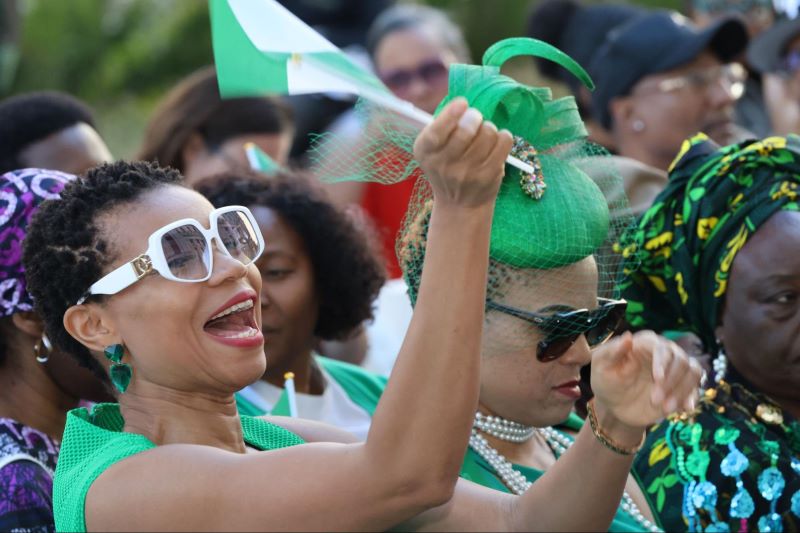
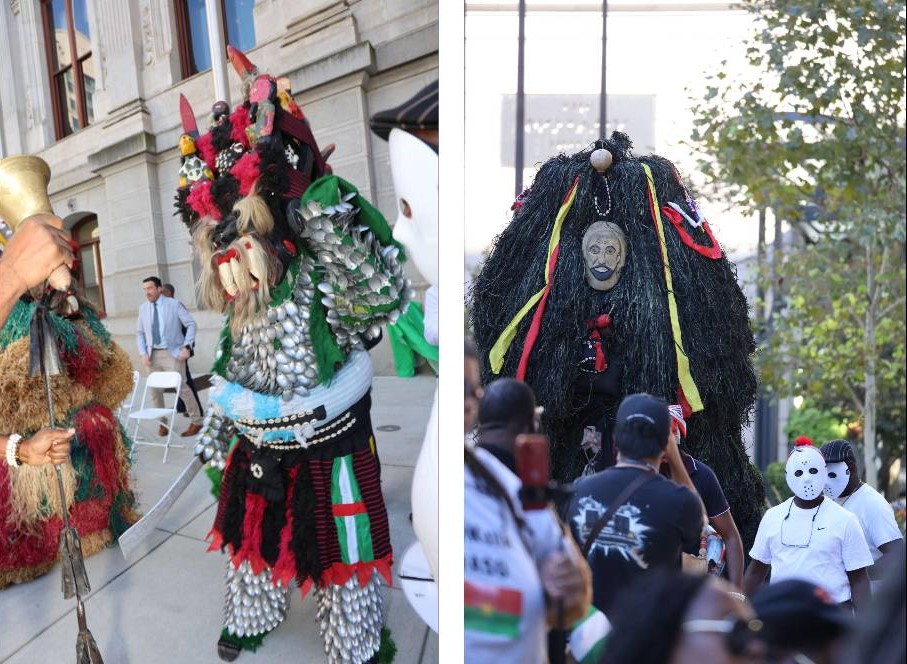
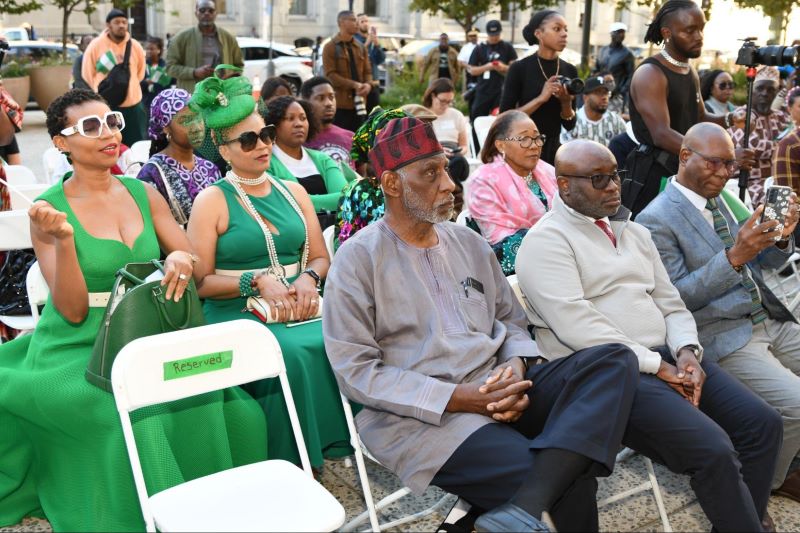
The autumn wind was cold, but the energy was warm. Beneath the towering arches of Philadelphia City Hall, drums echoed through the chill, a heartbeat calling the city to witness something powerful. The mic check rang clear, and as the rhythm of the drum rolled in, men in elaborate Egungun regalia emerged, their faces veiled and their movements commanding. Around me, people were dressed in radiant shades of green and white, proudly representing Nigeria’s colors. Flowing gowns, headwraps, agbadas, and scarves shimmering. Together, they transformed the space into a sea of national pride.
The drummers continued to strike their rhythm in unison, and the silver-shell details on the mascot clacked in time with the beat; a sound both ancient and electric. The air pulsed with movement as cameras flashed, journalists leaned in, and the crowd swayed between awe and mesmerization. Beneath the street, trains roared; above ground, the culture rose higher as the traffic flow.
The green and white of Nigeria’s flags being passed out waved through the crowd like a living breeze. Strangers paused mid-step to take in the sight, the celebration of heritage right in the heart of the city. For a moment, everyone felt included in the story.
As the music softened, Dr. Juliet Njoku took the stage to welcome guests and open the ceremony. Honorary guests and city officials sat proudly on the podium, their expressions mirroring the pride in the air. A prayer was offered; solemn, hopeful, resonant. The Director of Immigration Affairs, Charlie Ellison was announced, but as he prepared to speak, a brief ripple of protest broke the calm. A woman raised her voice for what she believed was her truth, escorted peacefully by security as she continued to express her rights. The interruption was brief, but a reminder that even in celebration, democracy lives.
Mr. Ellison delivered a heartfelt tribute to the Nigerian community, highlighting the deep cultural and historical bonds that connect Nigeria and the United States. He began by drawing parallels between America’s founding quest for independence and Nigeria’s own fight for self-governance, emphasizing that both nations share a legacy of resilience, determination, and an unyielding spirit of freedom.
“As the birthplace of American independence,” he said, “Philadelphia has much in common with Nigeria in its ongoing pursuit of self-determination and progress.” He praised the Nigerian community’s extraordinary contributions to Philadelphia’s social, academic, and professional fabric; particularly in medicine, science, education, technology, arts, and culture. Mr. Ellison noted the city’s abundance of Nigerian scholars and students across the University of Pennsylvania, Drexel, and Temple University, Lincoln University, as well as the many physicians, researchers, and innovators of Nigerian descent shaping the region’s future.
Among those he mentioned was Dr. Lola Fanti, a leading oncologist at the Hospital of the University of Pennsylvania, who exemplifies the community’s excellence in healthcare and service. He also highlighted Nigerian-owned businesses like Suya Suya, along with thriving Nigerian-inspired fashion and cultural enterprises enriching the city’s creative landscape.
The speech also reflected on the community’s humanitarian outreach, from sending thousands of water bottles to Flint, Michigan, during its water crisis, to offering disaster relief in Houston and Chicago. “Nigerian Americans show up every day to strengthen bonds among immigrants, African Americans, and the wider Philadelphia community,” Ellison said.
He concluded by honoring Nigeria’s 65th year of independence, calling it “a milestone of growth, prosperity, and unity for Nigeria and Nigerians across the globe.”
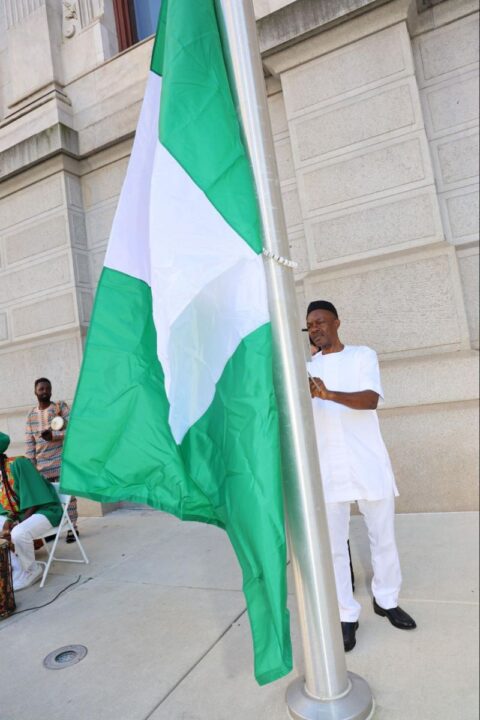
Then came the pivotal moment: Dr. Eric Nzeribe, founder and publisher of FunTimes Magazine (1992), lifted the flag skyward. The crowd joined in as both the Nigerian and American anthems were played, guests sang, their voices trembling from the cold but burning with pride. Cameras clicked, capturing the unity between nations, between histories, between hearts.
Just as the anthem’s last note faded, another masquerade figure appeared, taller, grander, its movements commanding attention. Phones came out, low cultural music began to play behind him, and applause broke through the crowd.
Moments later, Dr. Eric Nzeribe returned to the mic. During his speech, he emphasized the significance of the Diaspora Advisory Council and its role in preserving the collective history of the African diaspora.
Dr. Nzeribe acknowledged the elders and community leaders whose wisdom continues to guide the work of the Diaspora Advisory Council, ensuring that history remains inclusive and reflective of all voices that shaped it. The roll call for the DAC members is Hon. Oliver St. Clair Franklin CBE, • Dr. Azubuike Ezeife • Dr. Diane Turner • Ms. Renee Sterling • Ms. Cheryl Thompson-Morton • Dr. Juliet Njoku • Ms. Sandra Lawrence • Dr. Eric Nzeribe. The Council was inaugurated and the Oral History Project was launched.
Dr. Nzeribe expressed gratitude for their mentorship and leadership in this initiative. He concluded by reaffirming a shared commitment to supporting African and African American businesses, encouraging entrepreneurs to seek collaboration and resources that help elevate their ventures to the next level.
The event, nestled between Broad Street and J.F. Kennedy Boulevard, became more than a flag-raising. It was a reminder of how far Nigeria has come and how strong its roots remain. The drums picked up again, and the crowd clapped. Though the chill of October was still prominent, at that moment, surrounded by color, rhythm, and history… the city felt a little warmer.
The ceremony continued with heartfelt tributes celebrating leadership, creativity, and service within the Nigerian and African diaspora communities.
Dr. Juliet Njoku, returning to the podium, shared the story of Nigeria’s first president, Dr. Nnamdi Azikiwe, affectionately known as Zik of Africa. She reflected on his journey from colonial Nigeria to Lincoln University, Pennsylvania, the first degree-granting historically Black institution that became a haven for African and African American scholars pursuing liberation and equality.
On Lincoln’s campus, young visionaries from across the diaspora exchanged ideas for freedom in late-night dormitory discussions — conversations that would later reshape nations. The same halls that nurtured W.E.B. Du Bois and inspired Pan-African unity also helped shape future leaders who returned home to fight for independence across Africa.
When Azikiwe became Nigeria’s first president, his leadership symbolized a dream fulfilled, one born in the classrooms of Lincoln University that led to the independence of a nation. Dr. Njoku recalled a powerful story of how the newly minted president’s representative, serving as ambassador, was refused service at a segregated restaurant in Washington, D.C. His quiet defiance became a defining diplomatic moment, reaffirming solidarity between Africans and African Americans in their shared pursuit of human dignity.
This connection between Lincoln and Lagos, Philadelphia and Nigeria, continues today through a new initiative led by Dr. Eric Nzeribe and supported by Lincoln University. The Oral History project seeks to preserve and digitally archive oral histories of elder generations, document the university’s influence in African liberation movements, and highlight Pennsylvania’s pivotal role as a crossroads of Pan-African solidarity.
Following the announcement, Dr. Brenda A. Allen, the 14th president of Lincoln University, was honored for her visionary leadership. Since assuming office in 2017, Dr. Allen, a proud Lincoln alumna, has revitalized the university through strategic planning, academic innovation, and campus expansion. Her distinguished career, spanning Winston-Salem State University, Brown, Smith, and Yale, has advanced academic excellence, diversity, and opportunity. Dr. Azubuike Ezeife, MD, presented her award.
As applause filled the air, the moment symbolized a full-circle legacy with a University that once inspired the birth of nations and now continues to prepare the next generation of leaders to transform the world.
Next, Hon. Christopher Chaplain took the stage to present the award to Dr. Odiraa Nwankwor, recognizing his extraordinary commitment to improving child healthcare in Nigeria. The award honored his “leadership and service to African communities worldwide.”
As a pediatric intensivist, Dr. Nwankwor was struck by the reality that in a nation of over 200 million people, Nigeria had long lacked a single pediatric intensive care unit. Determined to change that, he returned home to establish the country’s first PICU, a life-saving step toward transforming pediatric care in Nigeria. “What I’ve learned here,” he said, “I’m bringing back for Nigeria’s development.”
The final honoree, Laolu Senbanjo, a multidisciplinary artist and human rights advocate, was recognized for his creative excellence and dedication to uplifting African heritage through the arts. Though unable to attend in person, his brother, Ayanjo A, accepted on his behalf, alongside remarks by Dr. Ken Scott, President and CEO of Beech Company, who presented the award.
“This award is not just for Lanre,” Ayanjo said, “but for every Nigerian, in Brooklyn, in Lagos, in London, creating something meaningful wherever they are.”
As the ceremony drew to a close, FunTimes Magazine unveiled its special Independence Day edition, featuring the honorees on the cover. A fitting tribute to leadership and legacy. Live drumming and applause filled the air as copies circulated through the crowd, the rhythm and pride of the Nigerian spirit echoing across Broad Street.
In her closing remarks, Dr. Juliet Njoku thanked the immigration office, the advisory council, community leaders, and guests, urging continued support for African-owned businesses and cultural initiatives. Her final words echoed the spirit of the day, that collaboration, creativity, and community are the heartbeat of progress.
A Personal Reflection
The reception that followed was equally engaging. I had the pleasure of connecting with Dr. Ariana Neely, an internal medicine specialist, who attended in support of Dr. Odiraa Nwankwor. She shared how inspired she felt by the event, and she looked stunning in her elegant green dress. I also had the opportunity to meet Mr. Ellison and took pictures.
Dr. Nzeribe thanked all the sponsors and partners, which included Always Best Care, Brown’s ShopRite, Employment Professionals, Campaign for Working Families (CWF), and Beech Companies. FunTimes partners and collaborators include The Lenfest Institute for Journalism, Independence Public Media Foundation, Press Forward, The Pivot Fund, Philadelphia Journalism Collaborative at Temple, Lincoln University, and The Charles Blockson Collection, amongst others. Dr. Nikia Owens, President and CEO, CWF, briefly spoke about their free tax services and economic stability work
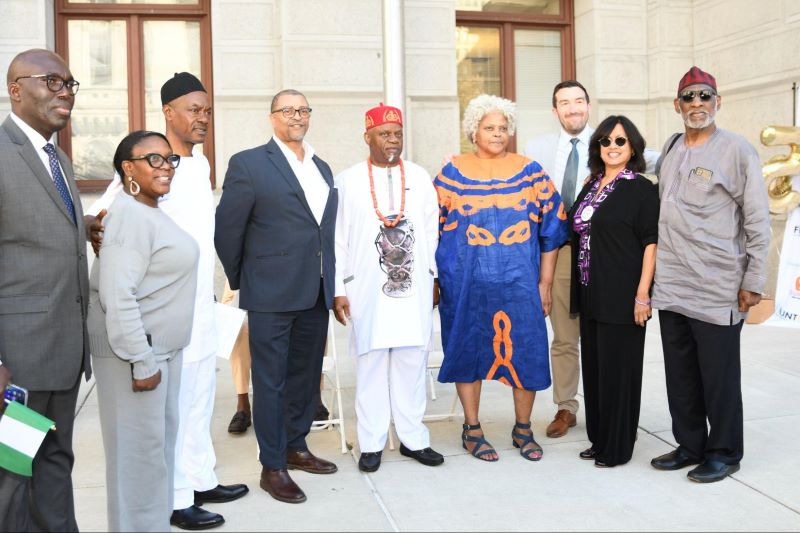
One of the highlights was taking a photo with Dr. Brenda A. Allen, my University President, alongside Dr. Eric Nzeribe and several other guests who helped make the ceremony a success.
All in all, the event was beautiful, empowering, and deeply unifying. A reminder of how culture, community, and connection can turn even the coldest evening into something full of light.