Image Source: Facebook / Kangwa K Kamando
The first time you attend a traditional African wedding, you will realize one thing. It is a gathering of family, culture, and a tradition passed down for generations.
Across the continent, the wedding traditions take different forms. In some communities, it is the way a bride greets elders. In others, it is how she serves her husband. But among the Bemba people of Zambia, one of the most fascinating and deeply symbolic traditions centers on something both simple and powerful: food.
The Bemba tribe is the largest of Zambia’s 72 tribes in Southern Africa. It is also the most predominant language in the country. Its homeland is Luapula, Northern, and Muchinga provinces. Some Bembas can also be found in the Democratic Republic of the Congo and Angola.
The Bemba tribe migrated to Zambia from the Luba Kingdom (present-day Democratic Republic of Congo) during the Bantu Migration, which took place between the 15th and 17th centuries.
One exciting thing about the Bemba ethnic group is their traditional marriage rites. Marriage is a very serious process with several stages that must be completed before the couple is declared married! Each approach has its cultural significance. Also, because of the Bemba people’s strong sense of oral tradition, marriages are contracted by word of mouth, not by a certificate.
Their marriage starts with a class called Bana Chimbusa, a secret counseling session for the bride. It is followed by Chilanga Mulilo, which has become the most celebrated, most photographed, and now most TikToked pre-wedding ceremony in Zambia.
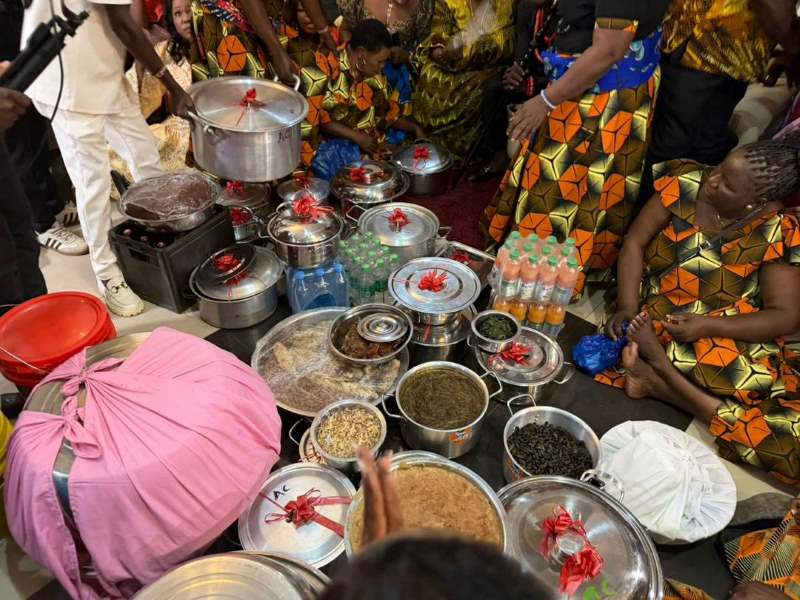
Chilanga Mulilo, loosely translated as “showing the fire,” is a food-tasting pre-marriage rite ceremony, where the bride’s family prepares various traditional meals to introduce the groom and his family to their food culture. It gives a symbolic preview of what the groom will be fed when married. It shows the groom’s family that they can always eat at their in-laws’ homes and also symbolizes an open invitation to the groom to dine with the bride’s family on all future visits. Before this, the groom could not eat at the bride’s parents’ or guardians’ house.
Discover other African wedding traditions: The Rich Symbolism Behind Wine-Carrying And Other Wedding Traditions Across Africa
Speaking with FunTimes, Mazuba Kapambwe-Mizzi, a freelance travel writer, explained that each family does the ceremony differently.
“Historically, it was only the Bemba people who did the Chilanga Mulilo, but now it has become so commercialized, and everybody does it in my country. There’s another group in Eastern Zambia that does something similar, but they call it a different name, and it’s on a smaller scale.”
The bride is expected to showcase her cooking skills. It signifies that she is ready to care for her groom. However, the ceremony has evolved over time, with families adjusting it to suit their preferences.
“A long time ago, it was just the bride and her immediate family who would cook. But now, some families outsource the cooking. You pay a caterer who specializes in traditional food to cook the majority of the main dishes, and then the bride’s family will cook specific things. These days, the bride would just cook the pap or nshima. Even in that case, the bride doesn’t cook the whole thing. Like for me, I just cooked a particular portion for like a minute,” she says.
As Mazuba puts it, it signifies that the groom will be well cared for. “As we know, in most African societies, nutrition is the responsibility of the woman. She does the majority of cooking,” she notes. “Again, in African society, even in Zambian society, food is a very social activity and very important. It shows that if visitors come, you are going to receive and care for them well.”
The bride prepares the nshima on the day of the ceremony. One might worry about a high-stakes ‘kitchen fail’ on such a big day, but Mazuba notes that the chances of this happening are very slim. This is because the majority of households in Zambia eat it, and the average girl, by the time she’s a teenager, knows how to cook nshima. The bride also has a lot of people helping.
“When the nshima is almost done, it’s the older women who are doing the work and making sure it’s ready. The meals are dished. The bride’s female relatives and friends are the ones who carry the food in pots on their heads to the groom’s house. The whole thing is led by women who are called Bana cimbusa. She’s a traditional instructor and communicates with the groom’s instructor about when the food will arrive. So, the groom’s family knows what time they are expecting it.
“When the bride’s side shows up at the groom’s house, they cannot just enter the premises. The groom’s instructor comes out with other male relatives, who start putting money down to motivate the bride’s family to walk farther into the house. Once the instructor is satisfied that enough money has been given, they start drumming and singing, and that is when they enter the house. The groom is already seated with his instructor and other men, including friends and family. All the dishes are put on the floor, and the female instructor starts opening each and explaining to the groom what it is.”
Traditionally, people from the women’s side are not meant to eat the food with the groom’s side. They leave the groom, and his fellow guys to enjoy their meal. Over time, this custom has relaxed, and today it is not uncommon for the bride’s family to stay and eat with the groom’s family. Mazuba notes that this depends on the relationship between the two families or on how modern you are.
“The bride is also not supposed to be there, but in my case, I was very curious. I went to the event but stayed in the car. After everything was done and my side had left, I stayed with my friends where the groom was. I didn’t eat, though.”
Source: JEB Photography
Learn about modern versus traditional African weddings: Tradition vs Trend, The New Face of African Weddings
The dishes prepared are typically traditional Bemba meals, and the menu may vary from family to family.
“The bride’s family will prepare meals that the groom can expect to eat in the home; meals that the wife’s family traditionally cooks. Because this ceremony was done by the Bemba, there are particular foods that they might eat that other parts of Zambia do not. The Bembas are known for eating dishes with a lot of peanuts. So, those would be the ones served.
“The most important thing at the ceremony, irrespective of the region, is the chicken. They make like three chickens, one for the groom, one for the male instructor, and one for the friends. The chicken is selected because it has different parts. When the bride is going through the pre-marriage instructions, they tell her about the different parts of the chicken, which is actually very sexual. Also, the way the chicken is served is very important. The legs are tied, and it is considered an insult if the bride were to serve a chicken with open legs.”
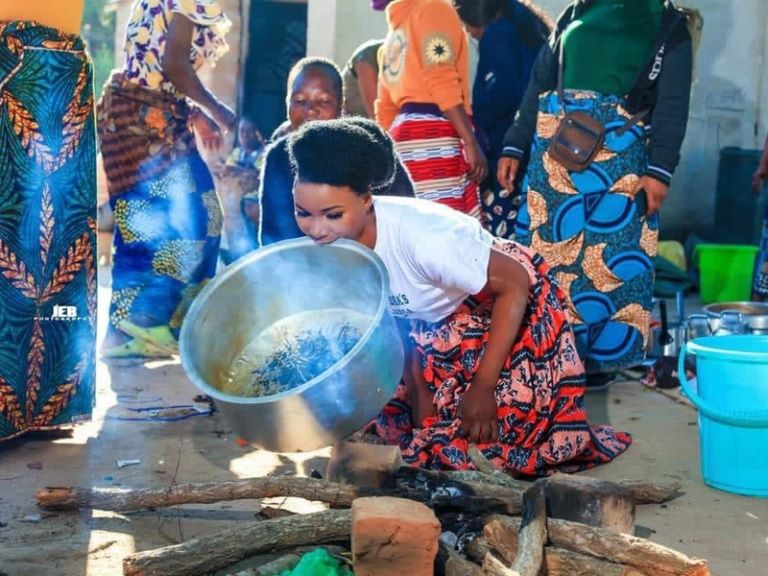
One controversial aspect of the tradition is that the bride uses her teeth to lift cooking utensils while preparing the meal for the groom’s family. Photographs and videos of this practice have circulated widely online, eliciting strong reactions ranging from pride and recognition to outrage and calls to abolish it. Critics have said it is a misogynistic practice and should be taken off the rites.
When Director JM, a creative director, shared a TikTok video of a bride kneeling and using her teeth to lift a cooking utensil, it sparked mixed reactions, with some saying the tradition should be cancelled.
Mazuba describes this tradition as very patriarchal.
“Using teeth is very dependent on who your female instructor is. I did not do it, and I would have refused even if they had asked me to. The symbolism is that if you are to get disabled in the future, or in an accident that will prevent you from using your hands, you should still be able to cook for your husband. It is very patriarchal.”
Although some of these Bemba wedding traditions are no longer practised, others are still in vogue, as many couples see their relevance and fun as part of the wedding ceremony!