
Image Source: cited in article
A winter morning in Philadelphia begins at the coat rack, and the order of dressing matters as much as the garments. The outer layer goes on last and does the most visible work. The sweater or hoodie beneath it carries the day indoors, and the hat and mittens decide whether the walk to the train is bearable. This guide moves from the outside in, starting with the coat and working its way down to the accessories.
The six brands span across Brooklyn, Detroit, Miami, Baltimore, and Philadelphia. Each is Black-owned according to the brand’s own description or to reputable press coverage, and each sells something meant for the cold weather. Where a price appears, it was read from the brand’s own store in November 2026 and can change before the holiday rush. Temperature ratings are left out on purpose, since the pages consulted do not state any.
The Brooklyn Circus treats the varsity jacket as a history lesson
The Brooklyn Circus is where the coat begins. Founder Ouigi Theodore built the label around menswear inspired by the pages of history books, according to the brand’s own description, and it is among the Black-owned labels every stylish man should know.
The signature piece is the Wool Varsity Jacket, and Theodore has explained its origin in personal terms. Esquire reported in its September 2023 issue that, as a teenager, he had to choose between his high school football team’s varsity jacket and a pair of Jordans. The jacket he later designed carries patches that connect American history, Black history, and the brand’s own history, in Esquire’s account.
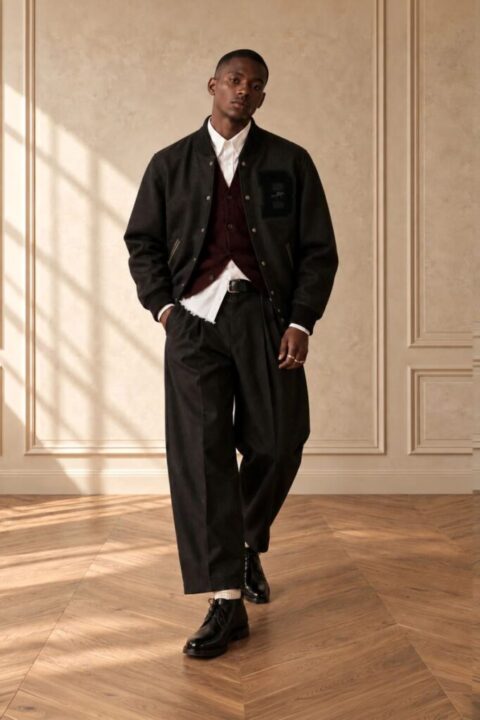
The “Black Ashe” wool varsity jacket, as featured on the Brooklyn Circus website
The store sorts the jackets by cloth. The all-black “Black Ashe” and the “Gibson Oats” wool varsity are listed at $595 each in hand-sourced wool. The “Charlie Brown” and the BKc Classic Triple Black are $765 each, built from a melton wool body, a nylon lining, and leather sleeves. Those are prices for a coat meant to last several winters. At least one jacket page lists a store-credit-only return policy, so sizing deserves a second look before the order goes in.
K. Walker Collective spent two years designing one puffer
K. Walker Collective is the Detroit answer to the same question. Ken Walker launched the label online in June 2018 and spent two years in residency at Détroit Is the New Black before opening a flagship at 4161 Cass Avenue, according to Hour Detroit. The Michigan Chronicle reported that the store opened on Saturday, November 26, 2022.
The puffer is the label’s cold-weather centerpiece. Walker told a local television host in December 2022 that its design took about two years because he wanted something warm and form-fitting that could still be layered over other pieces. It is listed in November 2026 as the Utility Puffer Coat at $119, available in vanilla as a pre-order.
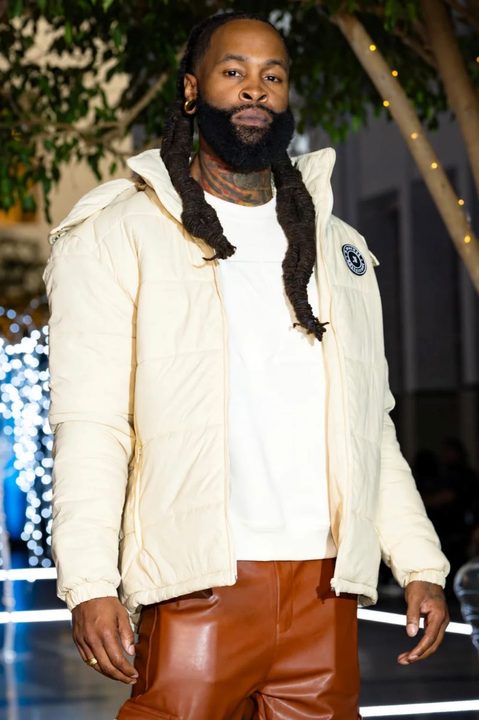
Utility Puffer Coat in vanilla, as featured on the K.Walker website
Walker has drawn a line between patronizing a Black-owned business and merely applauding one. “Don’t just support them,” he told a reporter in 2022. His advice on dressing for the season, given to Hour Detroit in December 2024, was just as short. “Don’t overdo it.” The magazine photographed him in a houndstooth overcoat from the winter 2025 line.
Agbobly knits a Togolese childhood into a sweater
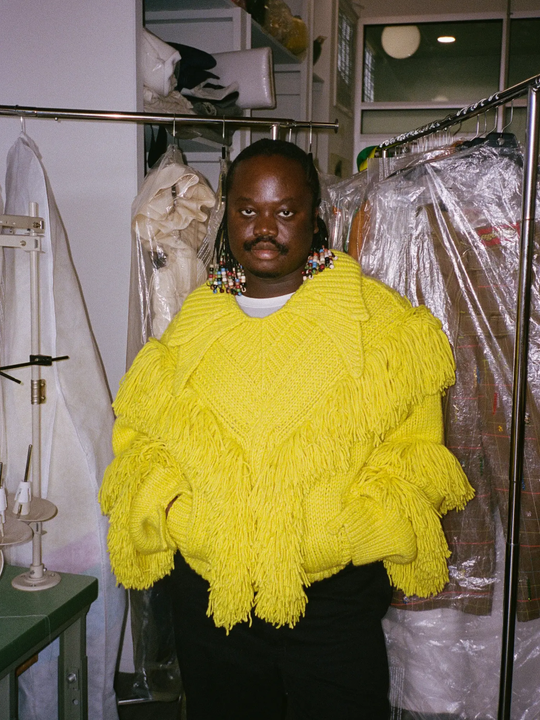
Agbobly began as a pandemic project. According to the Vilcek Foundation, the Brooklyn-based designer Jacques Agbobly launched the label as Black Boy Knits in 2020 and reintroduced it under the family name in 2023. Coveteur’s interview from February 2026 supplies the background. Agbobly was born in Lomé, grew up in Togo until the age of nine, and then moved to Chicago into a supportive housing community. The designer’s father sold secondhand clothing in Togolese markets, and his grandmother rented part of her home to seamstresses, so garments were never far away.
An early collection, “Togo Vivi Na,” was a love letter to that first home, and the work since has leaned on ginghams, stripes, and neon knits. The recognition is on the record. Agbobly was a CFDA/Vogue Fashion Fund finalist in 2022, an LVMH Prize semi-finalist in 2024, and part of the Costume Institute’s “Superfine: Tailoring Black Style” at the Metropolitan Museum of Art in 2025. A first runway show followed in fall 2025, and in 2026 came the Vilcek Prize for Creative Promise in Fashion and Design.
Source: Paper Magazine
The Vilcek citation describes a research-driven practice built on Afropolitan identity and diasporic memory, with sustainable made-to-order models grounded in West African craftsmanship. The store lists the Togo Stripe Long Sleeve Sweater at $575. Because the label operates on a small-batch, made-to-order ethos, and the sweater is currently marked sold out online, shoppers should check availability and shipping timelines before counting on a December gift arriving on time.
Read also: 8 Black-Owned Brands to Add to Your Black Friday Shopping List
KIN Apparel puts a satin lining inside the Philadelphia hoodie
KIN Apparel is the Philadelphia entry, and its origin story is about cold weather and hair. Founder Philomina Kane comes from a family of hairstylists. Philadelphia Magazine reported in February 2024 that her hair began falling out during her freshman year at Princeton in 2014. “My hair started falling out, and I chopped it off.” She then started a YouTube channel about healthy hair care that grew to almost 200,000 subscribers. The brand’s About page adds that cold weather and cotton fabrics, during her university rugby days, took a further toll, and that the idea of a satin-lined hoodie followed. Philadelphia Magazine dates the first one to January 2019.
The line has widened since. The About page lists satin-lined hoodies, thick hoodies, teddy fleece, beanies, and headwarmers, among other pieces. The brand appeared on Shark Tank in 2021, and Philadelphia Magazine‘s Best of Philly 2024 list named it Best Clothing Line, highlighting its online store alongside its local Philadelphia presence on West Girard Avenue.
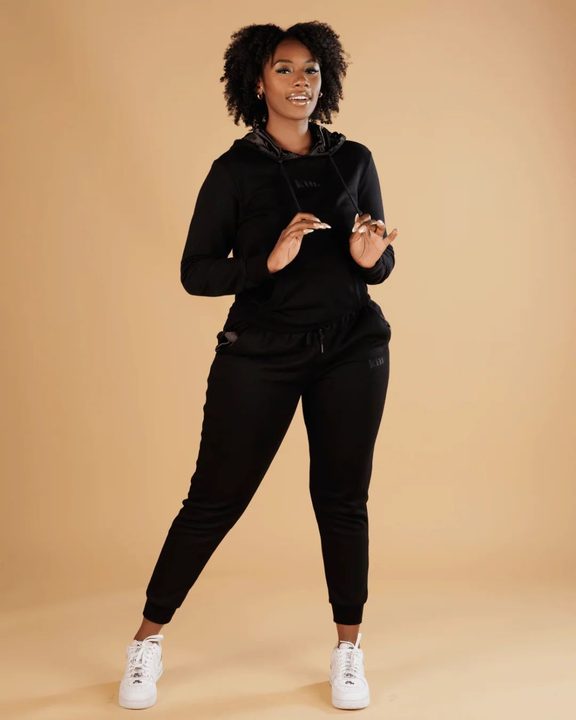
Source: KIN Apparel
The more recent chapter is legal. TheGrio reported on July 21, 2026, that Kane’s early patent applications were rejected, and that after Nike and WNBA star A’ja Wilson released a satin-lined collection in early 2025, Atlanta attorney Jasmin Robinson helped pursue a trademark instead. The application was initially rejected as generic. A 30-page appeal backed by five years of evidence persuaded the examiner, and the phrase “Satin-Lined Hoodie” was officially registered as a trademark in July 2026.
DungeonForward gives the beanie a patch system
DungeonForward is a Miami-based, Black-owned headwear and apparel brand founded by David Castro that bridges art, storytelling, HBCUs, and community, with the tagline “Crowns For The Culture.” Its cold-weather product is the Tactical Beanie, which the store describes as durable acrylic knit with a patent-pending patch system for function and storage. Colorways listed in November 2026 include Triple Black, Terracolor in wine and forest, Exrth in midnight blue, and pastel and hypercolor collections. Most are priced at $28 against an earlier $36.
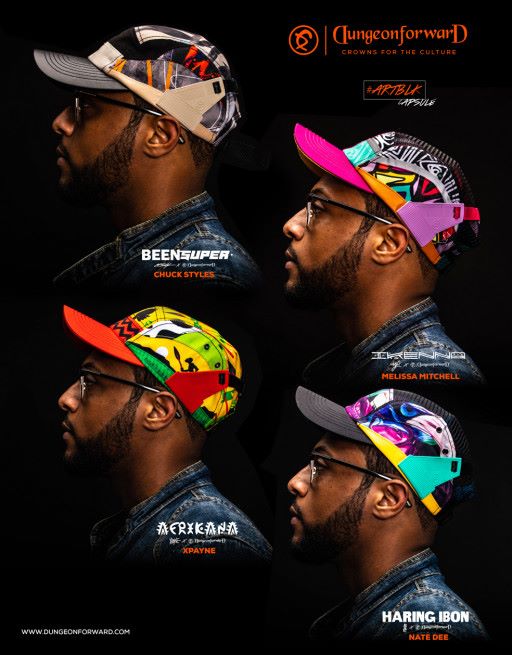
Source: Newswire
The brand’s Facebook page shows a design made for Alabama A&M University, which fits the HBCU thread. At $28, the Tactical Beanie is the least expensive item on this list, and a hat is the layer most likely to be lost on a train.
WhitePaws RunMitts keeps a Baltimore runner’s hands warm
WhitePaws RunMitts finishes the morning with the one part of the hand most gloves handle poorly: the thumb. Susan Clayton, a Baltimore runner who coached with the nonprofit Back on My Feet, could not keep her hands warm on cold runs, so she designed a thumbless convertible mitten with a pocket for a hand warmer. Running Lifestyle Media describes the mitten as fleece-lined and reports that she obtained a patent in December 2015. “I love solving problems,” she told the publication.
The Baltimore Banner reported in December 2024 that Clayton, then 62, had opened a hair salon 20 years earlier, and that the mittens were manufactured at Nightmare Graphics in Howard County. They were sold online and at REI, with plans to reach sports stores such as NFL and Ravens team shops. In 2022, the Nasdaq Center called her “one of two Black outdoor winter gear company owners in the U.S.”
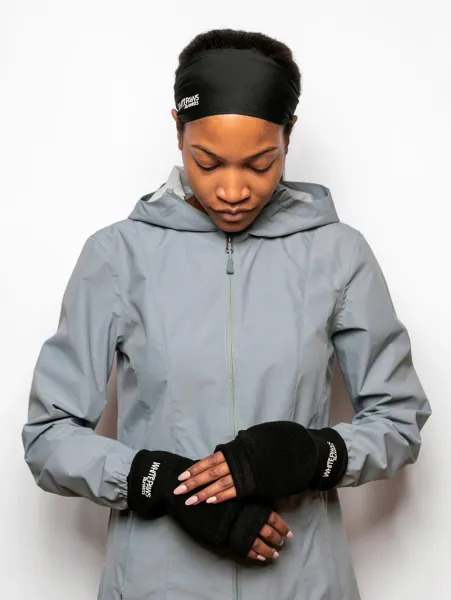
Wind and Water Resistant RunMitts at White Paws RunMitts
As of November 2026, the brand’s home page lists prices for its featured mittens alongside a 2022 copyright line, and Clayton recently announced she is stepping back from daily operations while the business remains active. Shoppers should still confirm current stock directly or through authorized retail partners before planning a gift around it.
What the six have in common
Prices at the stores run from $28 for a beanie to $765 for a wool varsity jacket, so a full winter outfit from this list can be built at several budgets. The founders arrived by different roads. A Detroit designer chased one coat for two years, and a Baltimore runner wanted a mitten without a thumb.
The coat goes on last, but it is chosen first. Shoppers who work from the outside in will have supported six Black-owned businesses by the time the mittens are on.
Read also: 6 African Designer Boutiques For Your Holiday Shopping

Anand Subramanian is a freelance photographer and content writer based out of Tamil Nadu, India. Having a background in Engineering always made him curious about life on the other side of the spectrum. He leapt forward towards the Photography life and never looked back. Specializing in Documentary and Portrait photography gave him an up-close and personal view into the complexities of human beings and those experiences helped him branch out from visual to words. Today he is mentoring passionate photographers and writing about the different dimensions of the art world.