Photo courtesy of Kelli Blake
In 2020, Woosler Delisfort spent 3 days photographing protests in Miami. As a documentary photographer, he had seen a lot. He had also been through police brutality himself, and by the third day it was too much. He drove to the beach and wrote down a question: where do we go to pray?
The next day he fell into a depression. He put his camera down for a year and a half.
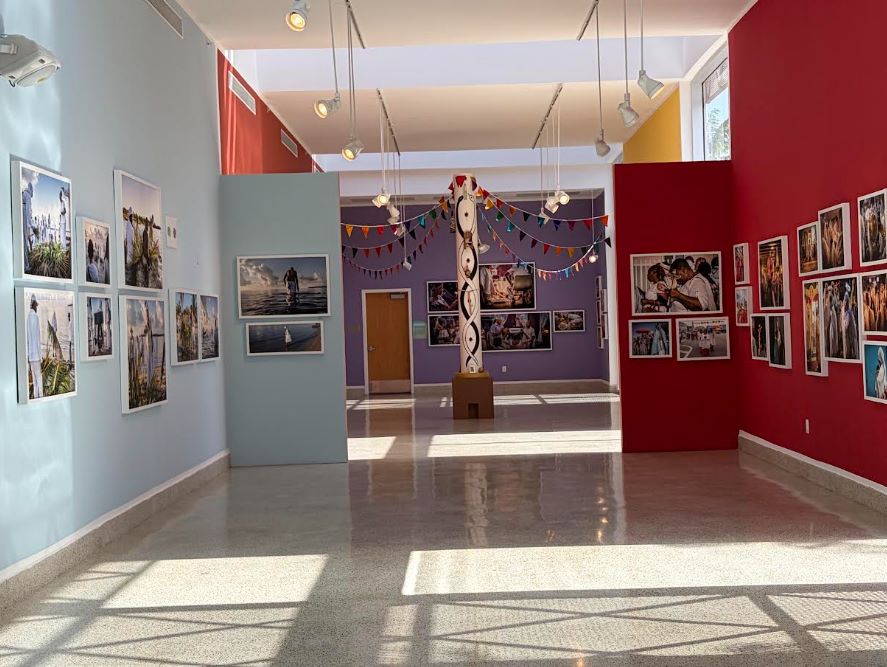
A friend kept pushing him to apply for a fellowship at HistoryMiami Museum. When the application asked what he planned to work on, he went down his list of ideas and stopped at one word: sanctuary. 3 years of shooting later, that word is a show. Sanctuary: Our Sacred Place is a collection of 9 photo essays on religion and spirituality in Miami’s Black and Brown communities. It opened at HistoryMiami in 2024. Now it hangs at the Little Haiti Cultural Complex, a few blocks from where Woosler grew up. I walked it with him.
The first essay, As We Pray, puts a mosque, a Vodou ceremony at the water’s edge, and a Catholic Mass side by side. Woosler’s point is simple. Everyone in these frames is praying to the same creator. “We just call him or her by different names,” he told me.
Water runs through most of the room. One wall is all baptisms: a Baptist minister in the ocean, and a Vodou baptism at Dania Beach. Indigenous and African spiritual traditions have always used nature as sanctuary, and the photos make that case without a caption. Nearby, a Vodou priestess teaches her children to bathe themselves in the ocean. A Lukumí practitioner prays to Yemoja.
Yemoja has her own altar in the gallery, built by practitioners. She goes by many names: Lasirèn, Mami Wata, and others. Woosler builds a working altar into every show, and he always has practitioners make it. If he is telling the story of her children, he says, she has to be in the room.
The essay that remained with me shows Juneteenth at Virginia Key Beach, the beach Black Miamians were allowed to use under segregation. For 30 years, the community has gathered there to honor the ancestors. Elders tie palm fronds together, lay out offerings, pray, and carry everything into the ocean. Woosler shot it gradually, and you can follow the ceremony from frame to frame.
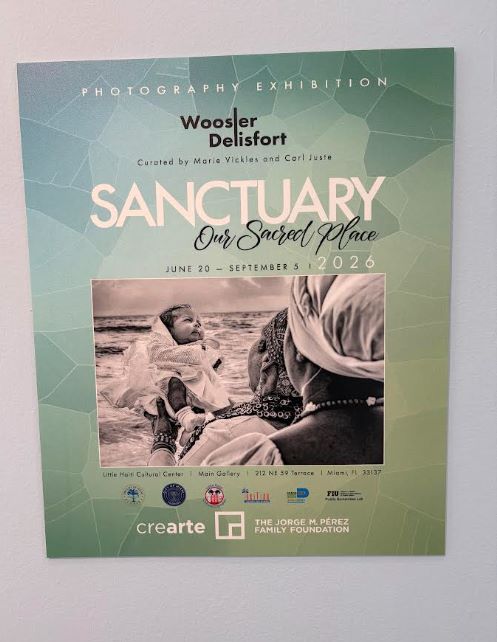
Photo courtesy of Kelli Blake
In a Haitian peristyle, the center post is the poto mitan. Practitioners circle it to charge it so that the living can reach the ancestors and the spirits. I asked Woosler about the circling, since so many faiths use it. He has seen people circle a tree the same way, with nothing built at the center.
There’s a vèvè, the sacred drawing traced on the ground to call in a spirit. This one comes from the lakou of Woosler’s spiritual mother, and her lakou also honors the Taíno. Haitian Vodou kept room for the island’s first people.
Then Remnants. During Fèt Gede, at the turn from October into November, Haitians feed and honor the dead. Woosler shot a Gede ceremony and a Día de los Muertos altar in Little Havana within 2 days. Hang them side by side, and the hands make the same gestures. The offerings sit in the same places.
The Catholic essays carry the same thread. Cuban devotees march through Miami’s streets for San Lázaro. Woosler photographed Holy Week in Sevilla, Spain, then found an Ethiopian Orthodox congregation in Miami observing Good Friday and Easter a month later, on their own calendar.
I walked out thinking about soup. A friend’s husband, who is Mexican, moved to Florida and was invited to a Haitian friend’s house for dinner. He had never spent time around Haitian culture. He took one spoonful and said it was his grandmother’s soup, the same recipe, from the other side of the Gulf.
In my mother’s generation, people counted Colombia and Mexico as part of the Caribbean. The map we use today, though tidier, is not accurate. People moved constantly across this region, carrying their food, their prayers, and their customs with them. The lines were drawn later to confuse and divide. The gestures in Woosler’s photographs are older than the borders.
I know “we’re more alike than different” sounds like a greeting card. Woosler spent 3 years with a camera proving it, one ceremony at a time, and the proof is on the wall.
Woosler is working on 3 more essays, including one on church choirs. The show also travels so that other cities may get it next.