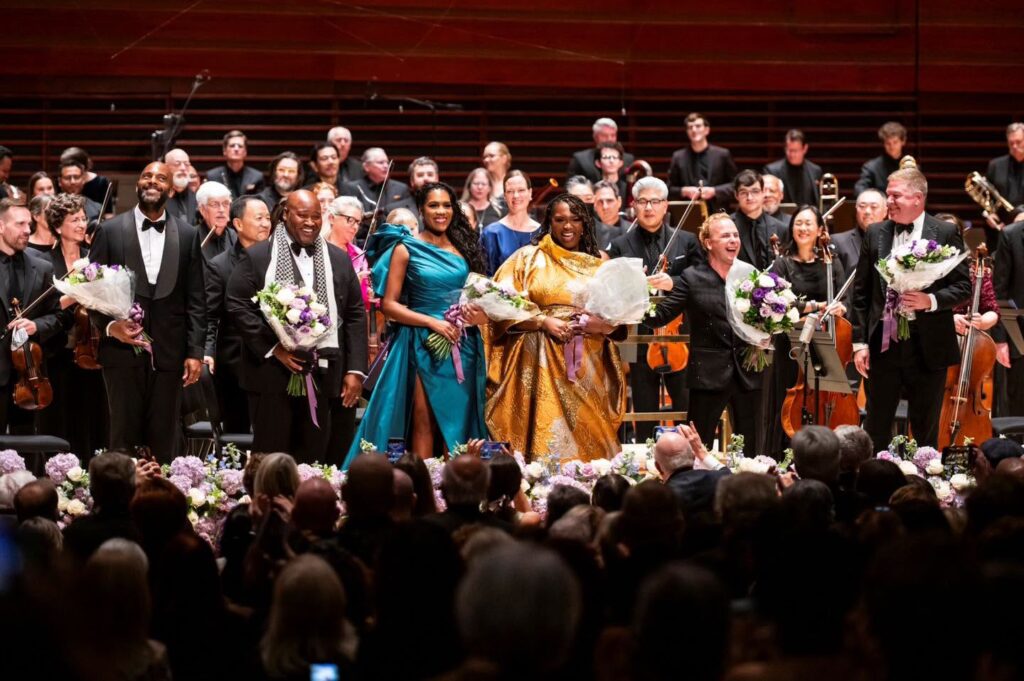
Image: Philadelphia Orchestra’s Opening Night Celebration, September 24, 2026 featured tenor Issachah Savage, bass-baritone Ryan Speedo Green, mezzo-soprano J’Nai Bridges, soprano Leah Hawkins, and conductor Yannick Nézet-Séguin. Courtesy of Philadelphia Orchestra
The Philadelphia Orchestra and Ensemble Arts has raised $344 million. The next question is how that investment reaches the people who make the city’s culture worth supporting.
A major arts campaign should be worth something to the person who has never bought a ticket.
The Philadelphia Orchestra and Ensemble Arts surpassed its $330 million fundraising goal, reaching $344 million, according to figures reported October 20 by The Philadelphia Inquirer. The organization’s own campaign announcement identifies arts education, community engagement and the preservation of its venues among the priorities the fundraising supports.
That is an achievement worth recognizing. Keeping an orchestra performing and cultural venues operating takes sustained support. For Black Philadelphia, though, the useful question goes beyond whether an institution can raise money. What becomes more accessible because it did?
The answer should include a way into the audience, a way onto the stage and a way to build a career behind it.
Understand what the money represents
The $344 million is a campaign total, not a newly created citywide fund for artists. Of that amount, $146 million came through regular annual giving used for operations. The campaign also supported endowment and artistic initiatives.
That distinction matters. Treating the entire amount as unspent money available for immediate distribution would misread the achievement. Reliable operations have value: an institution cannot offer much to a neighborhood if it cannot sustain its own work.
The stronger question is what that stability allows it to do consistently. Education should be easier to plan when support lasts beyond one event. A community partnership should have room to develop rather than disappear after a photo opportunity. Those are reasonable expectations to bring to a successful campaign, without pretending every donated dollar has the same purpose.
Make the first visit affordable
There is already a practical entry point. Art-Reach’s ACCESS program offers $2 admission at participating cultural organizations for eligible cardholders. Its partner directory includes The Philadelphia Orchestra. A qualifying cardholder can bring up to three additional people at the $2-per-person rate. Art-Reach instructs visitors to bring their ACCESS card and photo ID. Pennsylvania residents with a qualifying state-issued ACCESS or EBT card are automatically eligible at participating Pennsylvania sites. People who identify as having a disability, including out-of-state visitors, can instead purchase an Art-Reach ACCESS Card.
Readers should check the participating venue’s reservation instructions before choosing a performance.
Art-Reach notes that availability and pricing can vary for special events and programs. The discount is not a guarantee that every seat at every concert costs $2. For a family considering a first visit, that information is more useful than a general invitation to experience the arts. It gives them something they can act on.
A first-time visitor should be able to find the full cost, reservation process and accessibility information without needing to know someone on staff. If discounted tickets are unavailable, the venue should make that clear before a family plans the trip. Ordinary customer service can decide whether an invitation leads to an actual visit.
Black audiences are not a single income group, and an access program should never become shorthand for who Black Philadelphians are. Its purpose is to remove a financial obstacle for people who qualify. The broader responsibility is to make the institution understandable and welcoming to newcomers, whatever brings them through the door.
Connect recognition to opportunity
Black Philadelphia does not need an invitation to begin making culture. Its artists and institutions have already done that work. Joan Myers Brown founded The Philadelphia School of Dance Arts in 1960 and PHILADANCO! in 1970. That history belongs in any discussion of what cultural investment means in this city. Black artists are creators and institution-builders, not simply a prospective audience for somebody else’s work.
The orchestra’s home also carries a direct connection to Black achievement. In 2024, the orchestra announced that Verizon Hall would become Marian Anderson Hall, honoring the contralto, civil rights figure and Philadelphian. The announcement included an endowed scholarship partnership with UNCF for Black students from the Philadelphia region pursuing performing arts or arts administration.
A February 2026 scholarship announcement described opportunities for eligible students attending UNCF-member institutions or other historically Black colleges and universities. That connection between recognition and educational support is worth building on. A name on a building can introduce visitors to an artist’s legacy. Help with the cost of preparing for an arts career gives that recognition another practical use.
-These existing programs give the organization something to build on. The campaign’s value to the community will become clearer as people use those opportunities and see how they develop.
Access should also involve more than bringing people to a Center City venue.
The orchestra’s digital series, Our City, Your Orchestra, highlights the stories and causes of Philadelphia organizations and businesses. Its subjects include the Paul Robeson House, Harriett’s Bookshop and Grant BLVD, whose episode highlights its support for formerly incarcerated Philadelphians. The format puts the organization’s own story and cause at the center. That is a useful foundation for a relationship, provided the organization also has a say in how it is represented.
The opportunity is to deepen it. Could a partnership lead to paid work for local artists? Could a school or neighborhood organization help shape an activity rather than receive a finished program? Those are possibilities to pursue, not outcomes that a video appearance alone proves.
The distinction is important. Being featured and having a sustained role in a cultural institution’s work are different kinds of participation. Both can have value, but they should not be confused.
Make the community impact visible
A successful campaign deserves celebration. It also creates an opportunity to explain its public value in terms people can recognize.
A useful account would show how many people use reduced-price admission, whether first-time visitors return and what students gain from educational programs. It would describe paid opportunities for artists and explain which neighborhood partnerships continue beyond an initial event.
No single attendance figure can answer every question. A full room does not tell the whole story of who felt welcome, who could afford to return or who had a hand in shaping what happened there. Institutions can ask those questions directly and share what they learn.
The goal should be a relationship people can point to in their own lives: a performance they could attend, an opportunity they could pursue or a partnership their organization helped build.
That is how a $344 million achievement becomes more than an impressive number. The people who live here should be able to explain what it made possible.