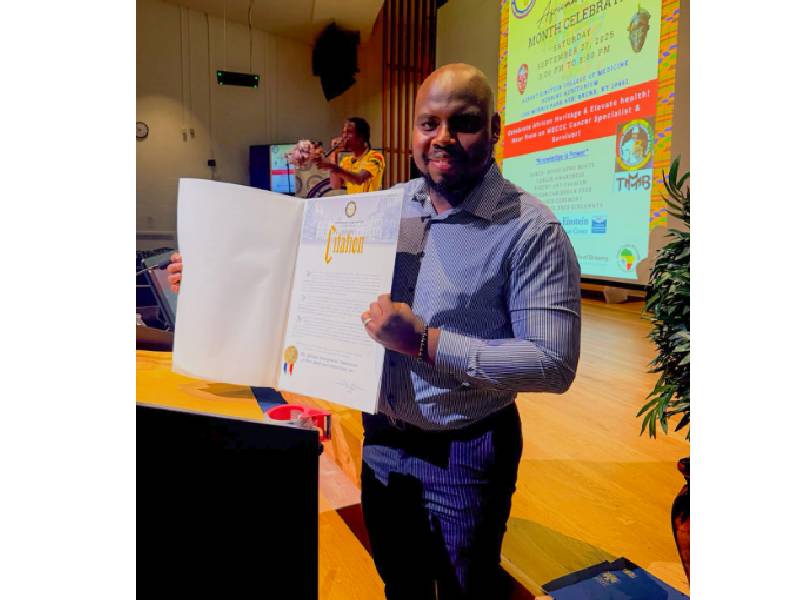
At 24, Joseph Okoroji moved to the U.S., carrying with him ambitions, memories, and expectations shaped by several cultures. More than a decade later, he is a martial arts coach, Muay Thai practitioner, and author of A Mark in the Sand.
In this conversation with FunTimes, Joseph pushes you to confront a deeper question: Can you ever feel truly free or at home in a country that isn’t yours, and what emotional cost are immigrants willing to pay for stability and opportunity?
Tell us about your background.
My mother is from Uganda; she’s a Toro baby. My father is from Imo State, Nigeria. They met in London, got together, had me, and that’s kind of how the journey started.
What brought you to the U.S. at 24?
For anyone above a certain age, there was always this idea of the U.S. being the land of milk and honey, where dreams could come true. It was almost mythical to a lot of us. I first visited in 2009, just me, a cousin, and two friends, and it was everything I thought it would be and more. That trip left an imprint. I actually moved permanently years later, on December 14, 2014.
Did your parents’ story shape your decision to leave for the U.S.?
It meant there was less fear about the idea, because I had a working example of two people who had already left where they were born and raised. On paper, I knew it was doable. But when you have parents who did not grow up where you grew up, there are a lot of nuances they simply never mention, because most of the time, if you have only ever seen a country from one side, small things you had never expected become genuinely problematic. Things like a driver’s license, opening a bank account, and understanding Social Security or its equivalent. There is no safety net for that kind of learning curve. You are building based on what you already know, in an environment that doesn’t necessarily support that. We are all speaking English, but how I pronounce a word might put someone off or get misread entirely.
Before you left, what were your expectations of America, and what was the reality?
America feels like a concept someone created in a lab. What is considered “normal” here does not match most normal metrics elsewhere. Take the classic trope of someone arriving with nothing but two hundred dollars in their pocket; most people would find that ridiculous, but it sounds pretty average to the people telling the story, and pretty normal to the people hearing it. Good or bad, in America, anything can genuinely happen. Everything you have seen on American TV has the potential to actually happen. It just needs the right ingredients, or the right people around you, and before you know it, there it is.
Did you find it hard settling in?
Generally, I would say settling in was a bit tough because of the differences between the UK and the U.S. The British way of carrying yourself is almost the exact opposite of the American way. You are raised not to be too loud, too outspoken, too overtly confident, not because anyone is trying to hide, but because standing out simply isn’t the British instinct. Watch our news, our comedy, anything; nothing is designed to make you stand out. Even the clothes lean gray and black, and if there is color, it is a burgundy or a mustard rather than a true red or yellow.
America is the exact opposite; it is a “show me” country. Everything is built with the intention of being seen. Over time, the lines blur a little. Trouble kicks in when a Brit brings Britishisms into an American meeting or social setting and gets overlooked entirely, because what is a virtue back home is the exact reason you might not get seen here. It is like growing up in a household where the first thing you do when you walk in is bow or take your shoes off, then you visit someone else’s house, and they walk straight through with their shoes still on. Your brain can’t process it. You are waiting for someone to say something, and it just never comes. So you are constantly in a state of waiting for the shoe to drop.
What is one reality about building a life abroad that people do not talk about enough?
Part of you has to die in order for you to fit in, or even flourish, in the new place. And the person who made the original decision to leave and start a new life never actually gets to see that new life happen, not really. It’s a bit like Martin Luther King and integration; he died before he ever saw it in full effect. The version of you that dreamed of starting over somewhere else doesn’t survive to witness it.
If someone back in the village is getting married while you are midway through your immigration process, you often can’t go because leaving might mean the process restarts, or you are not allowed back in. I have lived that personally. You miss baby showers, weddings, and the small maintenance that keeps relationships alive. How strong can a relationship really stay if it is mostly held together over WhatsApp? Things get forgotten, not because you don’t care, but because they are not in front of you anymore, so they stop functioning the way they used to. Even your memories start to blur. I have been in the States for about twelve years now, and things like Home Depot and Homebase, the UK equivalent, have become interchangeable in my head, because so much time has passed that the line between the two places has genuinely blurred.
You will miss so much. It sounds great from the outside, but a lot of people only ever show the sexy side of immigration. Do you think the people here are going to practice traditional Igbo customs? Are you going to put ogbono soup inside the office kitchen? Part of you has to go to make space for this new person that you are trying to become. And I don’t know whether people are truly prepared for that.
Read also: “I love Nigeria, but there’s nothing to come back to”
What part of yourself would you say you have lost in this process?
I can’t really watch football anymore. Growing up in London, you watch football constantly, and now I barely keep up because of the time difference. Same with the British soap operas I grew up on. Same with certain foods. Everything around you quietly pushes you to give it up because it is no longer easily within reach. There is a cost to all of it, and it is not just financial. The real question is just whether you are willing to pay it.
What part of your culture or upbringing have you deliberately held onto while building your life in the U.S.?
A few things. Whenever there is something worth celebrating, I go to a Nigerian spot in Inglewood and get my okra soup. To everyone else, it might mean nothing, but to me, it is ceremonial. It reminds me of my dad. That becomes the meal whenever there is an achievement, something worth marking. I might wear traditional clothes. It is not always convenient, but there still needs to be some sort of an anchor. Heavy enough that it grounds you, but not so heavy that it keeps you in one place.
Do you think the book your dad gave you when you were seven inspired you to write your first book, A Mark in the Sand?
Not initially, no. I went through years without reading much at all, and university made reading feel like a chore, something tied to school rather than something you would choose. Since I left school and started reading for myself again, I have genuinely filled storage units’ worth of books. Going back and rereading the book my dad gave me as a kid, you can see where some of it came from, even if I didn’t acknowledge it at the time. It has grown on me since. He gave me this book at seven, expecting me to be appreciative. At seven, Cartoon Network was as far as I went, but you don’t realize certain things until you are old enough to.
I do not think anything I have done feels extraordinary, partly because it feels normal to me, and partly because I watched a parent do it first. Writing a book does not feel so massive when a parent has already done it. Moving from country to country does not feel so extraordinary when both your parents already did. Same with education, same with a lot of things. It just becomes a question of whether it interests you enough to actually do it. They showed me that potential exists. A lot of your own capability becomes visible once you look at what the people before you already pulled off.
What is your book, A Mark in the Sand, actually about?
I originally wrote it at 26, and it was the ramblings of a young, arrogant person, which is pretty normal at that age; nobody usually writes it down, though. Looking back on it now, it turned out to be pieces of advice I probably needed to hear throughout this journey, but never got the chance to. It breaks down into a few tenets: having something, protecting it, following through on it, and understanding that whatever road you are on will be long, arduous, and not always fun. If you are trying to become something or someone, there will be a cost.
Have you ever regretted migrating? Was there a moment you felt that it was not the right move?
Absolutely, in the beginning. A close family member of mine was already going through health issues when I left, and by that January, a month after I had arrived, she passed. My immigration process had already started, and I was told that leaving mid-process could mean starting over, or potentially being denied re-entry entirely. Her funeral fell right in that window. I had a conversation with my mother, who told me this might be a once-in-a-lifetime opportunity and that trying to pause and restart might lead to my being potentially banned. So I had to sit at home and listen to the funeral of someone that I really cared about. In that moment, I wished I could be there.
The same thing happened when my father passed in Nigeria during COVID, when flight bans and tariffs prevented U.S. travel to Nigeria. That is two people I deeply cared about, and I could not be there to put either of them to rest because I was here. That takes a toll nobody warns you about.
What do you think about the immigration policies governments put in place, the ones that so often seem to work against immigrants?
Immigration is very weird. Because, like all things and all people, there are good and bad in everything. I will tell you a story. Around 2016 or 2017, I went to the immigration office in downtown LA. I had gotten a letter telling me to come in, with no explanation of why. I texted friends beforehand, half-joking, “There’s a chance I don’t come back out, so it’s been real.” When I got in there, they handed me a green card, ten years’ worth. Someone else I had met randomly in that same waiting room never came back out. I don’t know what happened to them, what their situation was, nothing. I just know we walked into the same office, and only one of us walked back out. That stays with you. I have watched people get deported, whole lives uprooted, and I genuinely don’t know how much humanity factors into those decisions.
How much peace do you really have in somebody else’s house? Even if it is a close friend or family, there is only so much peace you can really have, because you cannot operate in someone else’s house the way you would in your own.
There has to be oversight somewhere, a point where someone says, “This is too much.” In most African households, if your dad is the hammer, your mother is usually the one who says, that’s enough; they have learned their lesson. Where is the equivalent of that in government? Theirs is just hammer, hammer, hammer. And what does constant hammering do to a person? It crushes you. And how capable can someone really be while they are constantly being crushed? You lose confidence under that kind of pressure.
Have you ever been in a situation where, when you were young, your parent wanted to hit you, and you stopped them? They act like they have been assaulted because you have questioned their power. Suddenly, you are the disrespectful one, even though all you did was stop them from hitting you; you did not hit back. How is that different from what happens in the wider systems we live under? You get accused of something, and rather than take it quietly, you push back, and that pushback itself gets read as the real offense.
People want a whole new life. What does that actually look like underneath the surface? Depression? Dependency? Loss? I don’t think moving to another country deletes any of that on its own.
What are the biggest lessons new immigrants can learn from your journey so far?
First, understand that it won’t be easy. Second, understand that your new environment will not automatically change your circumstances unless you change your circumstances. Finally, you have to constantly remind yourself why you are doing what you are doing. Because those will be the things that get you through when things get tough, and they will get tough. Just remember those three things.