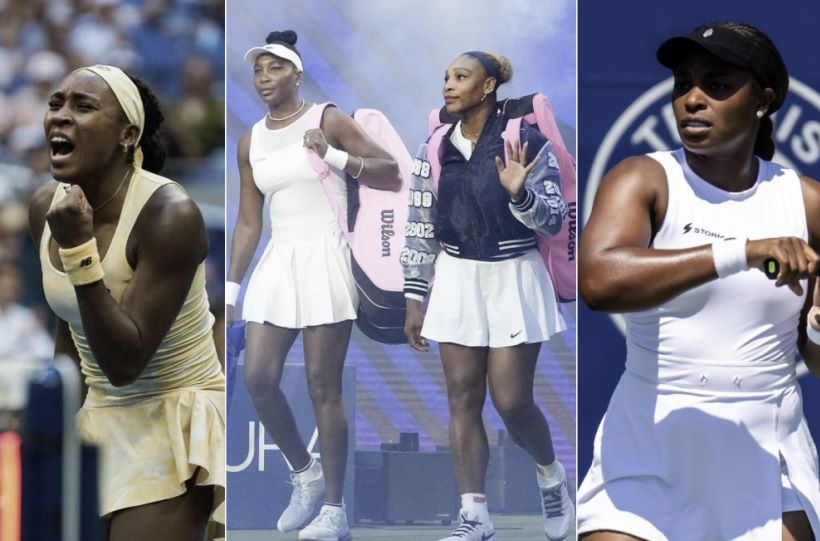
Photo credit: Instagram / serenawilliams, sloanestephens, cocogauff
The U.S. Open has always been loud, from the crowds to the lights, the energy, and the drama. Running from August 30 through September 13 at Flushing Meadows, this year’s tournament is already lighting up New York and the global sports world. One thing is unmistakable: Black women are commanding the spotlight. They are not only redefining the game and the culture around it, but they keep finding ways to make the tournament about more than just tennis.
For some fans, it is just tennis. But for Black audiences, there is often something more emotional happening. Maybe it is because tennis has not always felt like a sport where Black girls were expected to belong. Maybe it is because many of us grew up watching Serena and Venus Williams challenge the idea of what a tennis champion was supposed to look like. Now, a new generation is carrying that legacy forward in its own way.
From Coco Gauff, a defending champion, finding her spark again, to four-time Grand Slam winner Naomi Osaka, using her outfit to pay tribute to Philadelphia, Black women are making this year’s US Open worth watching, and there is plenty to celebrate.
Coco Gauff is already one of the biggest names in women’s tennis. At 22, she is no longer the teenager everyone was waiting to see become a star. She is already one of the biggest names in women’s tennis. The American entered the 2026 U.S. Open as the No. 4 seed and one of the tournament favorites. She is also the 2023 U.S. Open champion and the reigning French Open champion. Gauff won the Cincinnati title and carried a 16-set winning streak into the U.S. Open. In New York, she opened with a 6-3, 6-4 victory over Zeynep Sonmez before facing a much tougher test against Paula Badosa, which she survived 6-4, 7-6(5) to reach the third round for the fifth consecutive year. What makes Gauff’s story so relatable is that she has never pretended the journey is effortless. She has talked openly about frustration, pressure, and the difficulty of improving while millions of people are watching.
“Throughout my life, I was always the youngest to do things, which added hype that I didn’t want,” she wrote in a 2020 post for Behind The Racquet. “It added this pressure that I needed to do well fast. Right before Wimbledon, going back to around 2017/18, I was struggling to figure out if this was really what I wanted. I always had the results, so that wasn’t the issue. I just found myself not enjoying what I loved.”
Just as compelling is Naomi Osaka, a two-time U.S. Open champion and four-time Grand Slam winner overall, who has already lived through nearly every extreme a global athlete can face: Slam titles, enormous expectations, tough losses, motherhood, time away from the sport, and the work of finding her way back. Seeded No. 13, Osaka walked onto the court this year wearing a long white skirt and a gray hooded robe covered in newspaper clippings about her. When she removed the hood, Osaka revealed a black outfit and cornrows underneath a headband, a look paying homage to Philadelphia’s own Allen Iverson.
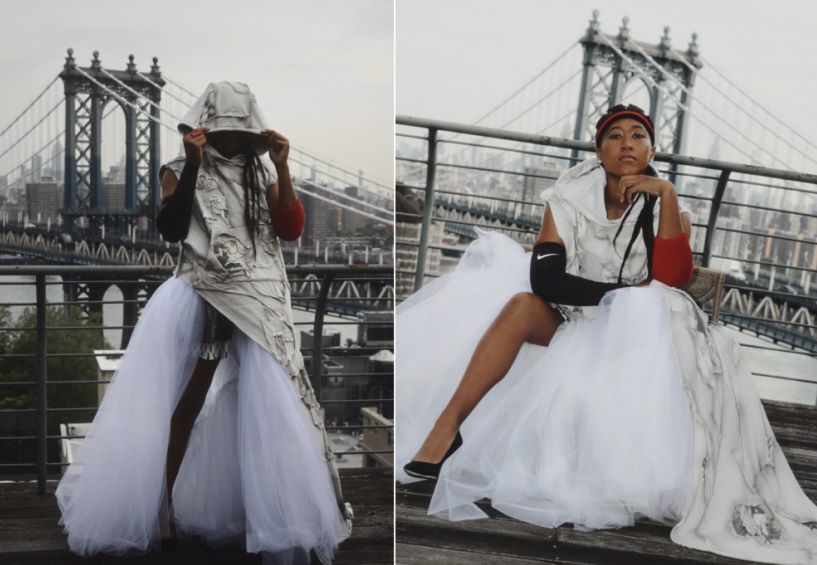
Photo credit: Instagram / naomiosaka
After her match against Katerina Siniakova, Osaka admitted putting pressure on herself to play perfectly, a reminder that even champions struggle. Assessing her performance, she said, “The match was definitely really tough. I just felt like I had to fight. I definitely had a couple of opportunities in the second set, and I think I was a little bit too hard on myself. So, I took the bathroom break, regrouped a little, came back, and just tried to have no regrets.”
For years, Black women have often been expected to be exceptional without visibly struggling. Osaka keeps pushing back on that, showing that you can struggle and still be brilliant. You can become a mother and still have ambition. You can take time away and still come back.
And while Osaka is making her comeback, Taylor Townsend is showing what it looks like to build a career on your own terms. She has faced criticism over the years about her body, her playing style, and whether she could compete at the top level. She kept playing anyway. Now 30, a mother, and a two-time Grand Slam doubles champion (Wimbledon 2024 and the 2025 Australian Open, both with Kateřina Siniaková), she is appearing in her 11th U.S. Open and quietly building one of this year’s most well-rounded stories, opening singles play with a 6-2, 6-3 win over Maja Chwalinska, then an emphatic 6-1, 6-1 win over Taylah Preston.
Then there is the reunion nobody thought they would see again so soon: Serena and Venus Williams are back on a Grand Slam court together, playing women’s doubles after receiving a wild card, their first Slam doubles pairing since 2022. The sisters have won 14 Grand Slam women’s doubles titles as a team. In addition to their two U.S. Open titles in 1999 and 2009, they won six titles at Wimbledon (2000, 2002, 2008-09, 2012, 2016), four at the Australian Open (2001, 2003, 2009-10) and two at Roland Garros (1999, 2010).
Serena, 44, is playing her first U.S. Open since her emotional retirement run in 2022, while Venus, 46, is making a record 26th U.S. Open appearance. When Serena Williams played the final match of her historic career at the 2022 U.S. Open, headlines focused on the impact she, as a Black woman, had left on tennis. Venus, on the other hand, continues to defy gravity and age, stepping onto the court with grace and unmatched style that leaves everyone paying attention. At this stage, the Williams sisters have nothing left to prove. They have already changed tennis.
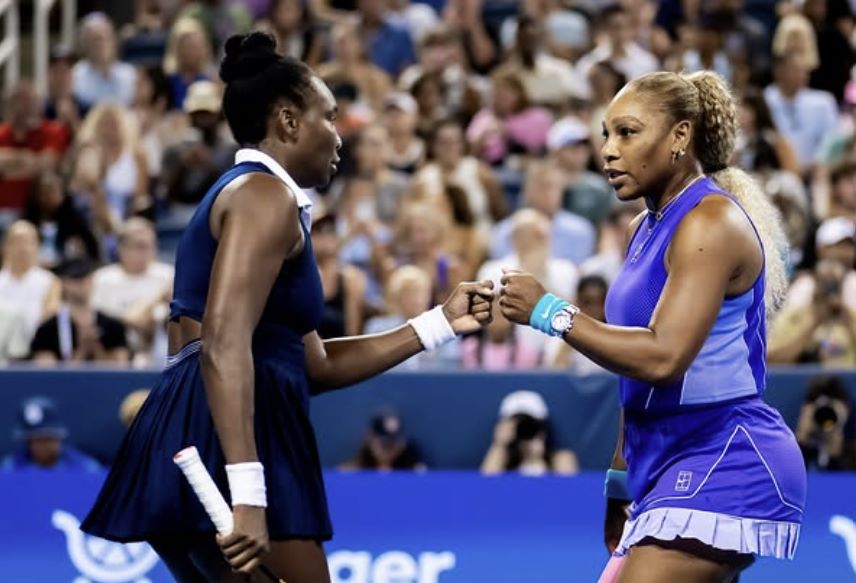
Photo credit: Instagram / serenawilliams
Madison Keys, whose father is Black and mother is white, has been one of the most recognizable American players of her generation. Now 31 and competing in her 15th U.S. Open, she has experienced almost every high and low the sport can offer. At 31, she is still competing, still learning and still chasing the U.S. Open title that slipped away from her nearly a decade ago. Her U.S. Open journey this year has already included a serious test of character.
Sloane Stephens is writing her own comeback chapter. This year, the 2017 U.S. Open champion returned to Flushing Meadows as a wild card and opened with a convincing 6-4, 6-1 victory over Clara Tauson, a result that had fans immediately reminiscing about her title run years ago.
Her presence at this year’s tournament was about more than another attempt at a comeback. She brought 15 children from her foundation to the U.S. Open, many of whom had never traveled outside California or even been on an airplane. She has increasingly spoken about using tennis as a vehicle to create opportunities for young people rather than simply as a route to another trophy.
“It’s not always about tennis, it’s about how we’re able to impact lives,” Stephens said.
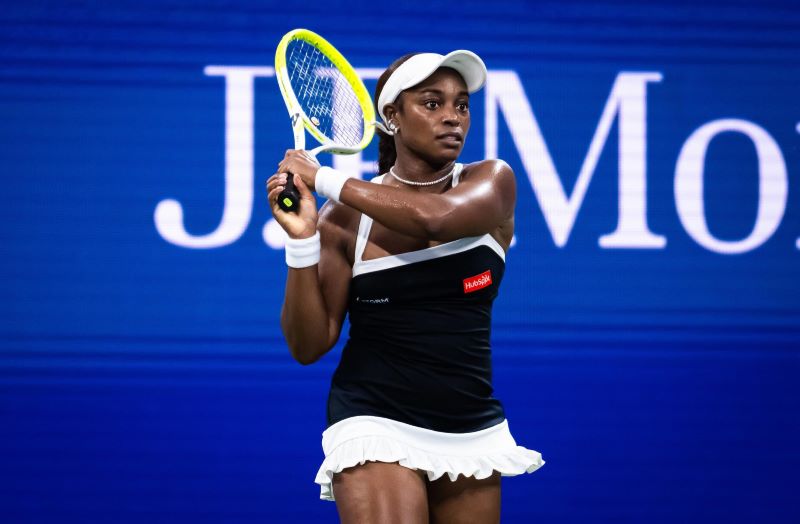
Photo credit: Instagram / sloanestephens
Perhaps that is the bigger story of Black women at the 2026 U.S. Open. Beyond the trophies, records and rankings, these women are widening the definition of who belongs in tennis. Gauff is modeling what it looks like to protect your joy under pressure. Osaka is using her platform to publicly celebrate Black culture. Townsend is proving that motherhood and ambition can fuel each other rather than compete. The Williams sisters remain the standard by which everyone else is still measured.
For Black girls watching from Philadelphia, London, Lagos, Canada, or anywhere else around the world, the message is clear. You can enter spaces that were not originally built with you in mind. You can change them, struggle in them, grow in them, leave and come back to them.