
Image: Freepik
When Ernie Green, a fullback with the Cleveland Browns from 1962 to 1968, discovered a lump by accident in his chest, it felt out of place, so he asked his wife, Della, to check it out. As a precautionary measure, Green made a doctor’s appointment. The doctor saw no cause for panic and told him not to worry, due to the rarity of male breast cancer.
A short while later, Green got a second opinion, and it was discovered he had Stage 1 male breast cancer. He survived and has since dedicated his time to raising awareness of the disease.
When some people hear the word breast cancer, what comes to mind is women. But can we blame them when the pink ribbons, annual fundraising walks, awareness campaigns, and mammogram reminders are directed at women?
Often overlooked and misunderstood, the reality is that men can also get breast cancer, though it is rare. About 1 out of every 100 breast cancers diagnosed in the United States is found in a man.
The American Cancer Society estimates that about one in 726 men will develop breast cancer in their lifetime.
The estimates in the United States for 2025 are:
- About 2,800 new cases of invasive breast cancer will be diagnosed.
- About 510 men will die from breast cancer.

Image: AI-Generated
While breast cancer in men is rare, they have a higher breast cancer mortality rate than women. This is mainly because men are overall less aware of breast cancer and are less likely to take a lump in the breast seriously, which can cause a delay in seeking treatment.
Men are frequently undertreated for breast cancer, as suggested by pioneering work by Dr. Fatima Cardoso and the BCRF-supported International Male Breast Cancer Program.
October is Breast Cancer Awareness Month. What better time than now to educate the public on the symptoms, risk factors, early detection, and treatment options? This knowledge is necessary, not just for men, but for everyone who advocates for cancer awareness.
Just like women, men also need to check regularly for a mass in their chests. As with all cancers, detecting it early is key, as this ensures the highest chance of survival.
Symptoms of Breast Cancer in Men
Although men don’t develop milk-producing breasts like women, they still have a small amount of breast cells and tissue that can develop cancer. The most common kinds in men are invasive ductal carcinoma and ductal carcinoma in situ (DCIS).
Breast cancer in men can exhibit the same signs and symptoms as in women, including a lump.
The most common symptoms include:
- A lump or swelling, with or without pain, located right under or around the nipple or in the armpit area
- Nipple discharge – may be blood-stained
- Pain in the nipple or breast area
- Changes to the breast skin, including dimpling, puckering, or redness
- Change in the breast shape or size
- A rash or a sore on or around the nipple or areola
- Inverted or tender nipple
If you experience any of these symptoms, do not ignore or delay contacting your GP.
Risk Factors for Breast Cancer in Men
It is still unclear what causes male breast cancer, but researchers have found several factors that may increase the risk of getting it. Certain risk factors for male breast cancer are similar to those for women. They include:
- Age
- Having a family history of breast cancer or an inherited breast cancer gene
- Exposure to X-rays and radiotherapy
- Hormone therapy treatment / higher estrogen levels
- Men with Klinefelter syndrome
- Certain conditions that affect the testicles
Certain lifestyle factors, like drinking alcohol and being overweight, can slightly increase the risk of breast cancer.
Diagnosis and Treatment of Breast Cancer in Men
The diagnostic tests for detecting breast cancer in men are the same as those for women. These tests provide further information and can inform treatment plans as needed.
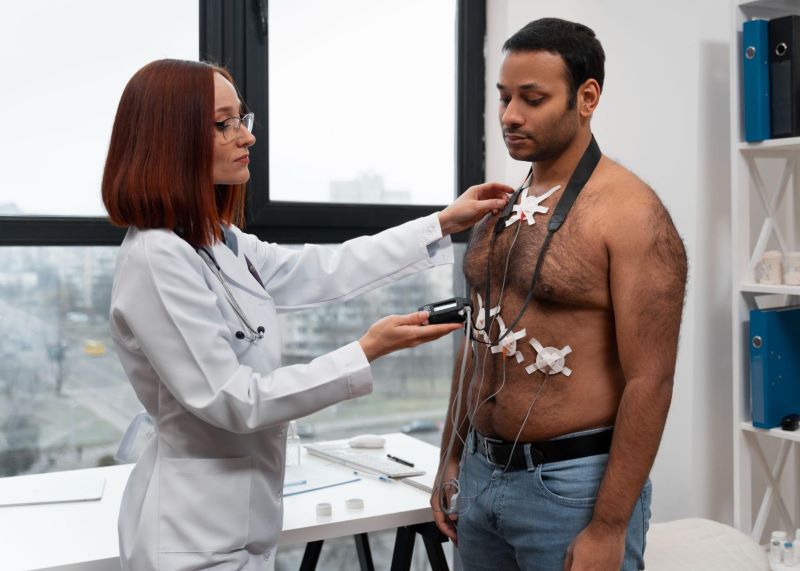
Image: Freepik
You usually start by seeing your GP, and if you have breast cancer symptoms or a family history, your doctor may recommend some of the following diagnostic tests.
Clinical breast exam (CBE): An exam of the breast where the doctor or other health professional carefully feels the breasts and under the arms for lumps or anything else that seems unusual.
Mammogram: This is an X-ray of the breast and one of the best options for detecting male breast cancer in its early stages.
Ultrasound exam: Often a follow-up to a mammogram, it’s a procedure that uses high-energy sound waves to create a computer image of the breast, known as a sonogram. These images can be used to identify abnormalities like lumps, cysts, or solid masses, their exact size, and location.
Biopsy: If these tests show an area that could be cancer, a sample of tissue from the suspicious area is taken and examined under a microscope by a specialist to check for signs of cancer. A breast biopsy is the only diagnostic test that can officially determine if the suspicious area is cancerous or not.
If these tests show that you have breast cancer, you might need to have other tests to find out more about the size and position of the cancer and if it has spread to other parts of the body. These tests include:
- an MRI scan
- a bone scan
- a CT scan
These follow-up tests and the results will help you and your doctor decide on the best treatment.
Just like in women, treatment for breast cancer in men depends on how big the tumor is, the type of cancer you have, where it is, how far it has spread, and your general health.
Treatment may include surgery, chemotherapy, radiation therapy, hormone therapy, and targeted therapy.
Stories of Survivors
Turns out there are still people who think breast cancer affects only women. Even some men who are aware feel embarrassed to talk about it, fearing the stigma and its association with femininity.
Though rare, fathers, brothers, sons, and friends are diagnosed with breast cancer every year, and they are now breaking the silence. Here are stories of men who survived breast cancer.
Richard Roundtree
The actor, who played John Shaft in the iconic 1971 film “Shaft,” found the lump while filming in Costa Rica.
“I was in the shower when I found it. It was the end of September 1993. I was lathering up and felt this lump under my left nipple,” he told People magazine in 2000.
Sharing his story, he said he questioned his masculinity after he was told he had breast cancer. After he was diagnosed with the disease in 1993, he underwent a modified mastectomy that removed his left breast from the nipple to the underarm, followed by chemotherapy.
The breast cancer survivor continued to advocate for male breast cancer education until he died in 2023 at his home.
Kirby Lewis

Photo source: Instagram / aacr_foundation
He was diagnosed with stage 2 breast cancer in April 2012 after he found a lump in his chest. When he told his wife about the lump and mentioned having breast cancer, she responded, “If you have breast cancer, I have prostate cancer.”
At 51 years old, he never expected it to be breast cancer, nor did his first doctor, who told him that “men don’t get breast cancer.” His fears were confirmed after several tests and a biopsy.
He underwent surgery to remove his left breast and several lymph nodes in May 2012, after which he was declared cancer-free. However, it returned four years later, and he was told he had metastatic cancer.
Thanks to cancer research, Kirby Lewis is living well with the disease. Now he spends his time raising awareness. “I hope that by sharing my story I can show others that life doesn’t end when you get a terminal diagnosis; it is still well worth living,” he stated.
Kenneth
At 34 years old, Kenneth discovered he had breast cancer. It all started when he found a lump in his chest and had it checked. When the doctor told him they would need to do a mammogram, he didn’t think of it as anything. When he was told he had stage 2 breast cancer, he was in shock.
Sharing his story, he noted that his grandmother passed on from breast cancer, and he thought it affected only women. “I did not know that men could get breast cancer,” he stated.
He had surgery, chemo, and radiation. Kenneth, who has been cancer-free, said he found strength in seeking help.
“I am in a good place, and I will continue to go to the doctor. I will continue to make sure I’m okay, but it’s a lot different now because I realized that there is something powerful about being vulnerable. It is powerful to ask for help,” he added.
As awareness about breast cancer in men grows, so does the hope that more men will recognize the symptoms and seek help. The more we talk about it, the more lives we save. If you’re a man or know one facing breast cancer, you’re not alone. Remain vigilant, know your family history, and never let the fear of being stigmatized be the reason for a delayed diagnosis. Early detection remains key to your survival rate.