

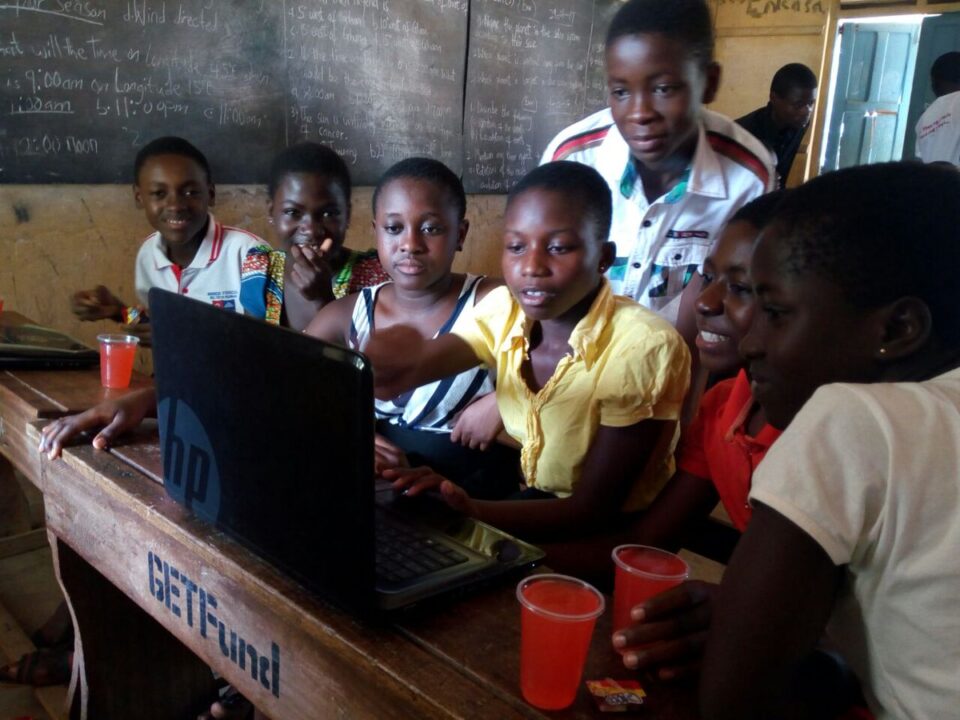
Focused Students in IT Workshop in Accra, Ghana. Photo by Zeal Creative Studios
When nightly power outages occurred in Apirede, a small village in Ghana’s Eastern Region, the local teacher was unconcerned about losing her lesson plans. The village’s modest mesh network connected the school to educational resources, health information, and mobile payment systems via battery-powered routers that communicated like a chain of digital neighbors. That tangle of antennas and cables, erected by the community, illustrates a larger trend in rural Ghana. Ordinary folks are building their own internet.
Mesh networks are providing affordable, durable connectivity in rural Ghana, where traditional telecom towers are typically inaccessible. These community-built networks disperse internet connectivity over numerous connecting points that can continue to function even in the event of a failure, in contrast to the single-tower model that predominates in urban areas. We’ll look at mesh networks, real-world projects that are altering people’s lives in Ghana, and the benefits, problems, and future of this grassroots approach to connectivity. These networks stand for a new method for Ghanaians residing in Philadelphia and other diaspora groups to take charge of their digital destiny.

Map of Ghana. Image: Getty
What Is a Mesh Network?
Technically speaking, a mesh network is made up of several nodes, which are tiny radio devices with the ability to send and receive internet signals. These nodes are arranged in a web-like pattern, allowing each node to communicate with several other nodes.
Each node serves as both a client and a router, allowing it to use the network while also extending it to additional devices. When you join a mesh network, your data does not need to travel back to a single central tower. Instead, it determines the optimum path through the network of nodes, automatically routing around any that may be offline.
Source: Rising Voices – Global VoicesWireless Ghana …
The term “node” refers to each individual connection point, which is typically a small router with an antenna; “peer-to-peer” means that devices communicate with each other directly instead of via a central authority; and “backhaul” refers to the primary internet connection that supplies the entire network, which is frequently a single fiber or satellite link that is shared by the entire community.
According to the Internet Society, this decentralized method makes mesh networks ideal for rural areas where traditional infrastructure is costly to create and maintain. Mesh networks’ organic nature allows communities to start small and progressively grow as more households and businesses join.
Why Mesh Networks Matter in Rural Ghana
According to the National Communications Authority’s 2019 household survey, only 39.7% of individuals aged five and older know what the internet is, and rural connectivity lags significantly behind urban areas. The World Bank reports that only about 50% of Ghana’s population has internet access, with rural communities falling far behind their urban counterparts.

Source: Getty
Education represents the most immediate impact. In communities with mesh networks, students gain access to online learning resources and educational content that would otherwise require expensive individual internet connections. Schools connected to community networks have reported improved student engagement with technology and better preparation for digital literacy requirements. The Akwapim Community Wireless Network, for example, has provided internet connectivity to multiple schools across six towns, directly serving over 1,700 school children with introductory ICT classes.
Health information access transforms rural healthcare delivery. Community networks enable telemedicine consultations, allow health workers to access current medical information, and support mobile health initiatives. Ghana’s Community-based Health Planning and Services program has shown how technology can extend healthcare reach when supported by reliable connectivity.
Small businesses and commerce benefit significantly from mesh networks through mobile money services, online market access, and digital communication with suppliers and customers. The NCA survey shows that 40.8% of Ghanaians have used mobile money, but rural adoption (32.1%) trails urban use (49.3%). Community networks can bridge this gap by providing the reliable connectivity needed for digital financial services.
These networks matter because they offer affordability and local control that traditional telecom services often can’t match in sparsely populated rural areas where infrastructure investment doesn’t generate sufficient returns.
Local Case Studies
Akwapim Community Wireless Network, Eastern Region (2005-Present)
The Akwapim Community Wireless Network is Ghana’s best documented community mesh network success story. This network, launched in 2005 by Community-Based Libraries and Information Technology (CBLit), stretches 20 kilometers across six settlements in the mountainous Akwapim North district.
The network combines low-cost WiFi hardware with CUWiNWare software from the Champaign-Urbana Community Wireless Network to form an “organic” mesh in which nodes can join or depart without disrupting others. Each node is built from discarded Dell OptiPlex PCs and D-Link wireless adapters and costs around $500 to install and maintain. The initiative connects schools, companies, community centers, and churches, with over ten active nodes offering connectivity to educational institutions and community organizations.
The network has provided internet access to over 3,000 community members and continues expanding with support from local chiefs, the Ghana Education Service, and the Akwapim North District Assembly.
Wireless Ghana Extension Projects
Building on the success of Akwapim, Wireless Ghana has established networks at the University of Cape Coast through the Campus Wi-Fi Project and provided connections in Sakumono, Tema Metropolitan District. These modifications show how the mesh network paradigm may be tailored to various community demands, ranging from university campuses to urban residential neighborhoods.
The expansion programs prioritize community ownership and local administration, with Wireless Ghana providing technical setup and training rather than continuing support. Communities contract with normal internet service providers for backhaul while maintaining the mesh infrastructure themselves, resulting in a more sustainable model that does not rely on external funding for day-to-day operations.
Social, Economic, and Cultural Effects
Local governance of these networks has created new forms of community organization, with management committees that include chiefs, elders, and community leaders working together on technology decisions. This collaborative approach builds local capacity for managing complex infrastructure projects.
The Akwapim network noted that women initially remained in the background but gradually began “articulating their needs and those of their children, providing suggestions and getting the men to accept constructive criticism”. Women’s groups have become important stakeholders in network governance, though more work remains to ensure equitable access and leadership representation.
Youth engagement and education benefits are particularly notable. Community networks provide local young people with hands-on technology experience and potential employment opportunities as network maintainers and trainers. Digital literacy programs connected to mesh networks have trained over 1,700 students in basic ICT skills.
Economic opportunities emerge through improved access to market information, digital financial services, and online business tools. Small businesses gain the ability to process mobile payments, communicate with suppliers, and access broader customer bases. However, the economic impact remains concentrated among early adopters with existing business experience.
Cultural preservation also benefits as communities use networks to share local content, document traditional practices, and maintain connections with diaspora communities worldwide.
What Needs To Happen
Policy reforms must prioritize community network recognition. The National Communications Authority should develop specific guidelines for community-owned networks, including simplified licensing procedures and clear spectrum allocation policies. Ghana can learn from countries like South Africa, which have created regulatory frameworks supporting community connectivity initiatives.
Public-private partnerships could accelerate network expansion by combining government infrastructure support with private technical expertise. The Ghana Investment Fund for Electronic Communications (GIFEC) could specifically fund community mesh network projects in underserved areas.
Local training programs need systematic expansion to create sustainable technical support within communities. Partnerships between community networks and technical institutions could provide ongoing skill development and create local employment opportunities.
Sustainable power solutions require coordinated investment in solar systems and battery storage specifically designed for network infrastructure. This connects to Ghana’s broader rural electrification goals while supporting digital inclusion.
Looking Ahead
Mesh networks in rural Ghana are still in their early phases, but their potential to improve connectivity is obvious. The Akwapim project’s 15-year history demonstrates how community-owned networks can provide long-term, locally controlled internet connectivity when backed by suitable legislation and technical help.
The communication revolution taking place in Ghana’s countryside is about communities gaining control of their digital future. For anyone inspired by these grassroots connectivity efforts, funding verifiable community projects or sharing these stories can help spread this silent revolution one village network at a time.

Anand Subramanian is a freelance photographer and content writer based out of Tamil Nadu, India. Having a background in Engineering always made him curious about life on the other side of the spectrum. He leapt forward towards the Photography life and never looked back. Specializing in Documentary and Portrait photography gave him an up-close and personal view into the complexities of human beings and those experiences helped him branch out from visual to words. Today he is mentoring passionate photographers and writing about the different dimensions of the art world.