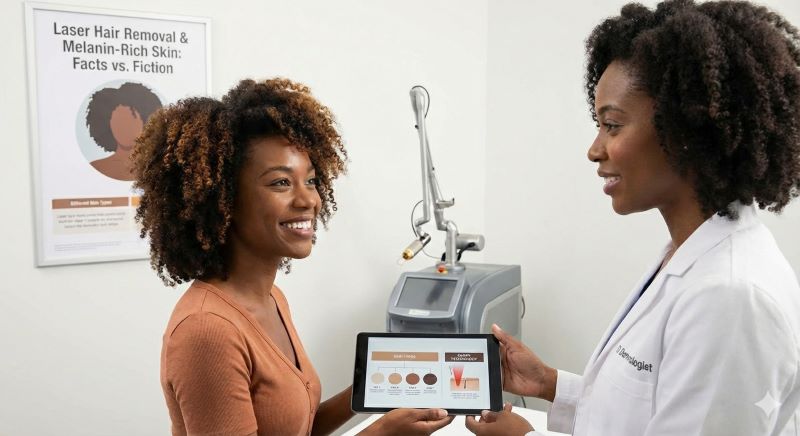
AI-generated image
LASER is originally an acronym for Light Amplification by Stimulated Emission of Radiation. But over time, the devices have become so popular that “laser” has become its own word.
While you might decide to get a manicure or facial on a whim, laser hair removal is one of those beauty treatments you usually have to think about before committing to the process, mainly for two reasons: the pain and the cost. Laser hair removal is a popular cosmetic procedure that uses concentrated light beams (lasers) to destroy hair follicles. Shaving removes the tip of the hair follicle, and waxing removes hair from the root, and in both cases, those hairs will grow back. Laser light, on the other hand, essentially kills a hair follicle so that it will not grow back.
Dr. Erere Otrofanowei, a consultant dermatologist, explains, “When we talk about laser hair removal, it really should be laser hair reduction because it doesn’t really remove it, but over time, it reduces how they grow. This depends on how many multiple sessions you’ve had. You can attack the hair follicles to the point where they are not producing hair as they should, and that would be, in effect, removal.”
When asked whether the process works differently for darker skin tones, she adds: “In the sense of the safety margins and the settings which you would use, I would say yes, but the principle is the same. Though the science is the same, the margin can change when it comes to darker skin tones. You have to have different selections. The target medium is the melanin pigment cell. The whole idea is that if you give the right laser, the right heat, it should destroy the follicle to the extent that it would reduce the regrowth of the hairs from the follicle. Hence, it is LHR (laser hair reduction), not necessarily removal. Because darker skin has more melanin, you can have injuries from the heat.”
The good news? In recent years, we have seen remarkable advancements in inclusive technology made especially for dark skin tones. But myths and misconceptions still persist. Let us set the record straight with expert insights from Black dermatologists and factors people of color must consider before booking a laser hair removal treatment.
Laser hair removal is painful and damages your skin
Most people are surprised to learn that laser hair removal is less painful than waxing. Most clients describe the sensation as a rubber-band snap. With each laser pulse, a cooling spray cools the skin and reduces potential discomfort. The laser targets the hair follicle, so your skin won’t suffer through the abrasive action that razors, depilatories, or hot waxes can cause. Laser hair removal can also eliminate shaving side effects such as razor burn and ingrown hairs.
Laser hair removal does not work on Black people
This myth was true when the FDA first cleared laser hair removal in the late ‘90s, but technology has advanced, making it safe for all skin tones, including various shades of brown. Black people do need to look out for the right laser. The two main types of lasers best suited for people with darker skin tones are the Nd:YAG and diode lasers. The Nd:YAG laser has a lower melanin absorption rate and longer wavelengths, making it safe to use on dark skin tones.
Speaking about laser hair removal on Black people, Dr. Nicole James, cosmetic doctor and skincare expert, notes, “The bottom line is if you have a darker skin tone, you can only use the Nd:Yag 1064nm for laser hair removal. Anything else, and you risk hyperpigmentation, hypopigmentation, or even burns. The sad reality is that a lot of practitioners don’t know this about melanated skin.”
Dr. Otrofanowei also recommends the long-pulse Nd:YAG 1064nm.
“Nd stands for Neodymium. It is the safest option for dark skin generally and fantastic for skin of color. With long wavelengths, it penetrates really deeply but is absorbed gradually by the epidermal melanin, so you have less risk of damaging the epidermis. You can also use diode lasers, which are not as long.”
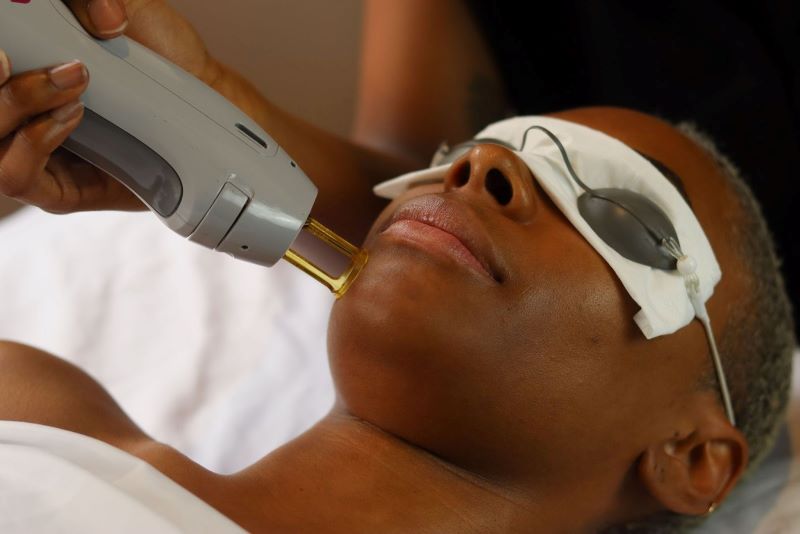
Photo source: https://www.peachfuzzlaser.com/
It is important to note that the number of sessions may vary depending on the skin tone. Some research suggests the diode may be slightly more effective at removing hair on brown or Black skin. It could also be worthwhile if you are closer to 3 on the Fitzpatrick scale and have a low pain tolerance. The Fitzpatrick scale is a tool practitioners use to identify your skin type based on your skin tone and how easily it burns or tans during sun exposure.
Intense Pulsed Light technology is the same outdated technology found in most at-home devices and should never be used on darker skin tones. It does not yield great results and may lead to burns and other complications for Black people.
Laser hair removal requires only one sitting or session
Since it is a non-invasive hair reduction procedure that uses only the laser for treatment, you may require 6 to 12 sessions, depending on your skin tone and hair type. In the early stages of laser hair removal, sessions will be spaced 4 weeks apart. Larger areas may require more sessions because some hair can remain dormant for up to 6 years. With the completion of the recommended course, maintenance sessions may be considered to treat the dormant hair that becomes active at a later stage.
Laser hair removal treatments cost more than shaving
When you compare the recurring costs of waxing or tweezing year after year, you will notice that the cost of a laser hair reduction procedure is, in fact, affordable. Costs for laser hair removal vary by body area treated, geographical location, the expertise of the person performing the procedure, and the time required. According to the latest statistics from the American Society of Plastic Surgeons, the average cost of laser skin treatments, such as laser hair removal, is $697. This figure is only part of the total price, and does not include other related expenses. There is a higher upfront cost with laser hair removal, but it actually costs thousands less over a lifetime than shaving, waxing, or using depilatory creams.
What are the risks of laser hair removal for dark skin?
Darker skin tones contain more melanin, making them more susceptible to damage. Discoloration, including both hyperpigmentation and hypopigmentation, is the biggest risk with laser hair removal on dark skin, but choosing the right laser can minimize these risks. Other risks include burning and blistering, which are more likely if devices are used incorrectly or the wrong laser is used on your skin tone. It is incredibly important to go to a medical professional who is thoroughly trained in laser hair removal.
“The risk, for the most part, is post-inflammatory hyperpigmentation. It might take a longer wavelength to get to your endpoints with darker skin types as opposed to lighter skin types. The post-inflammatory hyperpigmentation (dark patches) is easier to correct than the post-inflammatory hypopigmentation (light patches),” Dr. Otrofanowei adds.
Caring for dark skin after laser hair removal
After you undergo laser hair removal, there are certain things you will want to do and others you will want to avoid to ensure you get the best possible results. Pain and sensitivity during the sessions are normal, but those sensations should subside immediately afterward. Not everyone will experience the same sensation during treatment or the same side effects after treatment. For irritation or redness, hydrocortisone can help to resolve the inflammation.
For an acne-like eruption or ingrown hairs, use topical antibiotics. A high-quality sunscreen should be worn on all exposed areas. Keep the areas well moisturized with a rich body lotion. Exfoliation should be avoided for at least a week after treatment. Take precautions with hot showers or baths; instead, opt for warm water.
Dr. Otrofanowei’s advice for anyone considering LHR is to go where the people know what they are doing.
“The most important thing to take away is, you need to go to people who actually know how to use the machines. It is important to ask that the operator is very well-licensed and trained, preferably by a dermatologist who knows what they are doing. Not every dermatologist is very experienced in lasers or knows which lasers to use. Some have the theoretical knowledge but probably don’t do the hands-on, but it would be easier to do the hands-on because the laser machines are quite easy to operate, but the experienced practitioner is best.”
Reference